
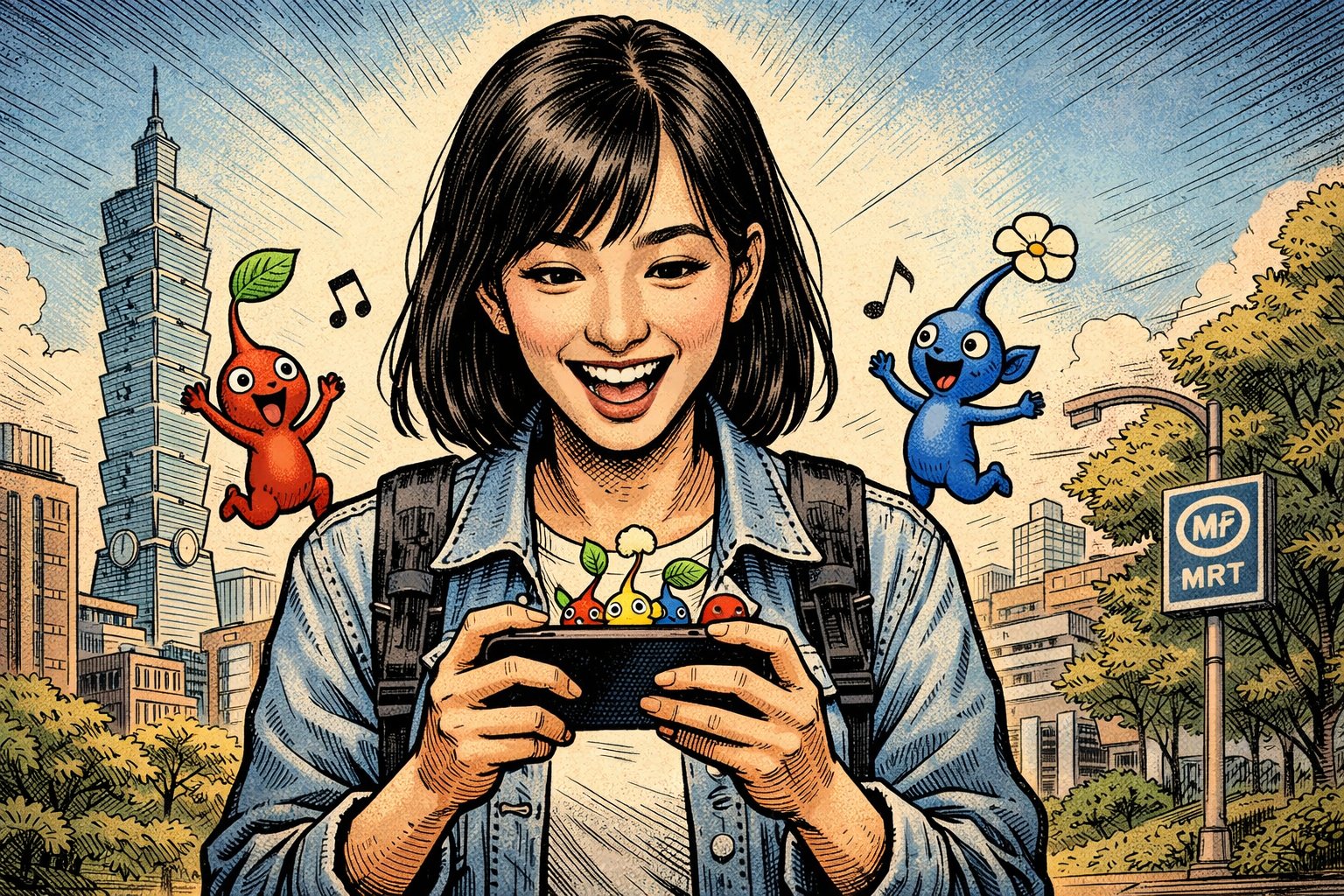
Nintendo and Niantic’s AR walking game Pikmin Bloom has kept growing four years after launch, reaching $100 million in lifetime revenue on Dec. 1, 2025. The source says 2025 was its strongest year on record, making it the only title among Niantic’s three location-based games to post growth every year.
Taiwan stands out as one of the hottest markets. Data from ActivePlayer.io cited in the source places Taiwan second worldwide in Pikmin-related search interest, with an index score of 72, behind Hong Kong at 100. The local Facebook community for the game has passed 130,000 members. Taiwan’s Chinese-language Threads account, launched on Jan. 7, drew nearly 18,000 followers on its first day, according to Liberty Times. By January 2026, global monthly active users were about 1.2 million, while downloads in November 2025 reached 667,000 for the month.
Young women have become a key force behind the game’s rise
The source highlights a clear pattern in Taiwan’s player base: a large influx of young women. On platforms such as Dcard and Instagram, strategy posts, outfit showcases and mushroom battle team-ups are dominated by female users. One reason is the game’s character design. Pikmin are built for collecting and nurturing, and the costume system gives players a steady stream of content to share.
Pop culture exposure has added fuel. Mentions of NewJeans members Hanni and Hyein, along with NMIXX member BAE, are described as major touchpoints for younger female audiences. The game’s structure matters too. Unlike competitive titles centered on battles and rankings, Pikmin Bloom leans on walking, cooperation and collection. That lowers pressure and makes the app easier to keep using over time.
Health motivation is another part of the appeal. The app logs steps and routes, then turns them into a daily walking journal. According to the source, players worldwide logged 3.9 trillion steps in 2024. The game ties exercise, light social interaction and collection rewards into one routine.
Growth came from sharing and real-world participation, not token incentives
The article describes Pikmin Bloom’s expansion as a simple loop: walk, collect decor Pikmin, post screenshots on Instagram or Threads, get friends to download the app, then go out together and create more shareable moments. No airdrop was needed. No token emissions either. The loop worked by linking social sharing to a real-world habit.
Nintendo and Niantic also pushed that loop offline. In March last year, about 4,300 FamilyMart stores across Taiwan became special in-game locations where players could receive a limited gold seedling tied to a Pikmin 4 spaceship decor item. In October, the Kaohsiung City Government and Niantic held Pikmin Bloom Tour 2025: Kaohsiung at the Pier-2 Art Center, billed in the source as Taiwan’s first official large-scale walking event for the game. Another FamilyMart collaboration followed in December with fourth-anniversary snack decor Pikmin.
Weekly challenges support the retention model as well. Four friends team up to hit shared step targets. The postcard system adds another layer, turning location photos and exploration into lightweight social interaction rather than simple item transfer.
STEPN drew users with earnings; Pikmin Bloom kept them with habit and play
The comparison with STEPN is central to the source. STEPN exploded in 2022 by letting users buy NFT sneakers and earn GST through walking or running. At its peak, one pair of sneakers sold for more than $1,100, daily income could reach $42, and the app attracted 700,000 monthly active users. Binance Labs also announced a strategic investment during that period.
Later, the economics collapsed. CoinGecko data cited in the source shows STEPN’s minimum daily earnings falling from $42.55 to $0.06, a drop of 99.9%. Other move-to-earn projects suffered similar declines: Genopets’ KI token fell 96.8%, while Sweatcoin’s SWEAT dropped 98.3%. The sector largely failed to hold attention once the payout faded.
The source frames the difference in terms of user motivation. STEPN drew people who wanted income. Once the income disappeared, so did the commitment. Pikmin Bloom offers no financial reward at all, yet players still walk every day because collection, routine and social interaction continue to give them a reason to return. The argument is blunt: retention in games starts with the experience, not the token design.
What the game says about Web3 gaming retention
The article uses Pikmin Bloom’s momentum to point to a broader weakness in Web3 gaming. It cites a figure saying 32% of potential players do not know how to start playing a Web3 game. Wallet setup, private key management and gas fee calculations all create friction before the game even begins. Pikmin Bloom asks far less of the user: download the app and start walking.
The source does not reject blockchain gaming outright, but it argues that digital ownership, token incentives and decentralized governance matter only after the core game is already compelling. Nintendo has remained cautious on Web3. Former president Shuntaro Furukawa said the company has interest in the metaverse but is not rushing in. The Pokemon Company has hired Web3 talent, yet it has not launched any token or NFT product.
Pikmin Bloom still has complaints around resource scarcity in cities, postcard photos that often capture unattractive landmarks, and a planned October 2025 campaign with EVA Air that was canceled for what the source described as unavoidable reasons. Even so, those complaints come from an active base. The source’s point is clear: these are problems that show up when a lot of people are still playing.