
Alea Research said markets rapidly rewrote the pricing for a second Federal Reserve rate hike last week. After the release of flash September PMI data and comments from Federal Reserve Governor Michael Barr, the price of an October hike on Polymarket climbed from 53.5% to 69.5% in about an hour. By Friday’s close, that probability had eased to 62.5%, still above 54.5% a week earlier.
The report said Wednesday was the worst day for rate-sensitive assets because that was when the market repriced the odds of an October move. On Thursday, the 10-year U.S. Treasury yield closed at 5.18%, the highest close since July 2007. The S&P 500 still finished the week higher, but the gain came largely from Meta and a small group of large-cap stocks rather than the broader market.
Markets moved closer to the Fed’s second-hike signal
By Friday’s close, Polymarket priced the odds of an October hike at 62.5%, up from 54.5% a week earlier. Alea Research noted that 16 of the 18 officials who submitted projections in September penciled in at least one more rate increase this year.
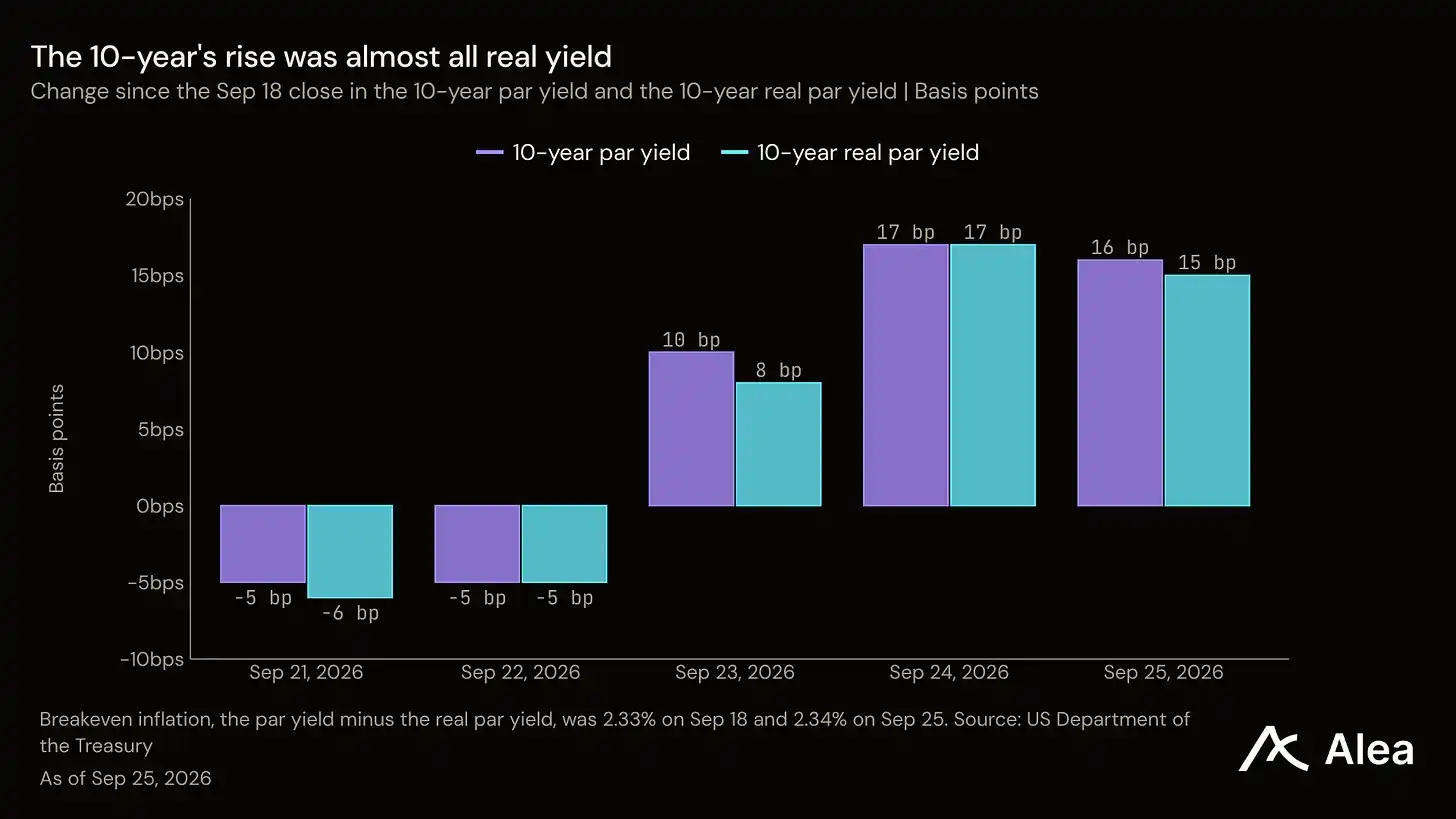
The report said the key shift was in the price of money rather than inflation expectations. The 10-year Treasury yield rose 16 basis points from the Sept. 18 close, and 15 basis points of that move came from real yields.
Headline indexes hid where the losses landed
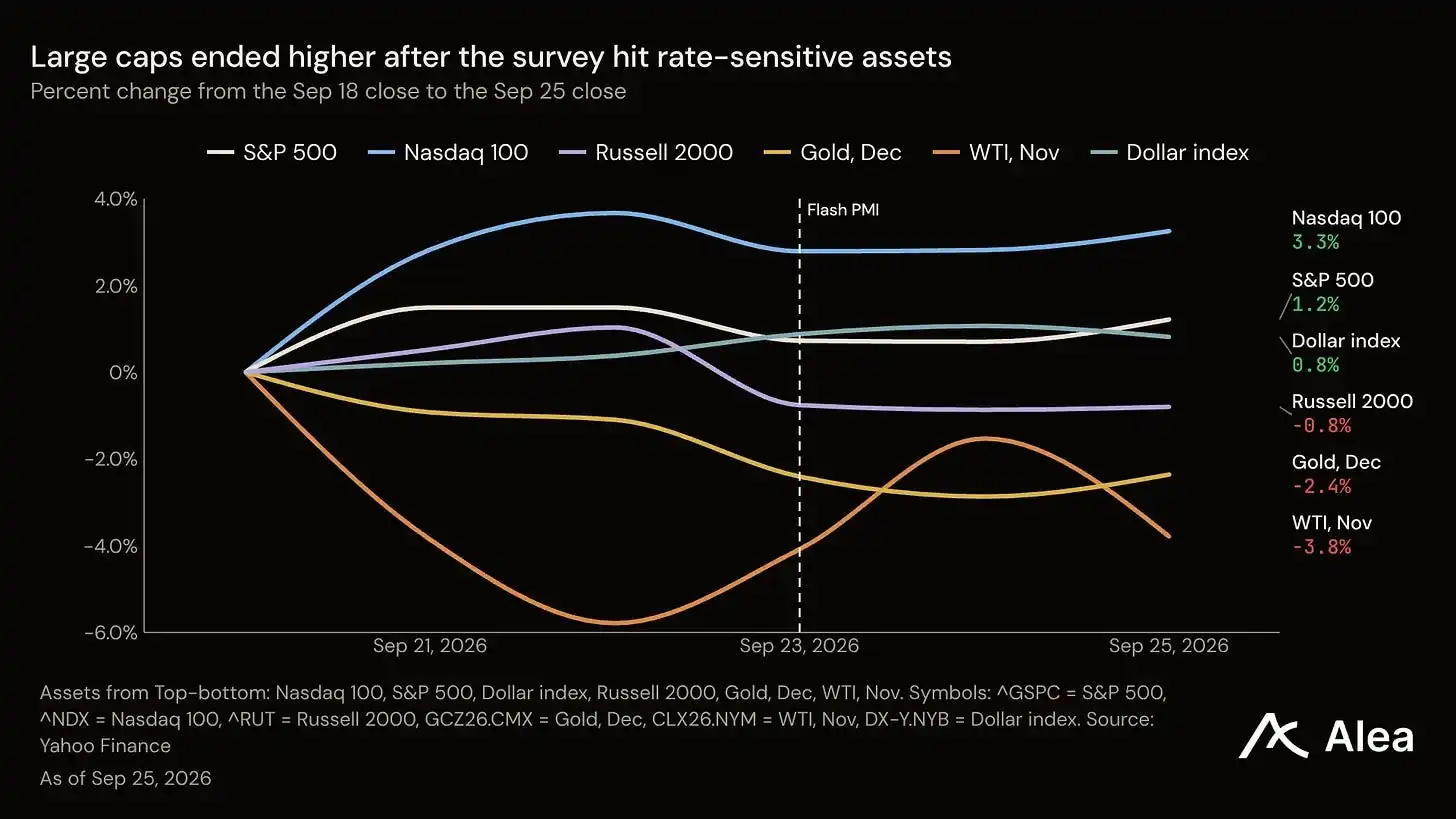
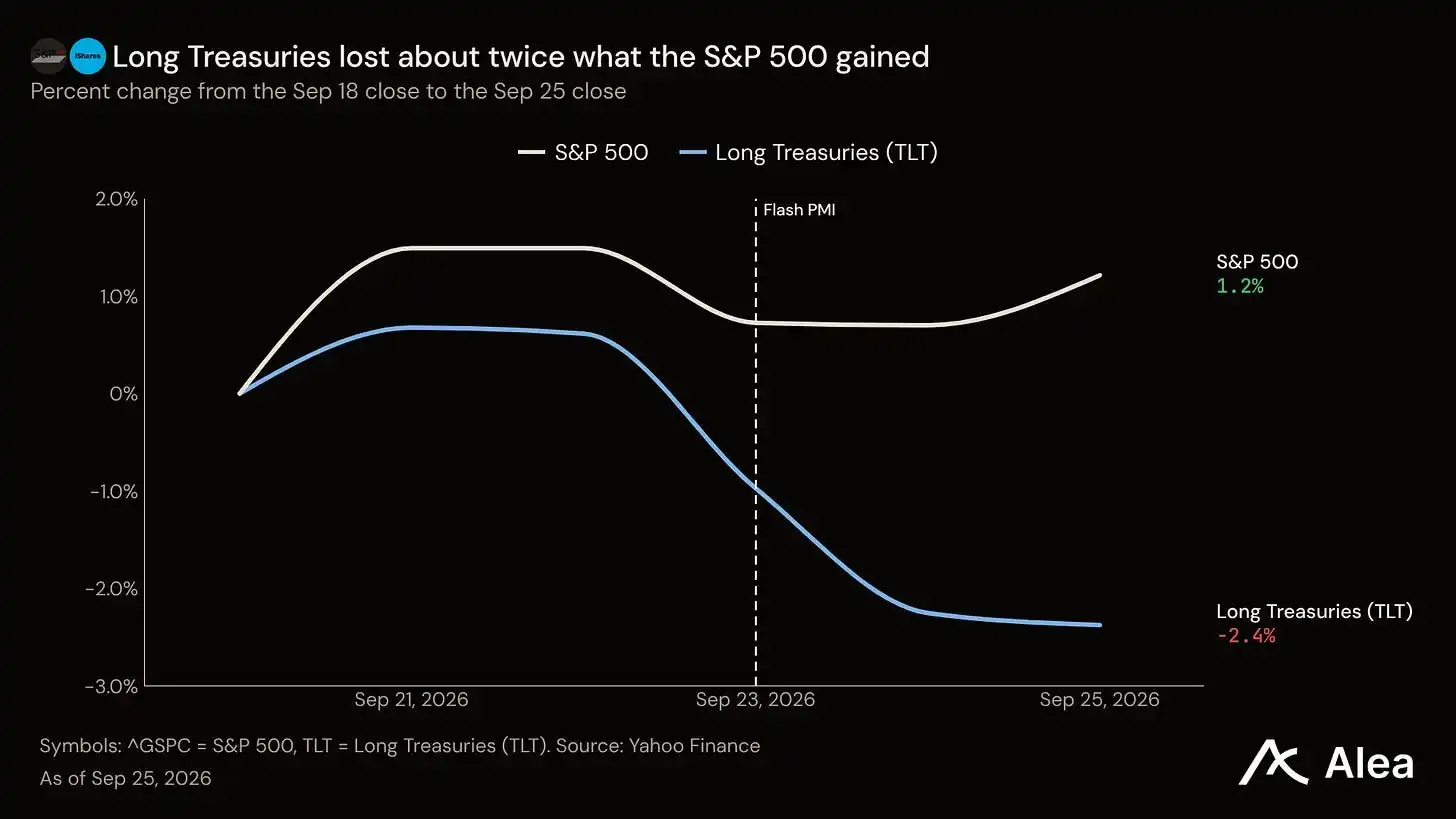
At the index level, the S&P 500 rose 1.21% for the week, with Meta leading the advance. But the equal-weight S&P 500 ETF, which better reflects the average stock, fell 0.56%. Long-duration Treasuries lost 2.38% and December gold dropped 2.36%.
In Alea Research’s reading, the bill was paid by long bonds, gold and the average stock rather than by the headline index itself. The U.S. dollar index rose 0.81% alongside higher yields.
Bonds paid for a calm week in stocks
The report said a balanced portfolio saw its bond allocation lose money in a week when stocks never delivered the kind of drawdown bonds are supposed to hedge. Options markets had priced a relatively calm week for both equities and Bitcoin, and both assets stayed inside those ranges.
At the Sept. 18 close, the VIX implied a one-standard-deviation range of about ±2.1% for the S&P 500 over the next five trading days, and the index used only a little more than half of that range. Deribit’s volatility index priced about 4.9% for Bitcoin over seven days, and Bitcoin used roughly 70% of that. Bonds were the noisy market instead: the 10-year yield rose 15 basis points on Wednesday alone.
Real yields rose while inflation expectations barely moved
Alea Research said its view from the previous week was that the latest rise in yields was no longer mainly about inflation. The new data backed that up. The 10-year real yield rose to 2.83% from 2.68% a week earlier, while breakeven inflation edged from 2.33% to 2.34%.
That left the market repricing the cost of capital rather than the price level itself. The 10-year yield also closed above 5% on Wednesday, Thursday and Friday, with Thursday’s 5.18% marking the highest close since July 6, 2007.
PMI and Barr comments changed pricing within 20 minutes
The report said the Fed had already signaled in September that one more hike was likely this year, but markets took a week to catch up. Of the 18 officials who submitted projections on Sept. 16, 16 wrote in a higher year-end policy rate. Even so, Polymarket still priced the odds of an October hike at only 54.5% on Sept. 18.
Two events, separated by 20 minutes, pushed that pricing higher. First, S&P Global’s flash September composite PMI came in at 58.4, above the prior 56.0 and the fastest growth since July 2021. Input cost growth was the fastest since October 2022. Within 11 minutes of the release, the price of an October hike rose from 53.5% to 60.5%.
Barr then said his baseline included more adjustment “to ensure inflation returns to target in a timely manner,” and within an hour the contract touched 69.5%. On Thursday, Philadelphia Fed President Paulson backed the September hike and pointed to mild additional tightening.
Treasury auctions cleared at higher yields
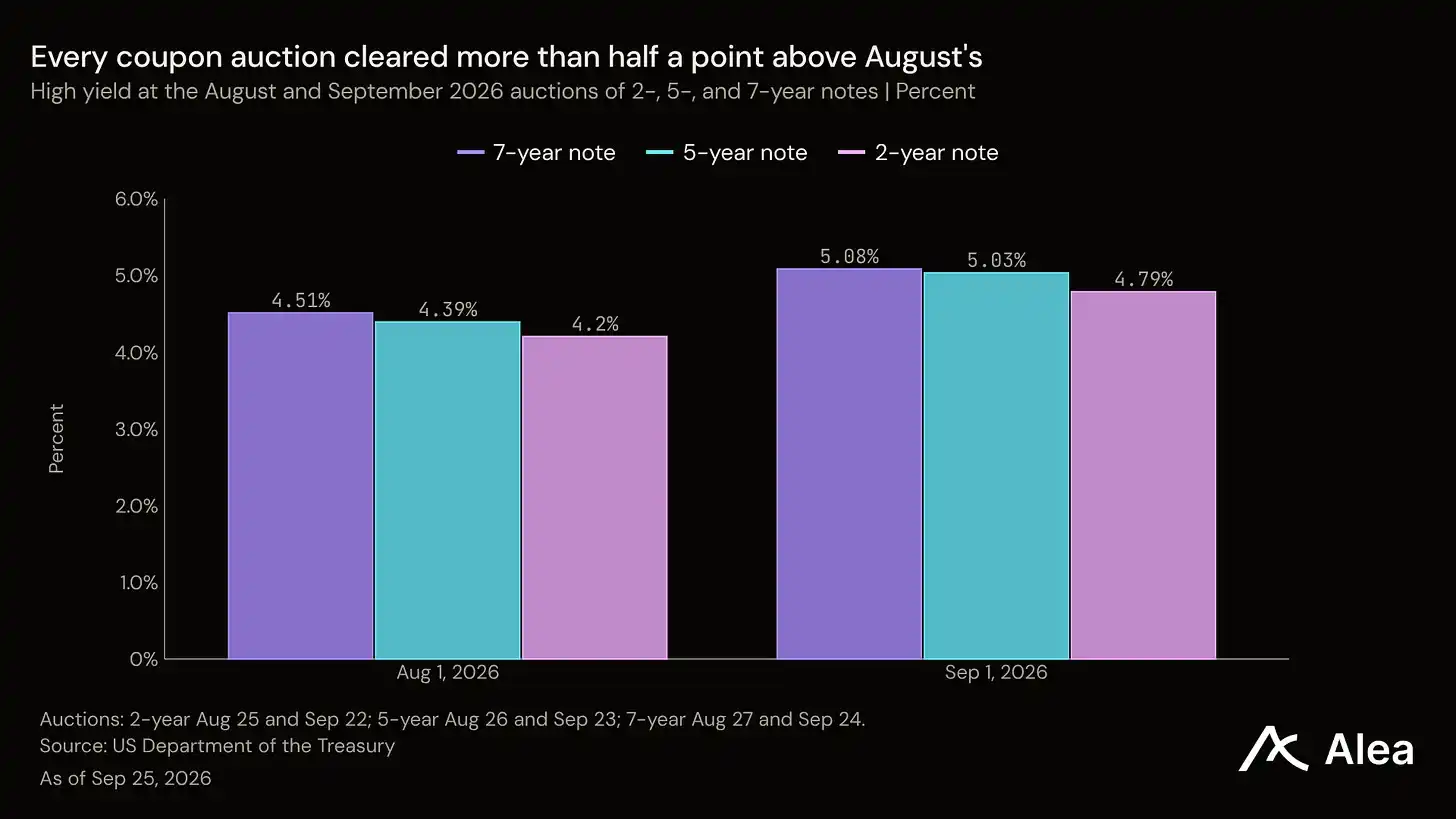
As policy expectations moved up, investors also demanded more to lend to the U.S. government. The Treasury sold $70 billion of five-year notes on Wednesday at a high yield of 5.033%, the highest for a five-year auction since June 28, 2006. On Thursday, it sold $44 billion of seven-year notes at 5.085%, the highest since that series was restarted in 2009.
The report added that the stop-out yields for the two-year, five-year and seven-year auctions were all more than half a percentage point above August levels.
Crypto buyers arrived through ETFs before the rate shock
Alea Research said it had described the previous week’s crypto rally as a squeeze rather than conviction. That view weakened this week because the buying came through spot ETFs, and it arrived on Monday, two days before the rate shock.
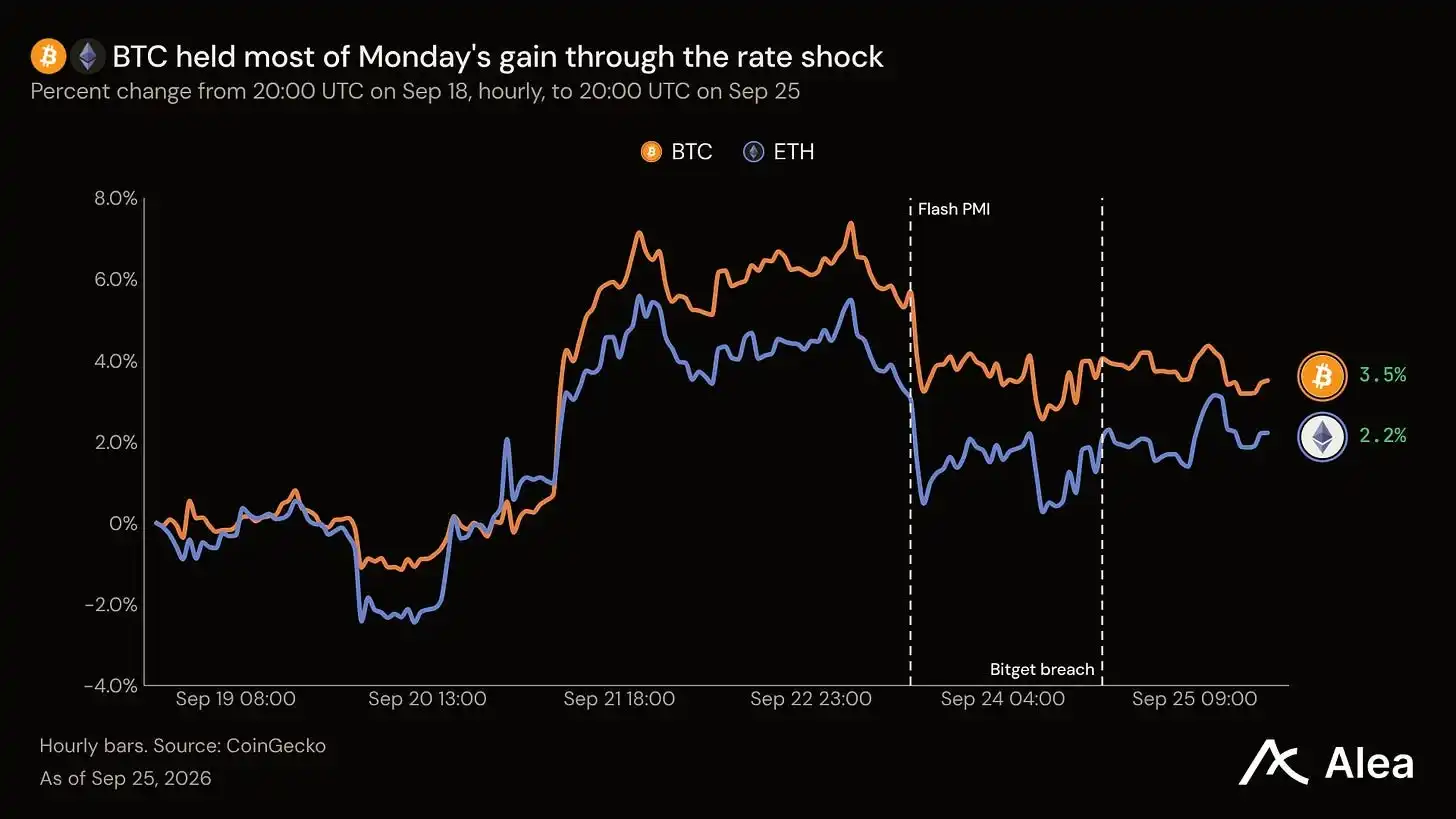
Spot BTC ETFs recorded $999 million in net inflows on Monday, the largest single-day intake since Oct. 6, 2025. Spot ETH ETFs took in $270 million the same day. Measured at the U.S. equity close, Bitcoin rose 6.6% on Monday.
Bitcoin gave back part of that gain after the PMI release and the repricing in rates. It fell 2.0% on Wednesday, the same day yields jumped and long-duration Treasuries sold off. Then at 18:31 UTC on Thursday, Bitget detected an unauthorized transfer from a hot wallet worth about $351.6 million.
Even so, Bitcoin was nearly flat by the Thursday U.S. close versus Wednesday, with the difference under 0.2%. It still ended the week 3.51% above the Sept. 18 close. Ether rose 2.22% for the week.
The report also said longs were not paying a meaningful premium to hold positions. On Hyperliquid, Bitcoin funding stayed at the exchange’s default level for 139 of 168 hours, equivalent to 10.95% annualized. Spot BTC ETF buying continued through Thursday, bringing four-day inflows to $2.25 billion.
Stocks rose at the top while the average company fell
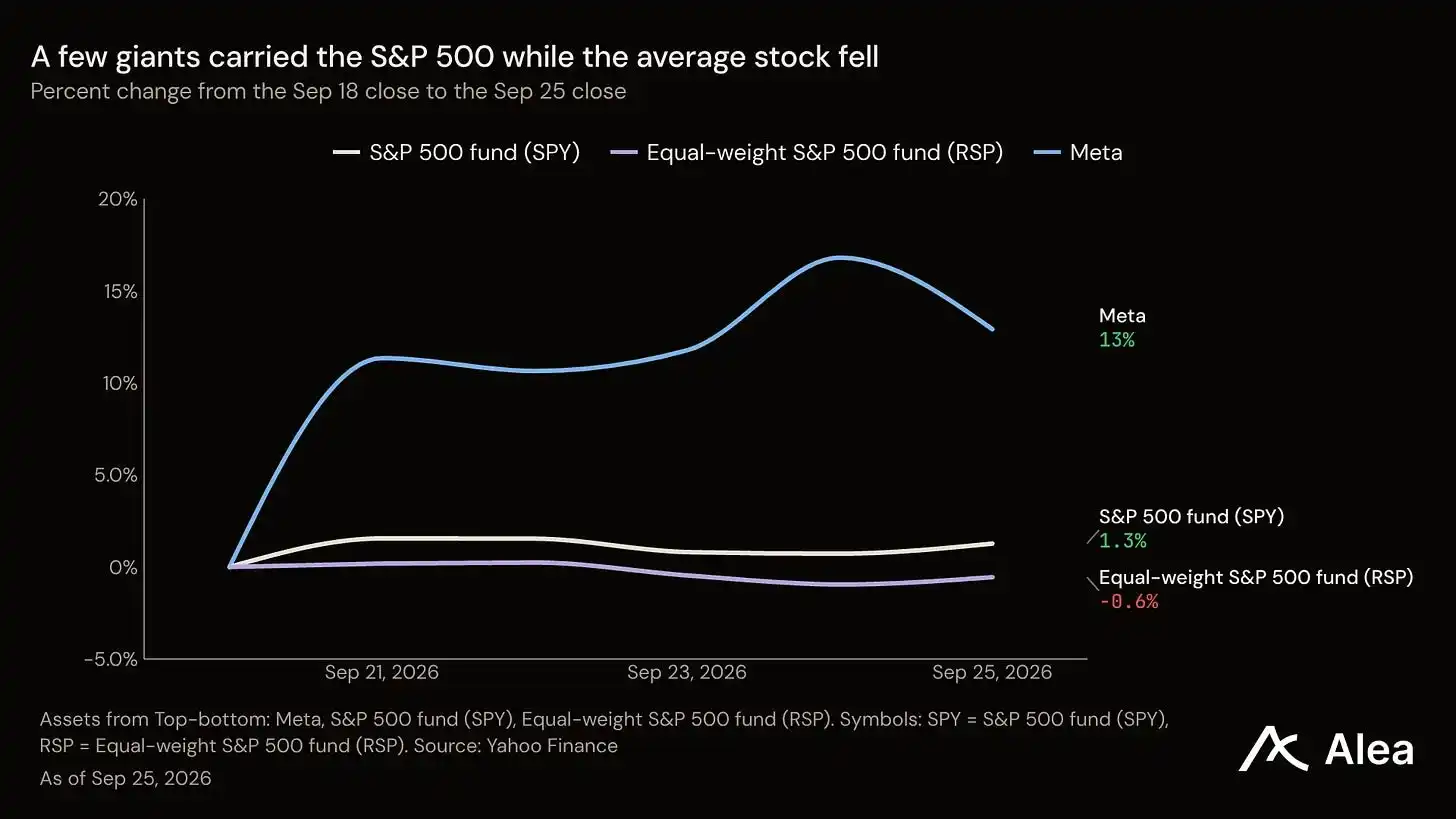
A small group of mega-cap names held up the major indexes. The Nasdaq 100 rose 3.25% for the week, led by Meta, which gained 12.90%. Most of that move came on Monday. Sensor Tower data showed that Muse, Meta’s personal AI agent launched on Sept. 8, had surpassed 2.5 million downloads.
The average company followed a different path. The equal-weight S&P 500 ETF fell 0.56% and the Russell 2000 lost 0.80%, with both posting their worst day on Wednesday. Another mega-cap, Alphabet, fell 3.8% that day.
Commodities split as Brent and WTI priced the Strait differently
Oil traders priced the Strait of Hormuz risk in two different ways. November Brent rose 0.48% for the week, while November WTI fell 3.79%. On Wednesday, the spot premium of Brent over WTI reached about $24 a barrel.
The BWET tanker shipping fund fell 18.2% on Tuesday after reports said Iran had proposed reopening the strait. A senior Iranian official said Wednesday that Tehran could reopen it within a week if the United States lifted the blockade. In the U.S., commercial crude inventories rose by 3 million barrels in the week ended Sept. 18.
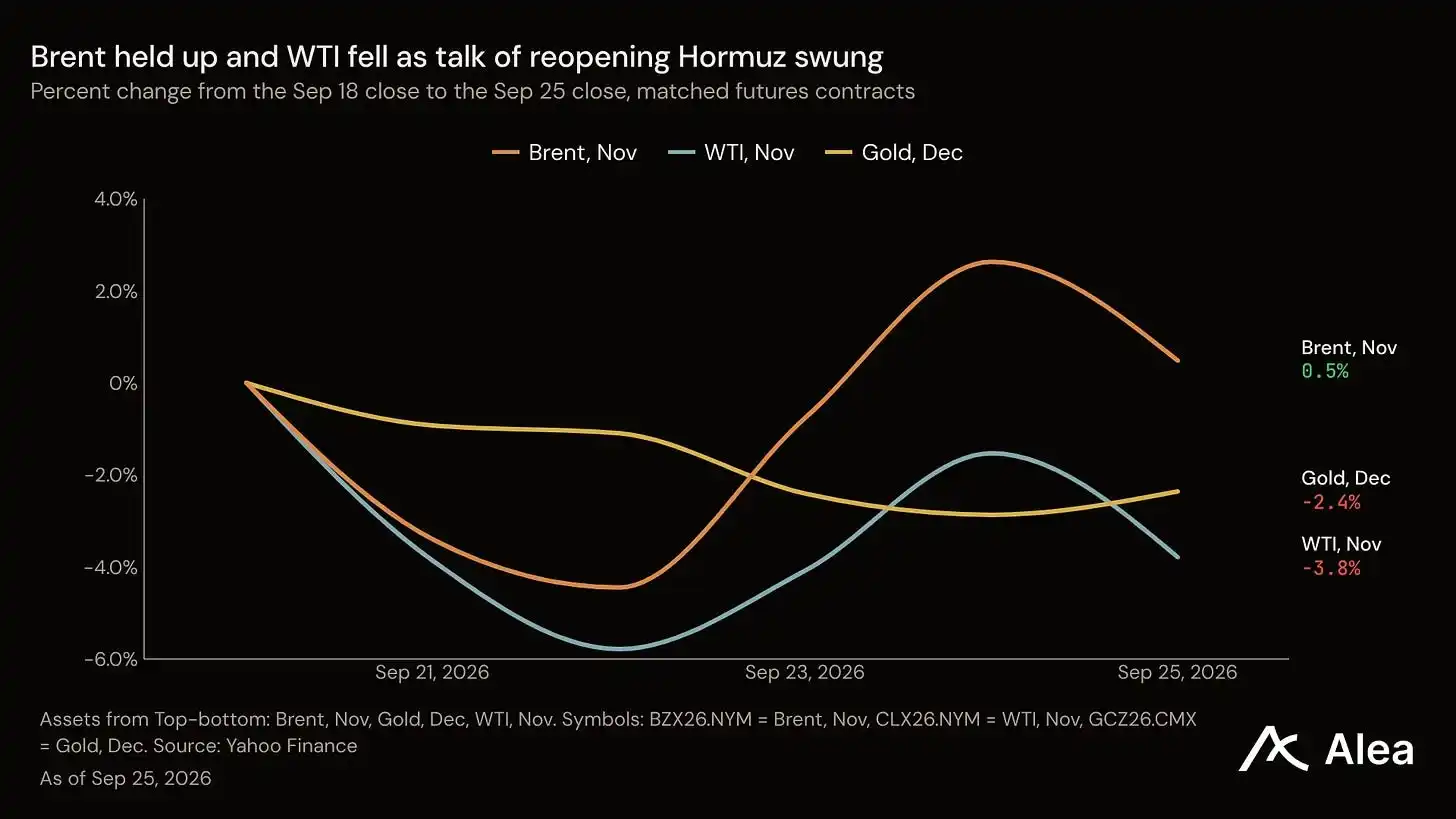
Gold took the rate hit directly. December gold fell 2.36% as the 10-year real yield climbed to 2.83%. The report said a non-yielding metal lost out to bonds that now offer higher income.
Markets have mostly caught up with the Fed
By Friday, the Polymarket October hike contract closed at 62.5%. Alea Research said two data releases still stand between that pricing and the Fed’s Oct. 28 decision: August PCE inflation due Sept. 30 and September nonfarm payrolls due Oct. 2.
Across assets, the report said markets have now largely caught up with the Fed’s dot plot by repricing the cost of money higher. Of the 16 basis points added to the 10-year yield, 15 came from real yields. Long-duration Treasuries, gold and the average stock absorbed that cost, while the index itself still rose because a handful of the largest constituents, led by Meta, kept climbing.