
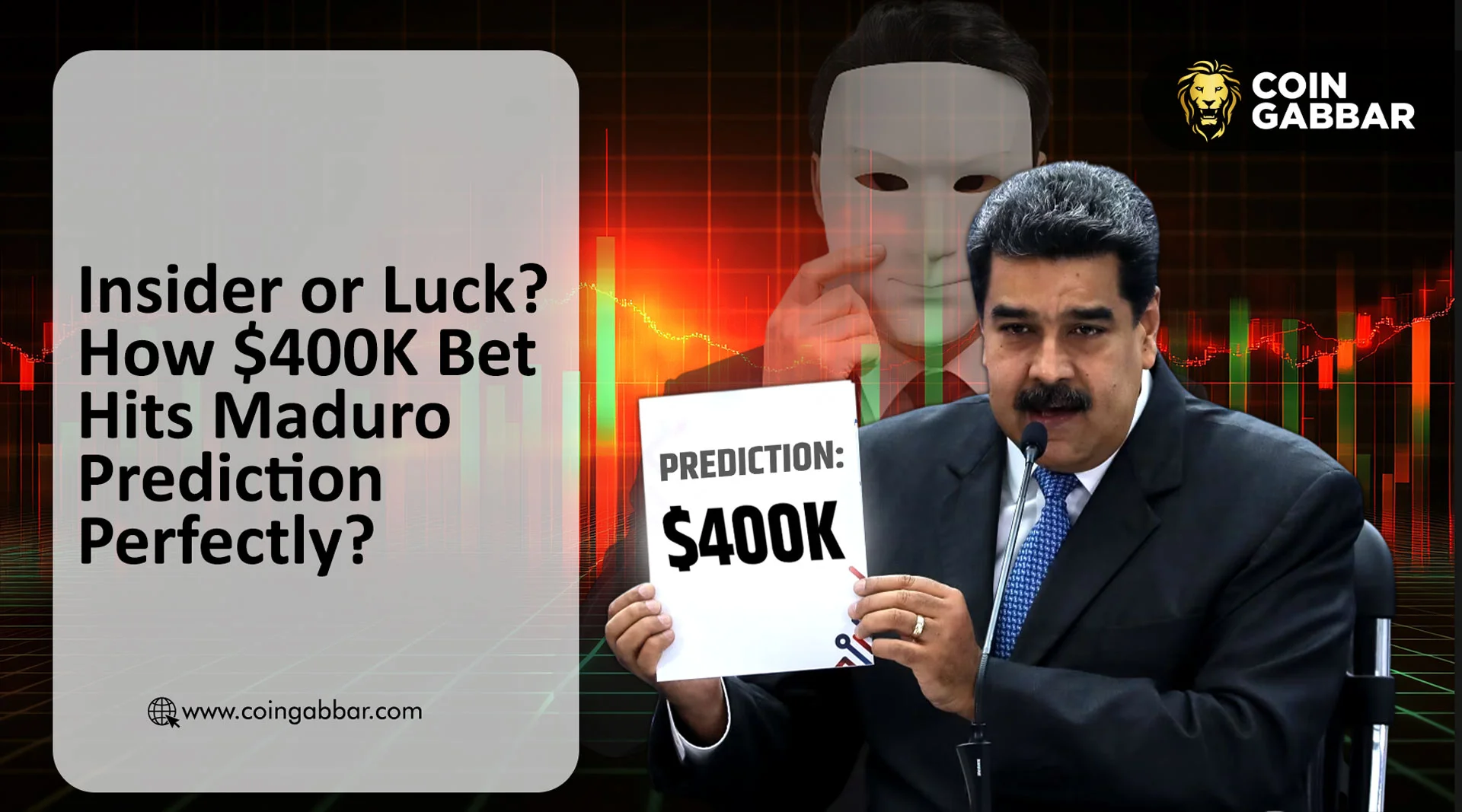
A Polymarket trader reportedly made about $400,000 by entering a winning position on the fall of Venezuelan President Nicolas Maduro before the real-world outcome was known. The profit itself drew attention, but the larger controversy came from the timing of the trade and the wallet trails that analysts later connected to name-service domains resembling those tied to Steven Charles Witkoff.
Funding wallets behind the winning account drew scrutiny
According to on-chain research shared by crypto analyst @Andrey_10gwei, the Polymarket account that captured the gain was funded by two wallets. Those wallets showed little activity apart from receiving funds from Coinbase and then sending assets into Polymarket. That pattern is often associated with intermediary or burner-style wallets.
One wallet, identified as 2i7HJJ..., received 252.39 SOL from Coinbase at 23:53 UTC on January 1, 2026. Investigators then worked backward to look for Coinbase-linked transfers with closely matching size and timing.
Near-identical SOL transfers became a focal point
The analysis pointed to another wallet, BCcTrxcow..., which had deposited 252.91 SOL into Coinbase roughly 23 hours earlier. The amounts were close enough that analysts described the match as roughly 99%. That numerical overlap, paired with the narrow time window, fueled claims that the wallets could be connected.
Researchers also noted that the wallet STVLU.SOL had registered several Solana Name Service names, including StCharles.SOL. At that point, the discussion moved beyond transfer patterns and into possible identity links through wallet naming conventions.
Name overlaps pushed Steven Charles Witkoff into the discussion
Additional tracing found that one original funding source for STVLU.SOL was Solhundred.sol. That wallet had reportedly made around 11 million transactions with another wallet called StevenCharles.sol. Because the names StevenCharles.sol and StCharles.sol appear closely related, analysts suggested there could be a connection to Steven Charles Witkoff, co-founder of World Liberty Finance (WLFI).
Even so, the report stopped short of claiming proof. The evidence remains circumstantial, built on blockchain flows and naming overlaps rather than a direct attribution showing that the wallets were controlled by Witkoff or WLFI affiliates.
Fartcoin transfer after the withdrawal added another layer
Attention increased again after the Polymarket profits were withdrawn. The report said that around 3 to 4 hours after the winning account moved proceeds to Coinbase, roughly 170,000 worth of Fartcoin was transferred out of Coinbase into the STVLU.SOL wallet. That sequence led to speculation that some of the gains may have been cycled into another speculative crypto asset.
Still, the timing alone does not establish recycling of profits or insider trading. On-chain visibility can show where funds move. It cannot, by itself, prove who controlled each wallet at every step.
No direct evidence and no public response so far
At the time of publication, none of the parties mentioned in the analysis had responded. The report framed the episode as an example of how blockchain transparency can expose suspicious-looking patterns while leaving attribution unresolved.
The same article also noted that World Liberty Financial, a crypto project associated with the Trump family, said a governance proposal had passed with 77.75% of the vote. The measure would allow an unlocked treasury to be used to incentivize adoption of USD1. That vote result does not serve as proof of any link to the Polymarket trade, but WLFI’s appearance in the wallet analysis helped intensify the discussion.