

After previously sharing an article about building an AI-assisted investment workspace, the author returned with a closer review of one specific tool in that setup: a Polymarket betting monitoring dashboard built through Coding. The broader workspace also included a cross-market asset panel, an investment map, and a personal content operations desk, but the Polymarket dashboard became one of the tools used most frequently in recent weeks.
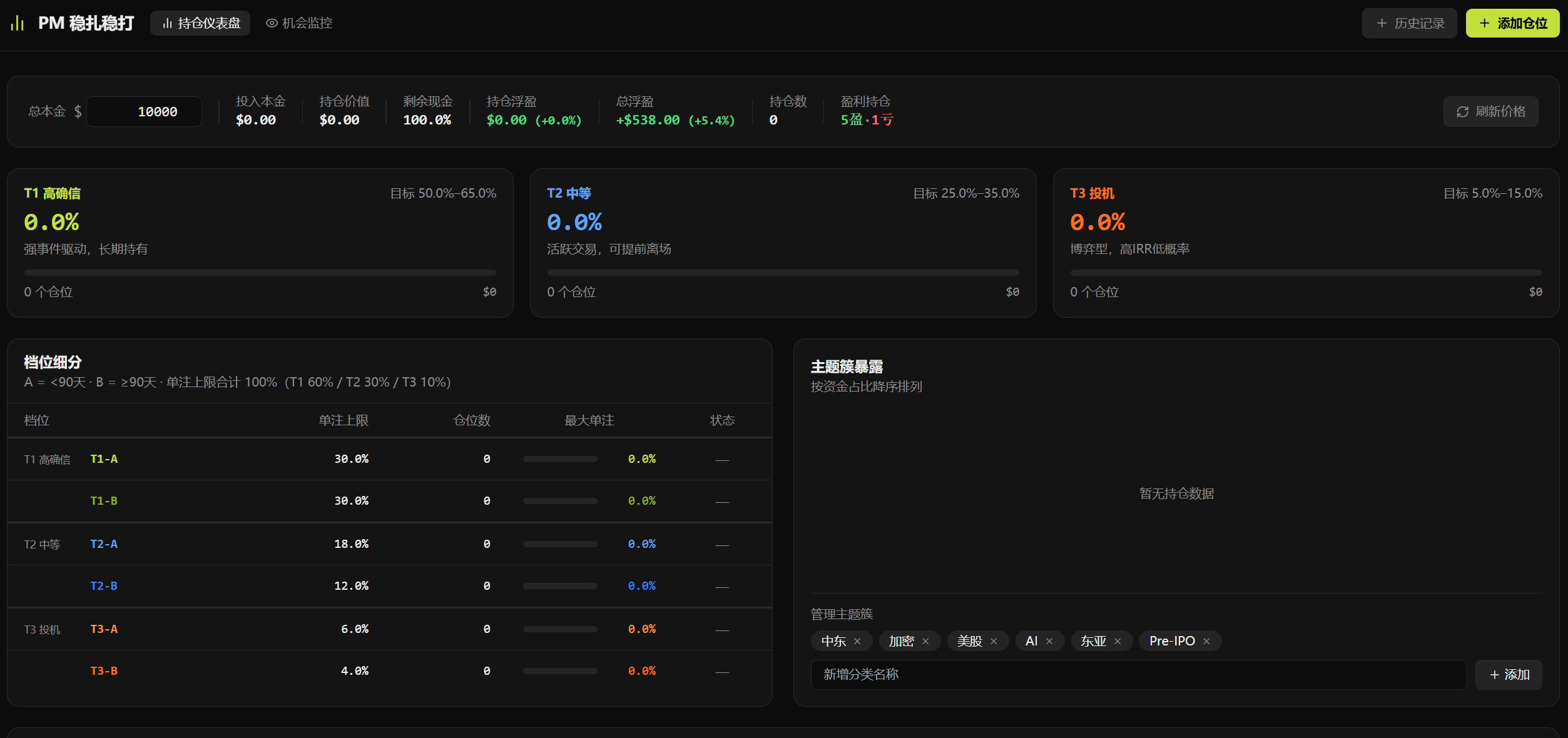
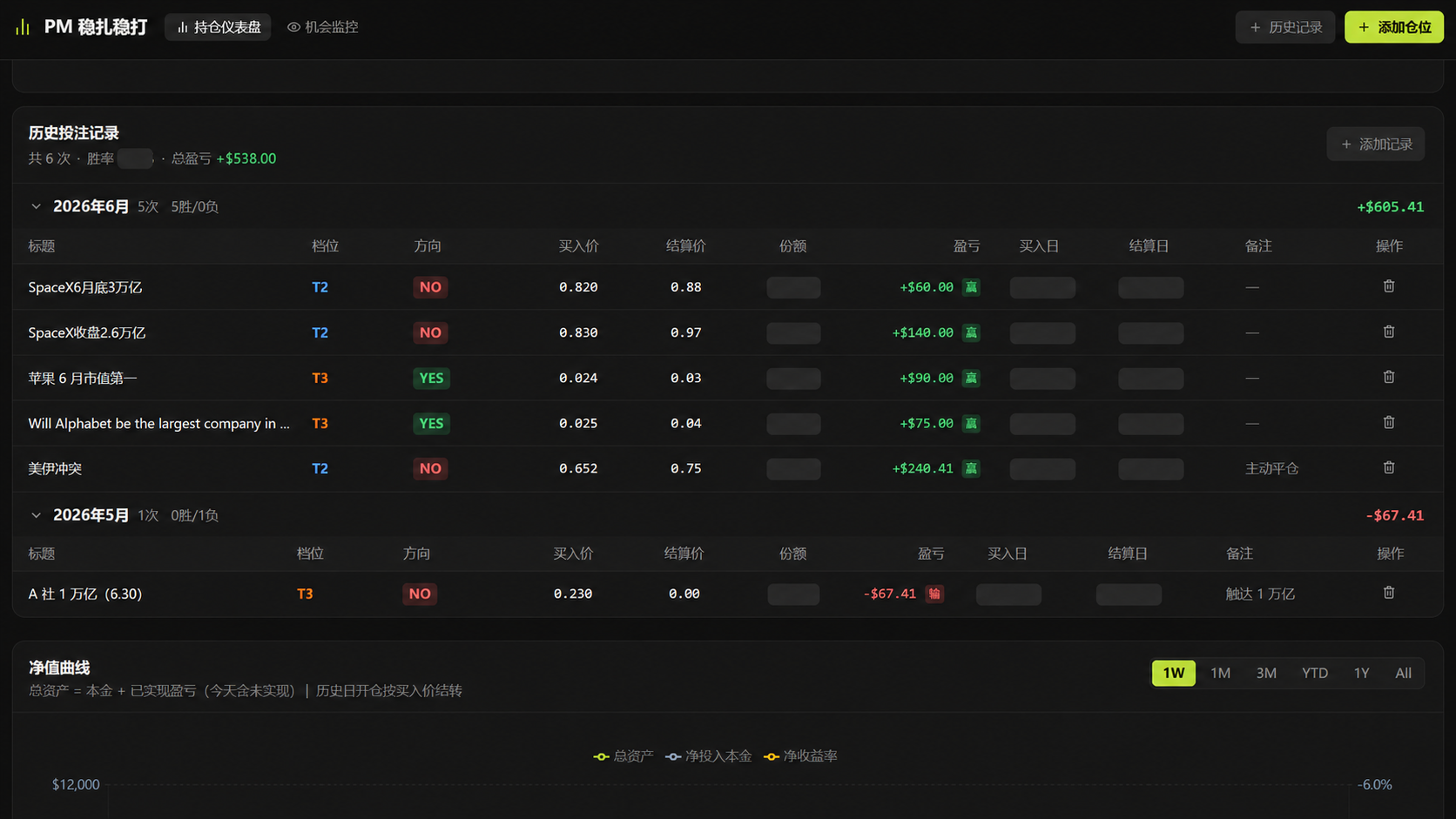
Over more than half a month of testing, the author deployed roughly $1,600 in principal and recorded returns of more than 30%. The dashboard’s real-time statistics were largely consistent with the final actual net profit, with a difference of around 6U, mainly attributed to small discrepancies such as pending orders and liquidity rewards. Yet the central message of the review was not that Polymarket is easy money, and it was not framed as an arbitrage tutorial. The conclusion was the opposite: after this round of testing, the author became more convinced that Polymarket is not a suitable place for users who enter with a heavy arbitrage mindset.
From manual Excel records to a real-time Polymarket panel
The author began manually building the dashboard around May 21. The initial need was simple: there was no desire to keep opening more than a dozen betting pages to check changing yes/no prices, nor to continue manually filling in Excel records. Before the dashboard, the author had been using Excel to track buys and sells, unrealized profit and loss, settlement dates, and event types. It was a simple method, but one that created practical problems once many markets were being followed at the same time.
In the author’s experience, many Polymarket positions can become difficult to control because manual tracking is too limited. A user may initially intend to buy only a small amount, then add more once the odds move because there is no intuitive view of the whole position. If a market suddenly moves and the spreadsheet is not updated in time, the user may miss the window for stopping losses or adding to a position. The broader issue is fragmentation: without a system, decisions can become more emotional.
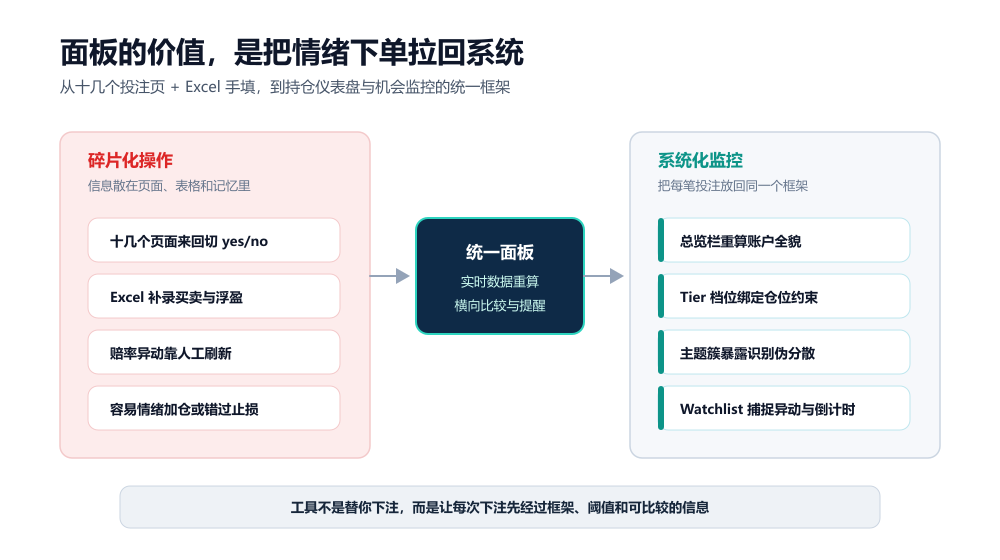
That is why the dashboard was designed to put every bet into one framework. Its role was not to create predictions, but to turn scattered impressions into visualized information that can be compared across markets. After several iterations, the author divided it into two tabs: a position dashboard and an opportunity monitoring section. The position dashboard is the core of the system. It can pull real-time PM data and recalculate key figures dynamically.
For each market, the dashboard records several fields: the event name, with a hyperlink that jumps directly to the trading page; a T1/T2/T3 tier label; the current yes/no prices; returns; annualized returns; abnormal price movement alerts; observation points set by the author; and a countdown to settlement. The abnormal movement threshold is customizable. For example, if a market moves by more than 20% within 24 hours, the dashboard can generate a pop-up alert as long as the webpage remains open.
The author highlighted two design details. First, after finding a suitable PM interface, the dashboard can parse a betting event simply by receiving the event webpage link. It then automatically identifies yes/no options, corresponding prices, and different option categories under the same event, reducing manual entry. Second, the tier assignment of a single bet can be automatically reordered according to the remaining time before settlement.
The expected return formula hides a full-loss tail risk
The dashboard also helped the author capture a concrete example. Before Anthropic released Mython, the watchlist showed a clear price movement. The author regarded it as a high-probability deterministic event, and entering at that time could generate around 10 percentage points of return. Without a watchlist, such opportunities would be hard to capture consistently. Still, this example did not change the broader conclusion: in a binary market such as PM, the structure is unfriendly to players who prefer single, concentrated positions, while it is more suitable for diversified participants who are willing to hold many smaller bets.
The author explained the structure through a simple expected value calculation. Suppose the yes price of a betting event, c, is 0.80, meaning the market is pricing the event as having roughly an 80% probability of happening. If the user’s own estimate of the real probability, q, is 0.90, the expected return can be roughly calculated as EV = q / c - 1 = 0.90 / 0.80 - 1 = 12.5%. On the surface, that looks attractive. But Polymarket is not a bond. Behind the 12.5% expected return is a sharp tail risk: if the judgment is wrong, the loss is not 12.5%, but 100%.
For that reason, the author does not look only at expected return inside the dashboard. Two other metrics are monitored at the same time. The first is the gap between the author’s own probability judgment and the market price, or q - c. The dashboard also includes an automatic take-profit reminder level, set at the midpoint between the purchase price and 100. The second is the impact that a single position going to zero would have on the whole account if the event is judged incorrectly.
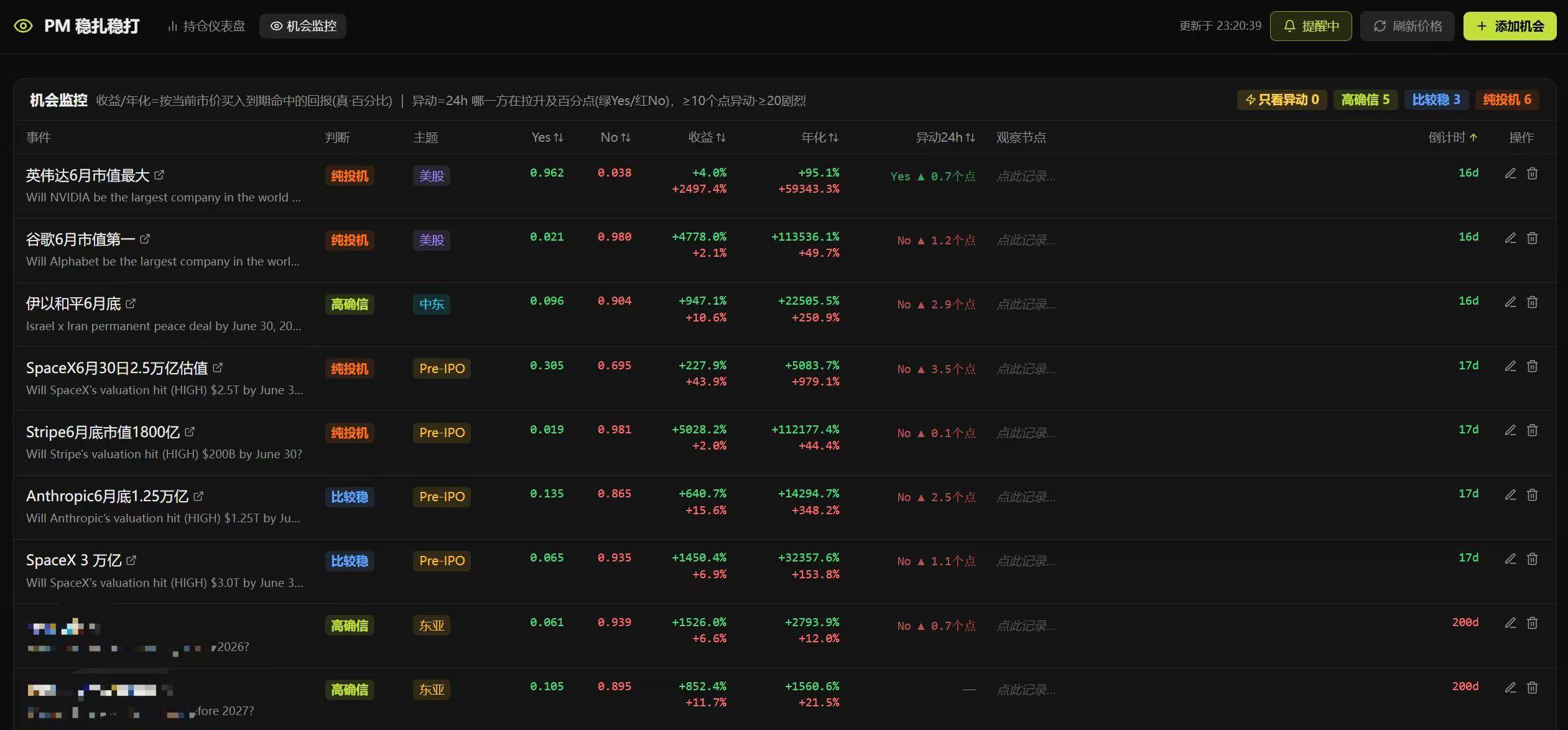
This logic also explains the T1, T2, and T3 classification system. T1 represents high-conviction markets. For the author, the comfort zone includes East Asia and certain geopolitical topics, where the author believes there can be an information gap between Eastern and Western audiences, and positions are added only after repeated checking. T2 refers to relatively stable opportunities, where the implied probability seems meaningfully different from the current yes or no price. T3 is pure speculation, usually involving very high odds. The author does not hold these frequently or size them heavily; the aim is more to trade rebounds and short-term reversion.
High conviction is not the same as high position size
Even T1 positions have hidden costs, especially when the settlement date is far away. The author gave an example: a T1 bet may show a static return of 18%, but if it settles 180 days later, the annualized IRR may be only 3–4%. In that period, principal is locked, and other high-IRR opportunities that appear later can be missed. Therefore, the author further separates T1 positions by time buckets. Short-term T1-A positions can be sized more aggressively, while longer-term T1-C positions require restraint. Holding too many low-IRR long-term positions creates an invisible drag on capital efficiency.
For T2 positions, the author acknowledges the existence of edge but still leaves room for being wrong. A single bet is capped at 8–10%, so even if it goes to zero, the total account loss remains within 10% and does not prevent participation in future opportunities. For T3 positions, the odds can look attractive, but the author uses the smallest position size for observation and does not expect them to produce large profits. Their function is to keep tracking high-odds events and build a feel for such markets.

In the author’s view, the essence of a position limit is to reserve an affordable cost for the possibility of wrong judgment. One counterintuitive but important point is that high conviction does not equal high position size. Even if an event is believed to have a 95% chance of happening, as long as there is still a 5% chance of the position going to zero, the size must be limited. In an extreme example, if someone makes 10 independent bets that they believe each have a 95% win rate, the chance that at least one is wrong is approximately 1 - 0.95^10 ≈ 40%. With enough bets, an error will eventually appear.
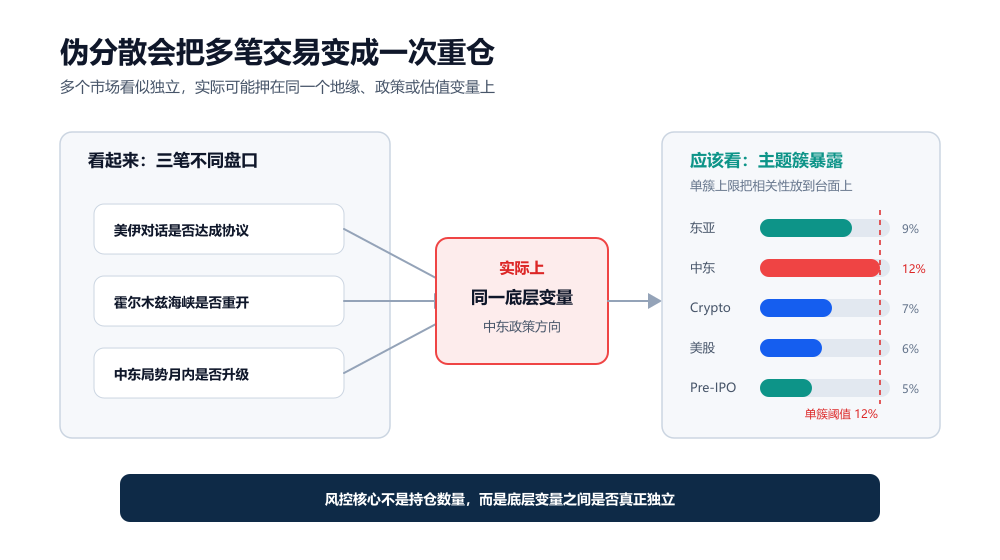
Reality is even more complicated because many PM markets are not independent. They can share the same underlying variable. The author cited three examples: whether U.S.-Iran talks will reach an agreement, whether the Strait of Hormuz will reopen, and whether the Middle East situation will escalate within the month. These appear to be three separate markets, but the core variable is almost the same: the direction of Middle East geopolitical policy. If that directional judgment is wrong, all three positions can lose at the same time. For the author, the dashboard’s greatest value is not that it increases the win rate, but that it limits the chance of making a major mistake. In plain terms, its core value is risk control rather than profit statistics.
Polymarket as a training ground for judgment
After more than half a month of intensive testing, the author’s strongest conclusion is that Polymarket does have opportunities, but it is not the arbitrage venue many people imagine. In on-chain arbitrage, the rules are often clear and price dislocations can be locked in. Polymarket is different. It tests the user’s understanding of how narratives and betting directions change around specific events, a kind of logic the author says is difficult to fully express in text.
For example, Chinese-speaking users may have a certain information-gap advantage in East Asia-related political and economic dynamics, and that angle can be explored. But it does not guarantee a win. Polymarket does not settle according to a user’s understanding of reality; it settles according to market rules and specified data sources. The author also noted that UMA manipulation issues have appeared repeatedly. In addition, something that looks certain in a Chinese-language context may not be defined the same way in the English rules of a market. The wording of each betting rule can contain traps.
Based on actual experience, the author believes PM does not offer many true arbitrage opportunities. Results rely more on information gaps and diversified sizing, and even high-conviction bets can encounter black swans. When that happens, the principal can be completely lost. The author quoted a friend: “投资这件事,哪怕只有 1% 的归零概率,也不应该抱有侥幸”.
The author’s current framework for PM is more conservative. First, it should not be treated as a stable income tool. Even after several high-conviction wins, a user should not assume they have found an ATM. The danger of binary markets is that after consecutive wins, they can make a participant believe they can judge everything, leading to one oversized final position that gives back previous gains. Second, a high win rate is not the same as a good trade. If an event with a 90% win probability is already priced at 0.95, it can be negative expected value. Conversely, if an event has only a 40% chance but the market prices it at 0.20, it can have positive expected value. Third, tail risk cannot be ignored. A visible 10% or 20% return does not make a trade low risk if being wrong means going to zero. From this angle, the author even argues that PM has no truly low-risk opportunities; each one is high risk. Fourth, pseudo-diversification should be avoided. Buying several markets does not count as diversification if the underlying variable is the same, as in the U.S.-Iran talks, Strait of Hormuz, and Middle East escalation examples.

For the author, PM is now better understood as a training ground for judgment. It fits naturally with a daily habit of reading political, economic, technological, and financial information, and it turns judgments that would otherwise remain at the level of personal impressions into a framework that can generate feedback. The author believes these skills are useful outside PM as well.
The author also mentioned another tool built with Codex: a private-market valuation monitoring dashboard. It mainly tracks valuation changes in unlisted unicorn companies such as Anthropic, OpenAI, Stripe, and Kraken, and compares those changes with corresponding PM bets. Polymarket is, in essence, an expectations market. Sometimes signals in the private market have already changed while PM prices have not moved; at other times, PM prices move first while real-world data has not yet caught up. The mismatch between the two is something the author intends to keep observing. But this is not risk-free arbitrage either. Private-market valuations are not fully transparent, and different data sources can diverge. As an observation framework, however, the author finds it interesting and plans to write about it separately later.
The final point of the review is not “I made 30% with a dashboard, so you can too.” The author’s more practical lesson is that a tool can turn feeling into a framework, and a framework into discipline. Many times, making money does not prove that someone has discovered a secret method. It only proves that the judgment happened to be right in that round.