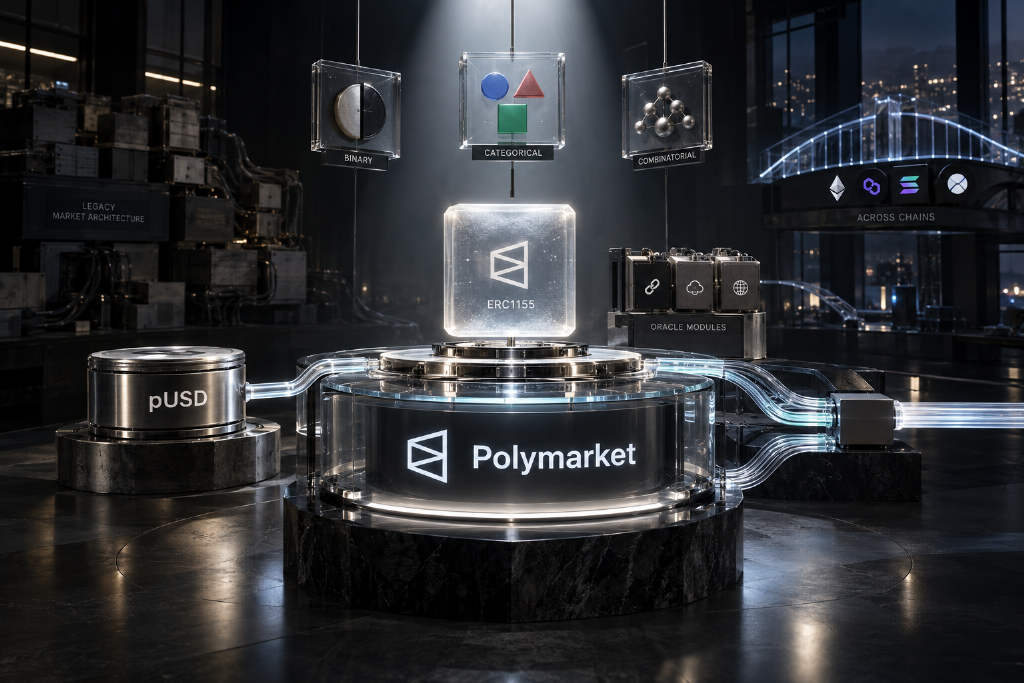
Polymarket has introduced Polymarket Protocol V2, describing it as its next-generation smart contract system for prediction markets. The upgrade replaces a structure built on Gnosis’ 2019 conditional tokens framework, where different market types were connected through additional adapters, with a rebuilt design centered on a single ERC1155 position contract, a single collateral asset called pUSD, one exchange, and one router. Position IDs now directly encode market type, market, and outcome.
The new protocol uses a modular architecture to support binary markets, atomic negative risk, incremental negative risk, and parlay markets, while expanding position operations to improve capital efficiency. For settlement, V2 connects to pluggable oracle sources through OracleAggregator, including UMA, Chainlink, and future providers. Polymarket also said the protocol includes built-in cross-chain bridging for positions, collateral, and settlement, and can be upgraded through governance. The company added that future development work will focus on scalar settlement and directional collateral refunds.
Polymarket said the codebase has been audited by Cantina, Certora, Quantstamp, SigmaPrime, Zellic, and Pashov, with formal verification completed by Certora. The maximum bounty for critical vulnerabilities is $5 million. A canary market is running in production from now through Oct. 30, and new markets are tentatively scheduled to switch on Nov. 2. At the same time, the company launched Data API V2, built on its in-house on-chain indexer with V2 support, a unified response format, and cursor pagination.
Prediction market platform Polymarket has launched Polymarket Protocol V2, which it describes as its next-generation smart contract system for prediction markets.
The current contract setup is based on Gnosis’ 2019 conditional tokens framework, with later market types connected through additional adapters. In V2, Polymarket rebuilt position tokens from scratch. The new design uses a single ERC1155 position contract, a single collateral asset called pUSD, one exchange, and one router, while position IDs directly encode market type, market, and outcome.
Protocol design and market support
According to the announcement, V2 adopts a modular architecture that supports binary markets, atomic negative risk, incremental negative risk, and parlay markets. It also expands position operations to improve capital efficiency.
For settlement, the protocol connects to pluggable oracle sources through OracleAggregator. Those sources include UMA, Chainlink, and future providers.
Cross-chain design, upgrades, and roadmap
Polymarket said the protocol includes built-in cross-chain bridging for positions, collateral, and settlement. It can also be upgraded through a governance process.
Future development areas include scalar settlement and directional collateral refunds.
Audits and rollout timeline
The codebase has been audited by Cantina, Certora, Quantstamp, SigmaPrime, Zellic, and Pashov. Certora also completed formal verification. The maximum bug bounty for critical vulnerabilities is $5 million.
A canary market is running in production from now until Oct. 30. New markets are tentatively scheduled to switch on Nov. 2.
Data API V2 launched alongside the protocol
Polymarket also released Data API V2 at the same time. It is built on the company’s in-house on-chain indexer and supports V2, a unified response format, and cursor pagination.
This article was originally published by Bit.Fan. For more cryptocurrency news and market insights, visit www.bit.fan. Disclaimer:
The market information, project data, and third-party content displayed on this platform are for industry information sharing only and do not constitute any form of investment advice or return commitment.
Cryptocurrency trading carries high risks. Users should fully assess their risk tolerance and make independent decisions. All profits, losses, and legal responsibilities are borne by the users themselves.