

A Polymarket account operating under the name swisstony has posted $18.62 million in lifetime profit, including $10.33 million over the past month, according to MarsBit.
The account was first registered in July 2025. Despite its relatively short history, its page views have climbed to 922,200 as the profit figures drew wider attention.
Nearly 140,000 predictions logged
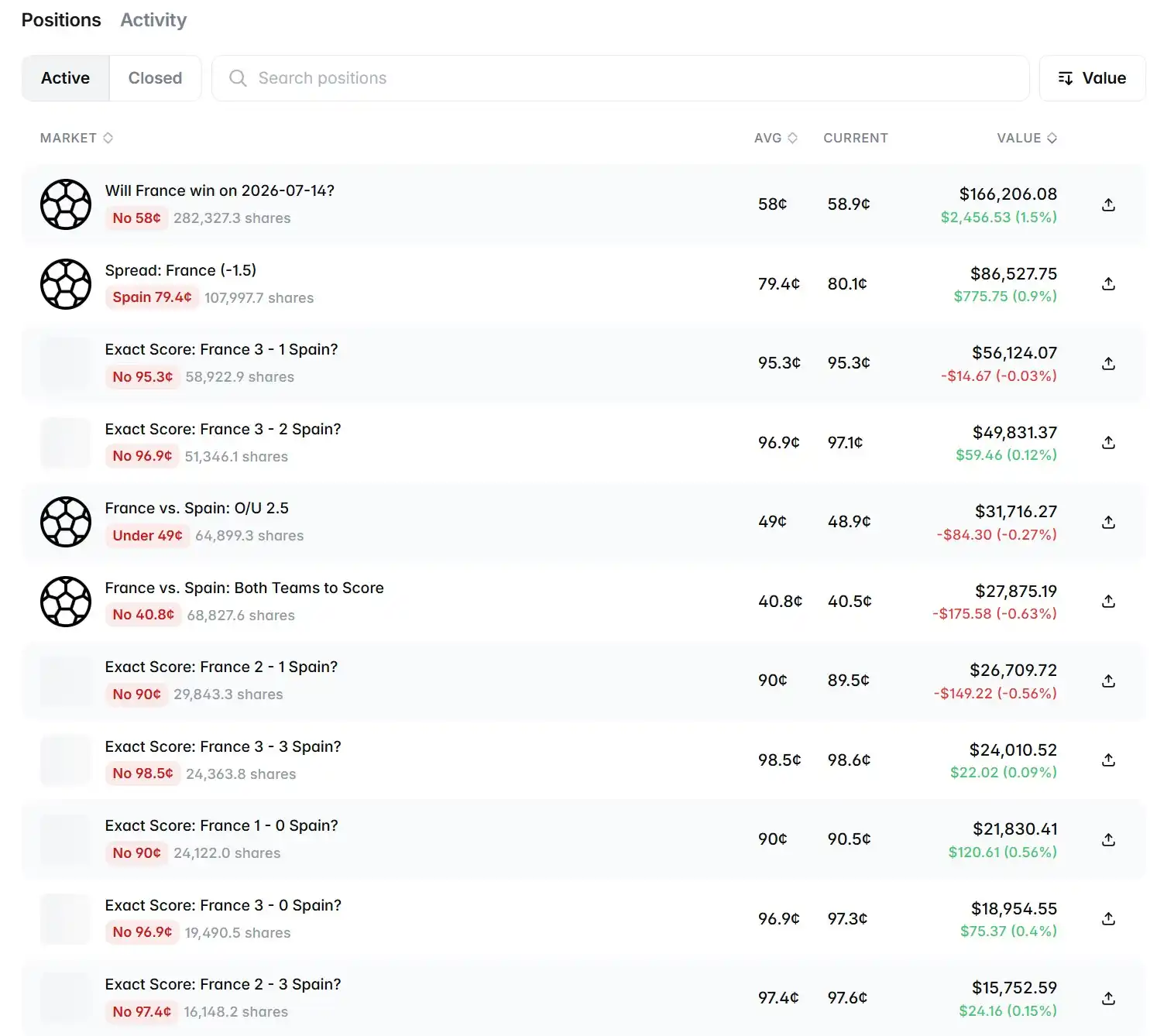
As of July 13, the account had made 139,617 predictions and held open positions worth about $606,100. Those positions were concentrated almost entirely on the July 14, 2026 FIFA World Cup semifinal between France and Spain.
One of the disclosed bets was about $160,000 on France to lose. MarsBit said the account also took positions across multiple exact-score markets, mostly buying NO, with targeted returns in the 5% to 10% range.
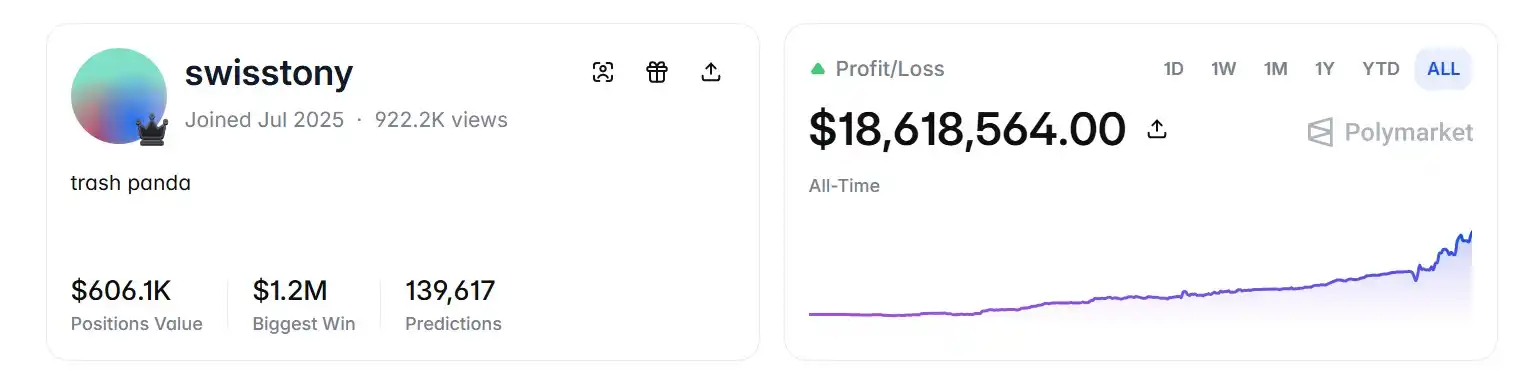
The account’s win rate was listed at 52.9%, with more than 245,000 total positions and trading volume in the hundreds of millions of dollars. The report placed those figures in Polymarket’s top tier.
MarsBit cited public research saying that most retail addresses lose money over time, while a small number of high-frequency and systematic accounts generate sizable positive returns through scale. In swisstony’s case, the article said a moderate win rate was amplified by very high trading frequency and position management, producing a positive EV edge.
About 380 trades a day
Since the account was created around a year ago, it has completed 139,617 prediction actions. That works out to about 380 trades a day and roughly 16 an hour on a round-the-clock basis.
Based on that activity level, the source article said the account was likely running an API-driven high-frequency quantitative bot. Its bio reads “trash panda,” a reference the article used to describe a strategy built around extracting profit from noisy data and small pricing gaps on Polymarket.
Seventeen trades earned more than $1 million
The account’s profit history shows 17 trades with gains above $1 million. The largest came from a June 25 Germany match result bet.
In that trade, the whale bought NO and made $2,221,241, for a return of 111.67%. Screenshots cited in the report showed generally high ROI, favorable entry prices, and position sizes that were often in the $400,000 to $1 million range.
The account frequently bet NO against teams the market appeared to overprice, including Germany, Paraguay, England and Japan. Entry prices were mostly between 35.8¢ and 53.7¢, implying market win probabilities of about 46% to 64%, while the actual outcomes were losses or non-wins for those teams.
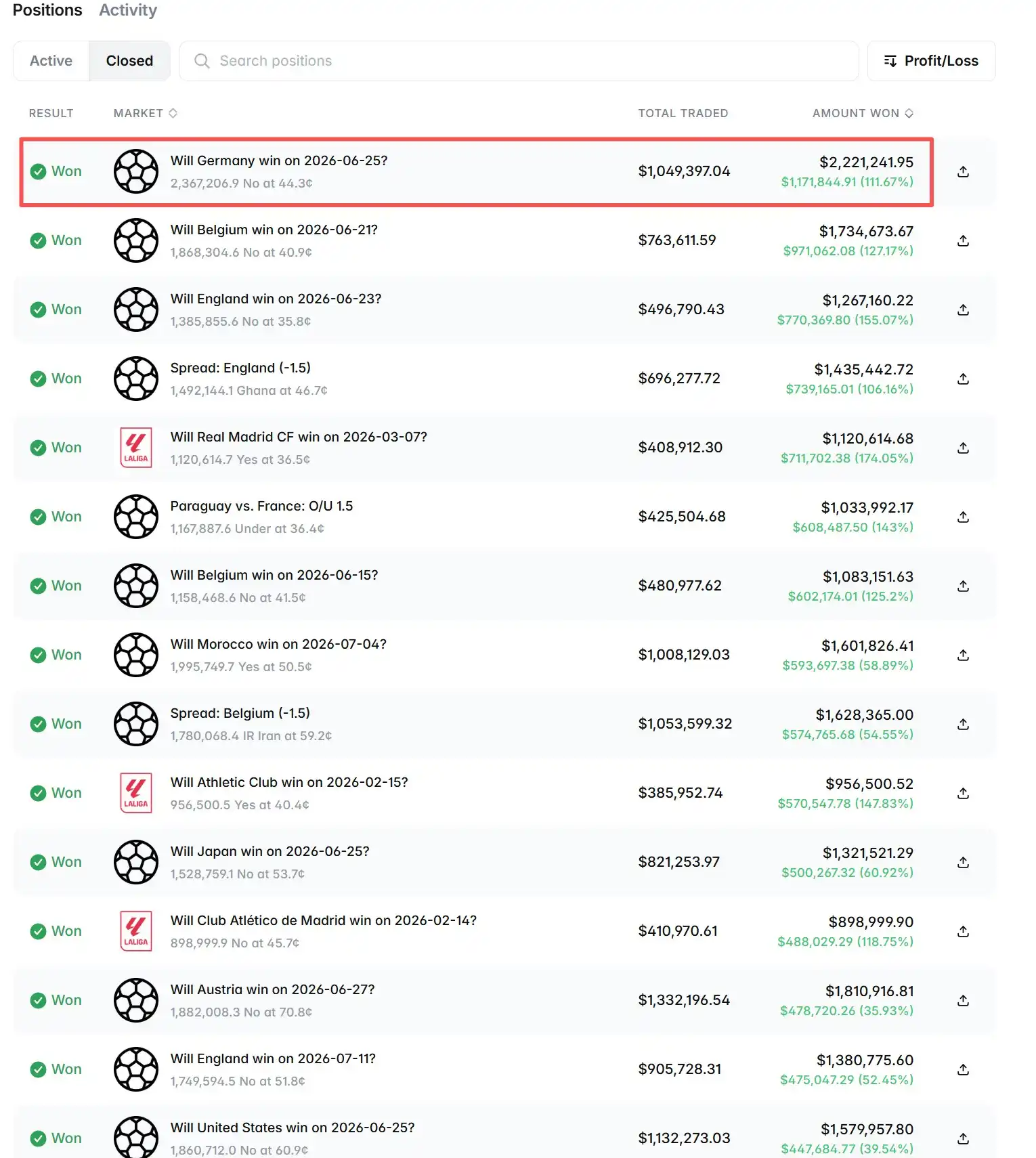
The article described that pattern as a contrarian strategy.
Small stakes on long-shot outcomes
The account also used smaller amounts to buy into very low-probability outcomes. In one example cited by MarsBit, entry prices ranged from 0.2¢ to 1.2¢, implying probabilities of just 0.2% to 1.2%. Position sizes were mostly only a few thousand dollars, yet each trade generated more than $100,000 in profit.
These were outcomes the market had treated as nearly impossible. When they happened, the account was able to turn a very small cost basis into a large payoff.
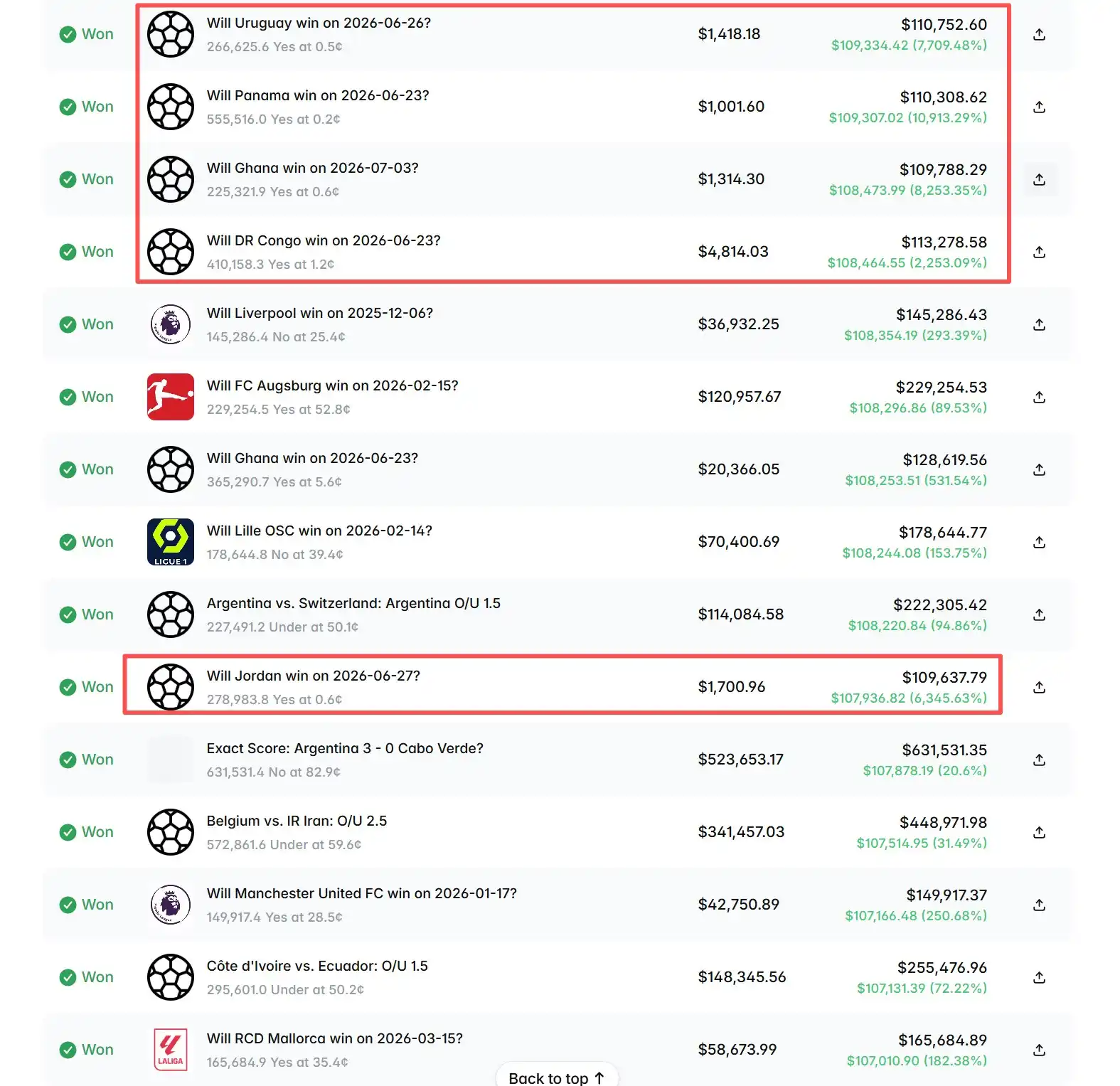
The report said most bets of this kind still lose because the probabilities are genuinely low. But occasional hits can lift total profit sharply without putting much capital at risk on each attempt.
Two-track trading approach
MarsBit’s overall read was that the account’s automated system may be covering a wide range of niche and low-liquidity markets, where more severe mispricing can appear.
It described a two-track strategy: large contrarian positions against overvalued favorites, and small positions on extreme long shots. The first side delivers bigger and steadier profits, while the second can raise overall returns through outsized payouts.