


Pop Mart’s earnings adjustment is still playing out. In a research note dated Oct. 28, JPMorgan said the company’s revenue for the third quarter of 2026 fell 45% to 50% from a year earlier. Revenue in China dropped 25% to 30%, while declines in overseas markets, including Asia-Pacific, the Americas, and Europe, were more pronounced.
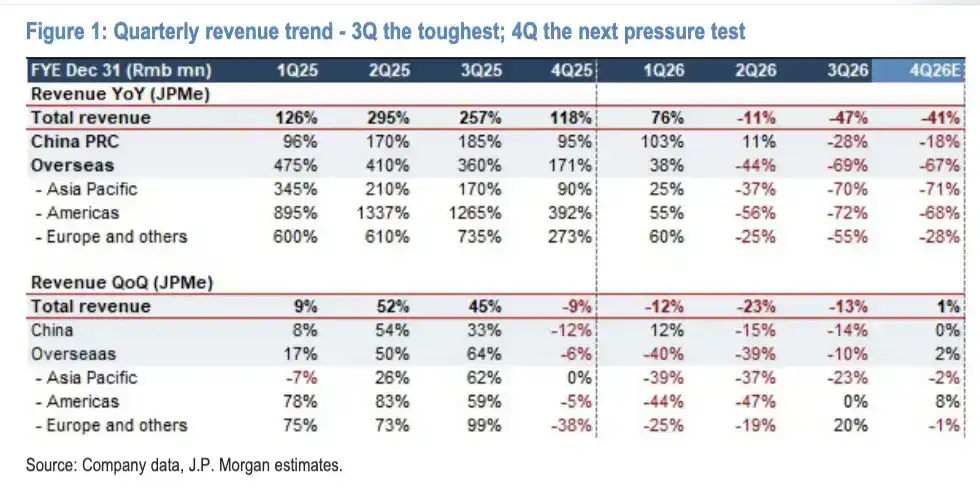
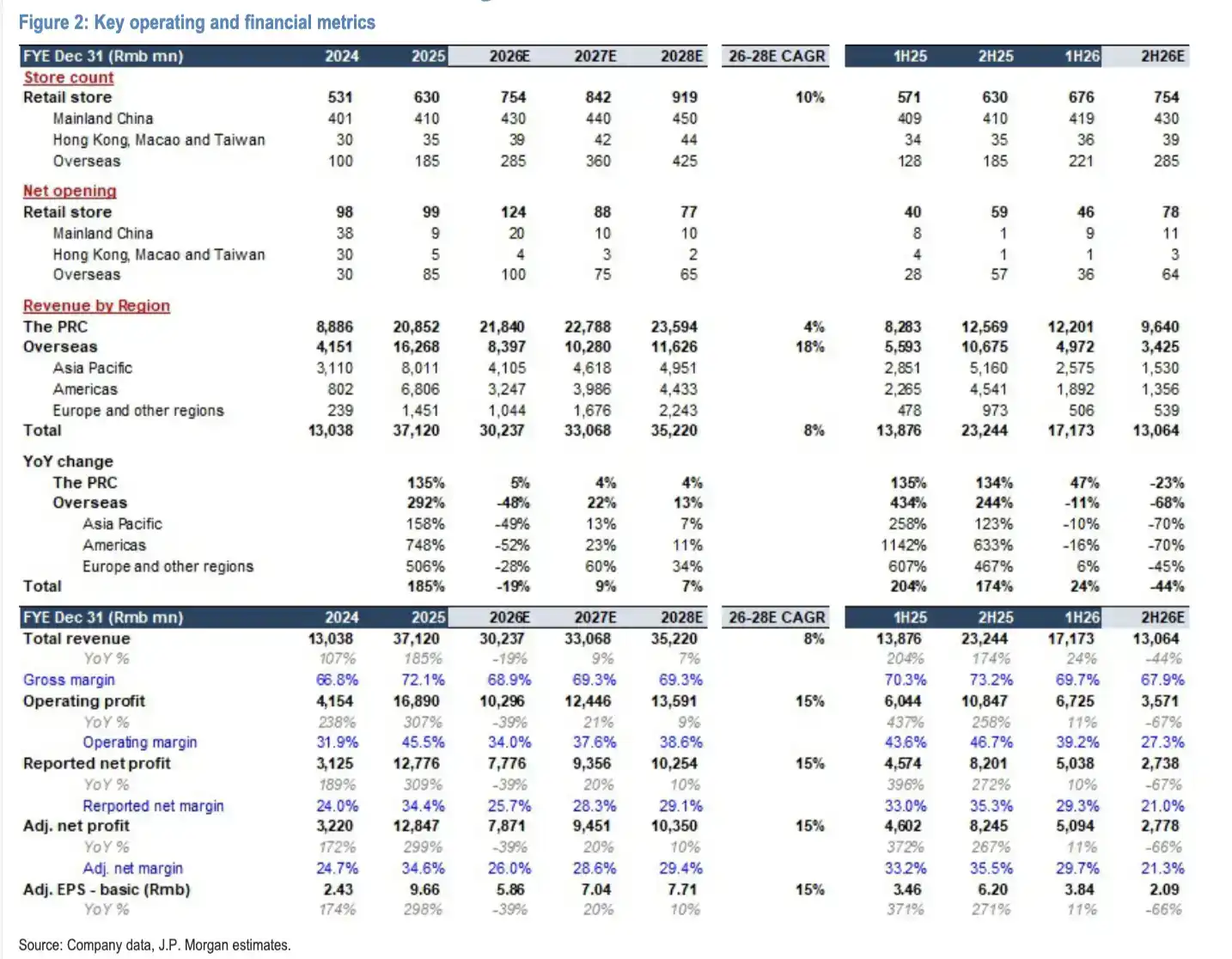
The result came in weaker than JPMorgan’s earlier forecast for a 37% decline and was close to the lower end of the buy-side expectation range cited by the bank. JPMorgan cut its target price on Pop Mart to HK$100 from HK$110, maintained an Underweight rating, and lowered its 2026 adjusted net profit forecast to RMB 7.871 billion from RMB 9.341 billion. That implies a cut of about 16% and a decline of about 39% from 2025.
Fourth-quarter sales stabilization is the near-term focus
Because the third quarter faced a high year-earlier base, sequential performance in the fourth quarter may say more about the near-term operating trend than the year-over-year decline alone.
JPMorgan expects fourth-quarter revenue of about RMB 6.56 billion, down roughly 41% year over year and up about 1% from the third quarter. Within that, China revenue is expected to be broadly flat sequentially, while overseas revenue is projected to rise about 2% from the prior quarter. In other words, the bank’s base case does not assume a strong seasonal rebound.
Management was more upbeat, according to the note. The company expects fourth-quarter revenue in China to be roughly flat sequentially with slight growth, and still sees full-year growth staying positive. Overseas revenue is expected to increase sequentially as the fourth-quarter peak season begins, though Europe still carries some uncertainty.
The regional split is also visible in JPMorgan’s full-year forecast. The bank expects 2026 China revenue of about RMB 21.84 billion, up about 5% year over year, and overseas revenue of about RMB 8.4 billion, down about 48%. Total revenue for the year is projected at RMB 30.237 billion, down about 19%.
For 2027, JPMorgan still models a mild recovery, with revenue rising about 9% and adjusted net profit increasing about 20%. That view depends on better execution overseas and a gradual stabilization in sales and margins.
Slower sales are putting more pressure on costs
As revenue cools, expense pressure is becoming more visible. Management expects gross margin in the second half of 2026 to decline by no more than 2 percentage points from the first half, while the expense ratio rises and net margin falls.
Management attributed the pressure on gross margin to two factors. First, overseas revenue now makes up a smaller share of the mix, even though overseas operations carry higher gross margin than the domestic business. Second, the company has adjusted prices in some overseas markets to stay competitive. Management said those price changes were not driven by inventory clearance.
Store-related costs are harder to pull back quickly. New overseas stores add labor, rent, and fit-out expenses. When revenue falls, those relatively fixed costs take up a larger share of sales and weigh more heavily on margins.
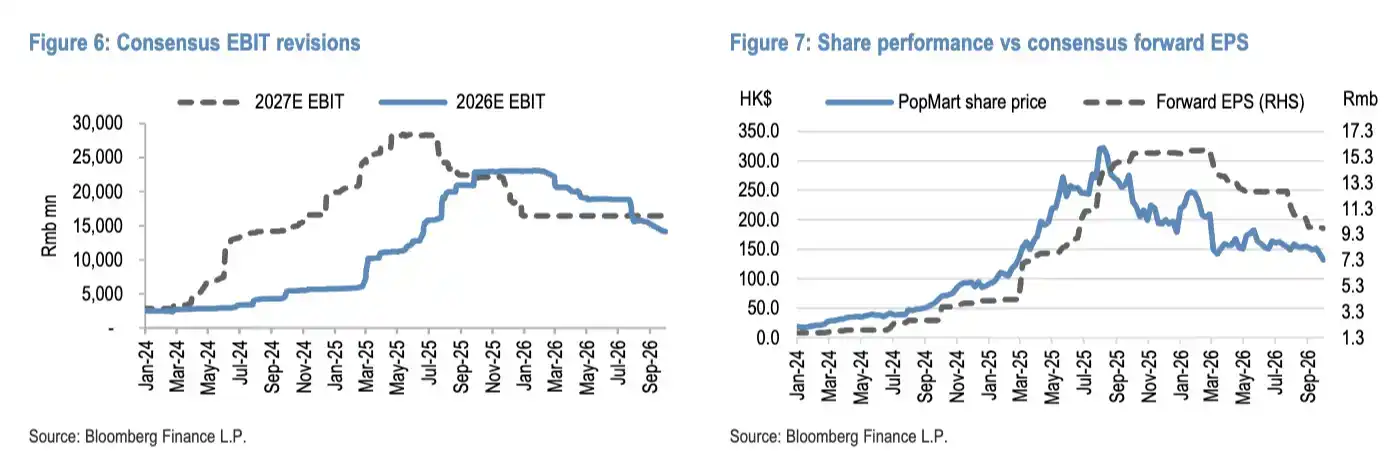
JPMorgan expects second-half adjusted net margin at about 21.3%, down from 29.7% in the first half. For the full year, it sees adjusted net margin at about 26%, versus 34.6% in 2025. The bank’s 2026 adjusted net profit forecast is also about 26% below the Bloomberg consensus cited in the note, showing a clear gap in margin expectations.
Flagship store expansion is adding traffic, but also raising the bar
Against that backdrop, flagship stores are serving as a customer acquisition tool while also increasing the need for operating efficiency.
Pop Mart is accelerating its overseas flagship rollout. Its Paris flagship opened in September, and the London store has entered trial operations. As of the end of September, the company had more than 100 stores in the United States. Projects in reserve include New York, Milan, and additional flagship stores in the U.S. and Paris.
Some domestic flagship stores have already shown stronger traffic pull. Management said October flagship store sales were still up by a double-digit percentage from August. Average monthly foot traffic was more than twice the average level of the company’s top 50 stores, with higher new-customer contribution and conversion rates. Some flagship stores generated more than RMB 10 million in sales in their first month.
Still, isolated flagship store performance has yet to prove it can translate into returns across the broader store network. If another strong IP cycle does not arrive soon, the key test for the expansion strategy will be whether larger stores can keep generating enough sales to cover the added cost base.
Inventory is improving, and the supply chain is being reworked
Inventory was one of the more constructive signals in the update. Management said total inventory peaked around May, started to decline in August, and had shown a clear downtrend by the end of September. The company reiterated that it is keeping tight control over inventory and has no plan for large-scale promotions.
Its supply chain is also being adjusted. Pop Mart has set up a global procurement team at headquarters, replacing the previous model in which four major regions sourced separately. Under the new setup, regional teams submit demand and headquarters coordinates procurement, with the aim of reducing duplicate stocking of popular products and mismatches in supply and demand across regions.
Cross-region inventory transfers have also increased, and warehouses in China are supporting overseas supply. U.S. e-commerce orders are already being fulfilled locally, while Europe is targeting local fulfillment by year-end. Those steps could improve inventory and logistics efficiency, though the outcome still depends on a recovery in end demand.
Member operations and new IPs are moving forward, but the post-Labubu gap remains in focus
On the consumer side, China showed some improvement. In the third quarter, traffic at retail stores rose from a year earlier, the number of new customers posted double-digit growth and accelerated from the second quarter, repeat purchase rate was broadly flat year over year, second-year retention improved, and the number of members buying across IPs and categories increased.
Overseas membership systems are still being built out. Aside from two or three markets, the membership system has already gone live in other markets, and member acquisition has been added to store operations and assessment metrics. Even so, the share of member sales in Asia-Pacific remains below China, and cross-channel purchasing is less mature.
On the product side, Pop Mart is broadening its IP lineup. Twinkle Twinkle performed well in the third quarter. Dimoo gained attention in Europe and the U.S. through a collaboration with Pixar. Molly’s 20th anniversary campaign drew attention in Bangkok, and Crybaby plans to open its first themed store there. In the third quarter, the top six IPs together contributed more than 60% of Asia-Pacific sales.
Those developments show that multi-IP operations are still advancing. At this stage, though, there is not enough evidence to say any one of them can replicate Labubu’s sales scale.
Content and new categories are still early, and valuation remains cautious
Contribution from content and new business categories will also take time. The Labubu film is still at the script stage, and animation projects are under discussion with overseas partners. Management expects no major increase in content spending in the near term. Dessert shops, POPOP stores, and Hirono lifestyle stores are being rolled out on a small scale, while progress in the building-block category has been slower.
JPMorgan’s HK$100 target price implies 12x its 2027 forecast price-to-earnings ratio, based on its projected 2027 earnings per share multiplied by a 12x valuation multiple. The bank said it used a multiple close to those of China discretionary consumer stocks, reflecting a cautious view on slower growth and margin pressure.
The variables that still need to be tested are now fairly clear: whether fourth-quarter sales can stop declining sequentially, whether overseas stores can improve returns, and whether IPs beyond Labubu can keep expanding their contribution to revenue. Lower inventory offers one sign of improvement. Whether earnings expectations can stabilize will depend on how quickly sales recover and costs are absorbed.