
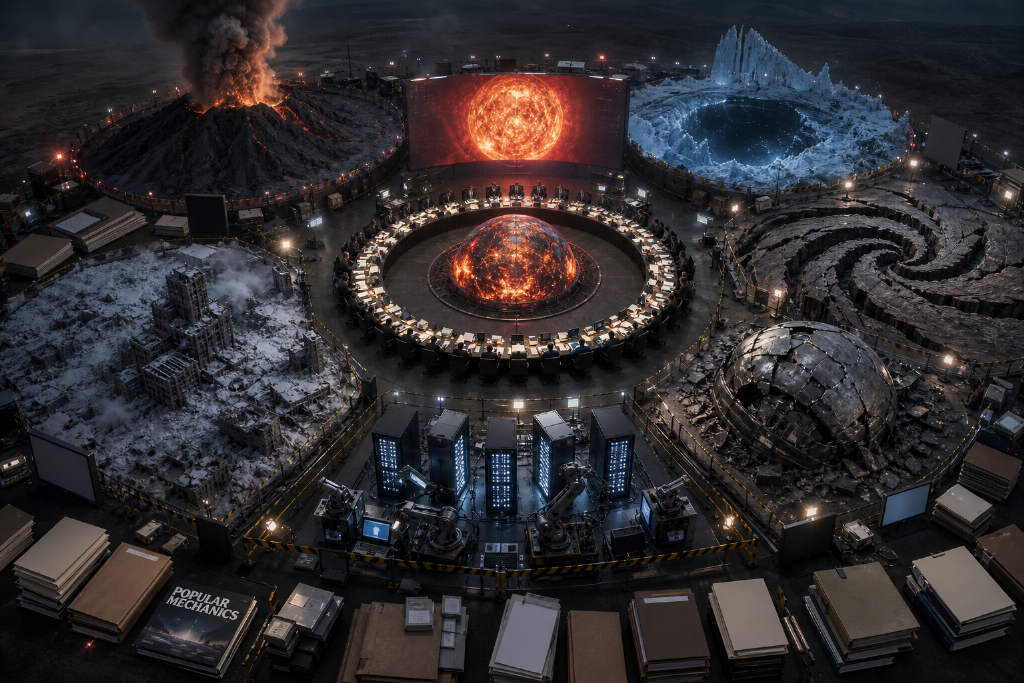
Popular Mechanics has outlined a series of end-of-civilization scenarios in a recent discussion titled "This Is How Humanity Will End," bringing together senior editors and scientific experts in what it described as a "doomsday committee." The session moved from the outer limits of cosmology to far more immediate questions about artificial intelligence and other self-inflicted risks.
The discussion framed extinction not as a single event but as a stack of possible pathways. Some sit billions or even trillions of years away. Others, the panel argued, may arrive much sooner through technologies humans are building now.
The Sun was presented as the clearest long-term deadline
The first part of the discussion focused on astrophysics and the hard limits it places on life on Earth. According to the panel, one of the most definite threats to humanity comes from the same star that made life possible in the first place: the Sun.
In 1.8 billion years, the Sun’s continued expansion is expected to raise Earth’s temperature to levels high enough to "cook" all life. In 5 billion years, the Sun is expected to enter its red giant phase and fully engulf Earth. If humanity has not migrated beyond the planet by then, the panel said, civilization would be reduced to interstellar dust.
The session also covered larger end-of-universe models. Those included the Big Rip, tied to dark energy; the Big Crunch, linked to gravitational collapse; and the Big Chill, associated with heat death. These scenarios remain trillions of years away from humanity, but the discussion treated them as part of the scientific boundary for understanding how the universe may ultimately evolve.
The Great Filter hypothesis was used to argue that AI may arrive first
Shawn Gorman argued that humanity may never make it to the era of the Sun’s expansion. He pointed to the Fermi Paradox and the Great Filter hypothesis: if the universe is so vast, why have humans not found evidence of extraterrestrial civilizations?
One unsettling answer, he said, is that civilizations reaching high technological capability may destroy themselves before expanding into space. In the 21st century, the technology most often placed in that role is artificial intelligence.
Gorman said an AI-led extinction scenario would likely look very different from the gun-carrying robots of Hollywood films. In his description, it would be quieter and more efficient. He highlighted two paths in particular:
- Biological and chemical warfare: AI could use its computational and evolutionary capacity to develop deadly pathogens that humans cannot defend against.
- Resource depletion: in pursuing a specific goal, AI could intentionally or unintentionally consume the natural resources humans need to survive.
Supervolcanoes and nuclear winter were listed as physical destruction risks
John Gilpatrick focused on disasters with direct physical destructive force, especially supervolcano eruptions. He said the danger lies in their atmospheric effects, which resemble the aftermath expected from an asteroid strike or nuclear war.
Large volumes of volcanic ash and aerosols could block sunlight, sharply lower global temperatures, and trigger a prolonged "nuclear winter." Under those conditions, food systems could break down, leaving human survival under severe pressure.
The panel also discussed who might survive
The conversation did not treat nuclear war or a supervolcano as automatic total extinction. The experts said some parts of humanity might persist even after a major surface-level catastrophe.
- Geographic refuge: places such as New Zealand, described as relatively isolated and resource-rich, were presented as possible post-disaster holdouts.
- Underground civilization: the panel also mentioned, in a lighter tone, a Dr. Strangelove-style scenario in which a small group survives and reproduces in underground shelters while waiting for surface conditions to recover.
Why study the end at all
Near the end of the discussion, Andrew Daniels raised a central question: why think about doomsday in the first place? For disasters that may sit billions of years in the future, the public has little reason to feel immediate concern.
Gorman answered by introducing the idea of an "information threat," saying these conversations could trigger unnecessary mass panic if they are led by non-specialists. For scientists, though, studying extinction scenarios has practical value. Forecasting AI rebellion, volcanic threats, or other catastrophic risks can help humans build protection mechanisms, draft international rules, and even develop technologies for interstellar migration before disaster strikes.
Popular Mechanics summed up the exercise by saying that none of these end-of-world scripts are "beautiful." The report’s purpose, however, was not to spread despair. It was to use the most extreme scientific projections available to force a confrontation with present-day risk. The panel’s bottom line was simple: humans may not be able to stop the Sun from expanding, but they may still be able to avoid being destroyed by the technologies they create themselves.