Polymarket Beginner Dilemma: Emotional Trading and Information Gap
Since the World Cup kicked off, Polymarket's champion prediction market alone has seen cumulative trading volume exceed $3 billion, yet a large portion of users are trial-and-play newcomers. Most beginners lack stable strategies and reference signals, relying on late-night group chatter and impulsive bets, often waking up to zeroed accounts. In contrast, experienced players leverage comprehensive analysis of team form, injury news, odds changes, etc. PPP (Prediction Market Analysis Tool) was built to solve the pain points of "can't see all, can't keep up, slow execution."
Signal Monitoring and Address Analysis: Rapidly Identifying Trading Opportunities
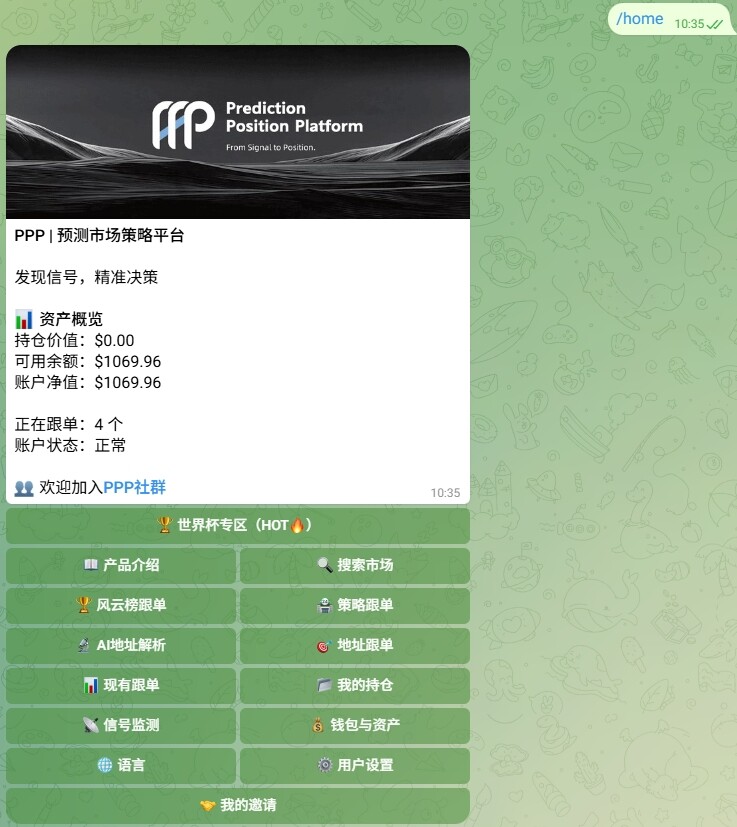
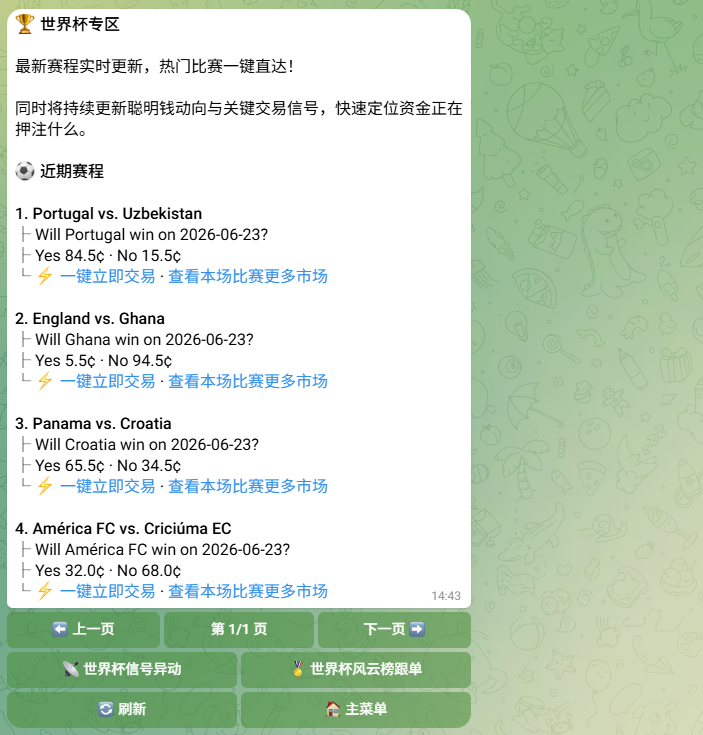
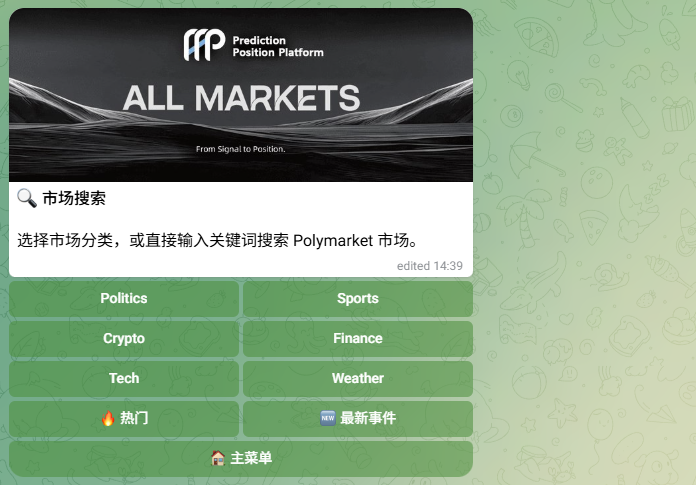
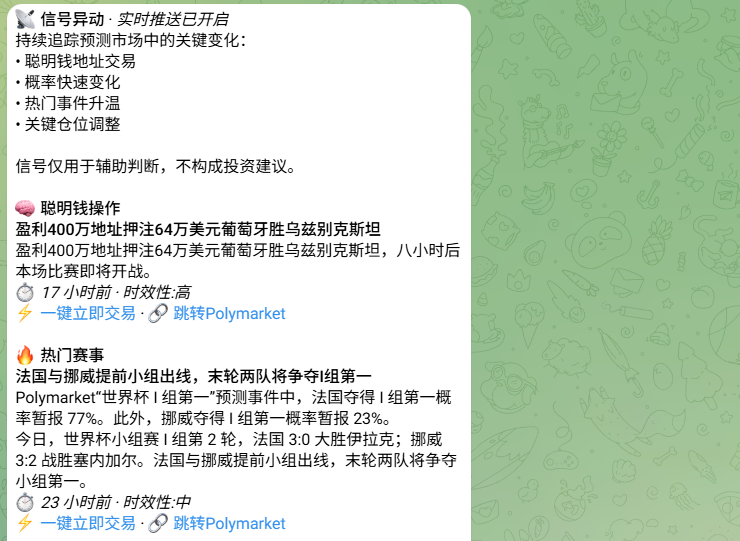
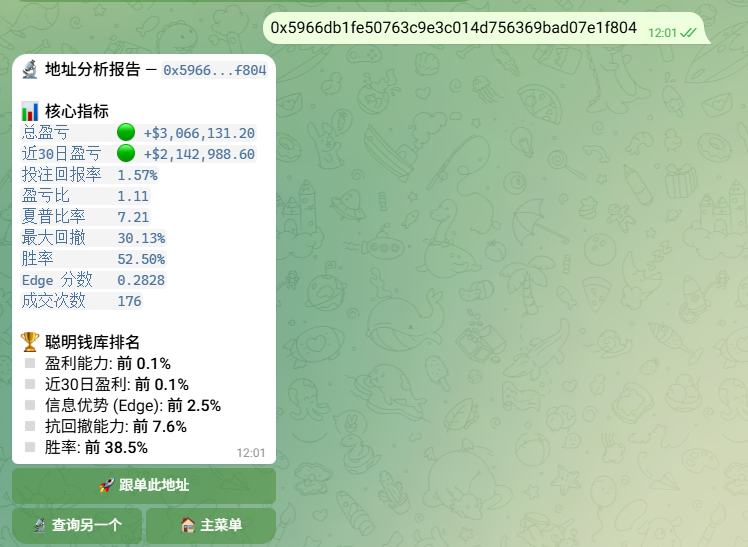
PPP offers a "World Cup Zone" displaying upcoming matches and hot information, allowing users to participate with one-click trading. Additionally, PPP supports event search across 8 categories (politics, sports, crypto, finance, tech, weather, trending, latest). The core feature "Signal Monitoring" helps users quickly discover potential opportunities. Users can input any wallet address to run PPP's algorithm model, which analyzes historical performance metrics: total P&L, win rate, profit/loss ratio, Sharpe ratio, maximum drawdown, etc. Simultaneously, the input address is compared against PPP's internal smart money database for multi-dimensional reference. This addresses two key problems: quickly searching for new opportunities and comprehensively evaluating known addresses.
Strategy Square and Trading Leaderboard: Multi-Dimensional Filtering for Follow-Worthy Addresses
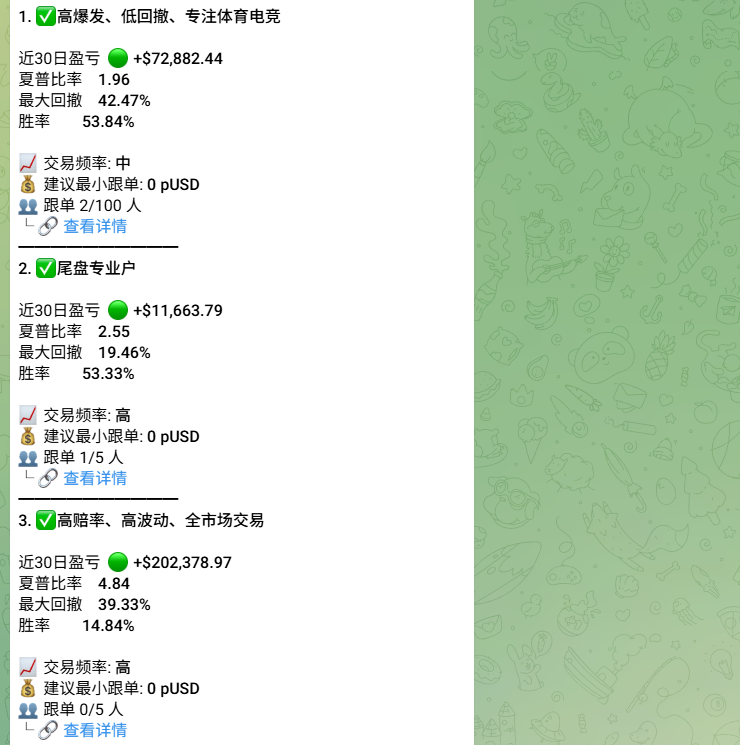
Simply looking at profit rankings often overlooks drawdown and position style. PPP built its own address database, deriving the "Strategy Square" and "Trading Leaderboard." The Strategy Square uses metrics such as profit, win rate, drawdown, activity, holding cycle, market participation quality, and fund behavior to model and analyze addresses, combined with manual review to exclude accidental gains and non-repeatable behaviors. Users can view address details (e.g., "Late Game Specialist" label) and set copy trading parameters like follow amount, maximum position ratio, and automatic take-profit. The Trading Leaderboard focuses on recently outstanding traders, presenting 30-day P&L, Sharpe ratio, max drawdown, win rate, etc., to help users catch short-term opportunities. Each address is tagged (e.g., "Recent High Win Rate") to help users assess stability and style compatibility.
Custom Copy Trading and Position Management: Non-Custodial Model for Fund Security
PPP supports users in adding custom copy trading addresses, preserving personal judgment. After executing a copy trade, users can manage all positions in the "Active Copy Trading" panel, adjusting amounts, risk parameters, or stopping. Historical positions and P&L data are available for evaluating address performance. For fund security, PPP adopts a non-custodial wallet model: the platform does not hold user assets nor requests private keys or seed phrases. Users can export their wallets and manage private keys independently. PPP only provides address monitoring, signal aggregation, copy trading execution, and notification services; trading funds always remain under user control.
Conclusion: Leverage Tools to Reduce Beginner Cost
The prediction market fluctuates rapidly, with active addresses switching between events. Ordinary users find it difficult to track many accounts long-term and to distinguish whether a profitable address stems from stable strategy or luck/extreme positions. PPP continuously filters addresses based on profit, win rate, drawdown, etc., helping users discover stable, trackable addresses without needing to stare at charts all night. Leveraging tools like PPP may be the most cost-effective way for Polymarket beginners to evolve.