
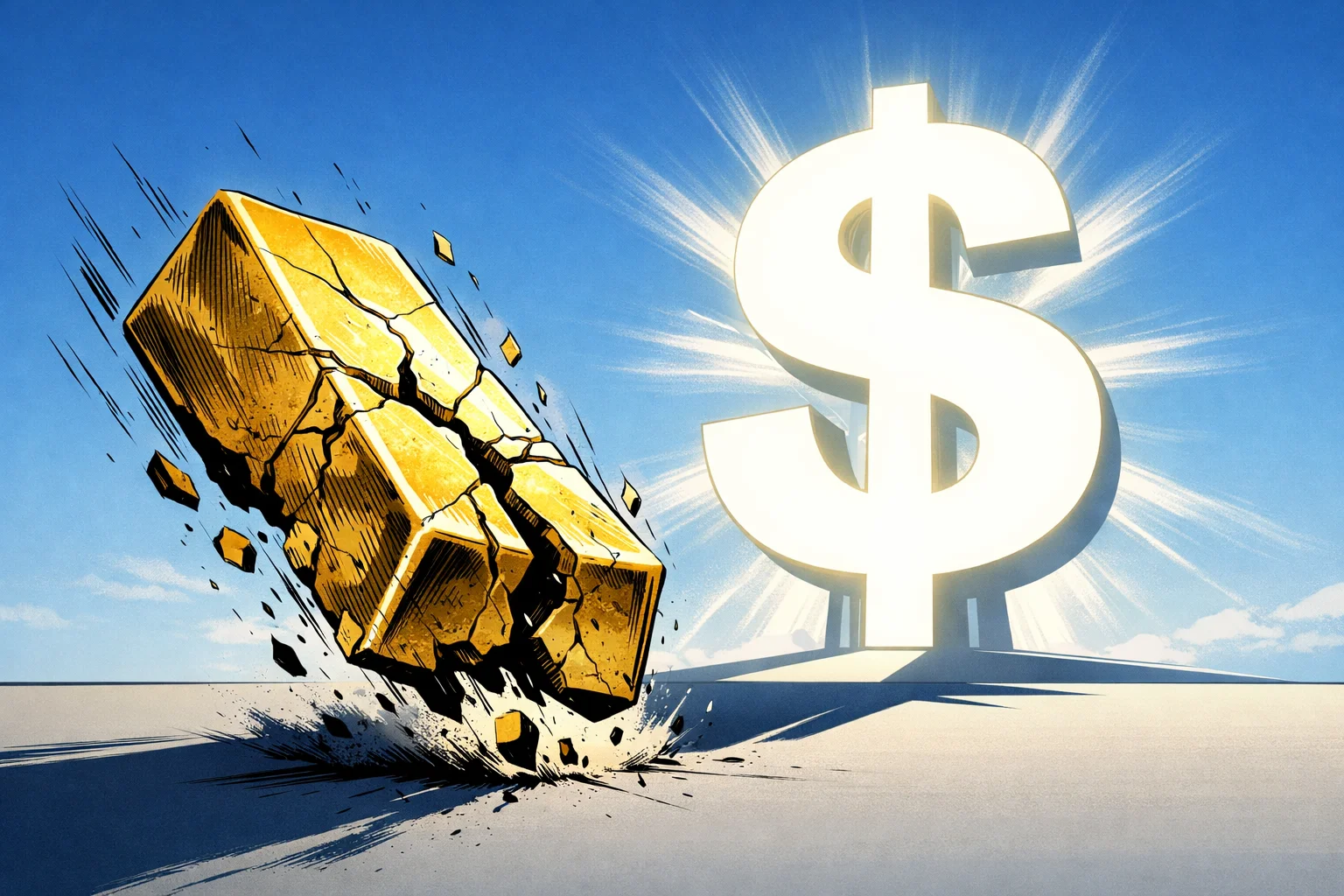
Spot gold stood at $5,006 at 9 a.m. Beijing time Tuesday. Two hours later, the price crashed below $4,800, a drop of more than 4%. Silver fared worse, plunging from $89.5 to under $74, losing nearly 17% of its value. The selloff erased about $1.4 trillion in gold market cap — roughly the combined value of Berkshire Hathaway and AMD — while silver shed $889 billion, equivalent to the market cap of JPMorgan Chase. The reversal followed a weak two-day bounce.
Three structural drivers behind the failed rebound
1. Dollar strength returns. The dollar's recent weakness had been a key driver for gold. But markets now see that weakness as "overdone." U.S. economic data remain resilient, making an early Fed rate cut unlikely. Treasury Secretary Bessent explicitly endorsed a strong-dollar policy, forcing a repricing: if the dollar rebound isn't temporary, gold will stay under pressure.
2. Hawkish Fed signals. Trump's nomination of Kevin Warsh to lead the Fed last week already dented the "continuous rate cut" narrative. Strong economic data now reinforce expectations that the Fed will proceed cautiously. Lower odds of rate cuts directly hurt non-yielding gold.
3. Technical resistance. Gold's free fall from the all-time high of $5,595 last Friday saw each bounce capped at lower highs. Today's failure near $5,000 confirms a short-term downtrend, with traders now treating $5,000 as resistance rather than support — a psychological flip that reinforces selling pressure.
Long-term outlook remains intact
Most analysts still see a solid long-term case for gold as a safe haven. But in the near term, catalysts for a fresh rally are sparse. Major banks maintain year-end targets: JPMorgan at $6,300, Goldman Sachs at $5,400, Deutsche Bank at $6,000. Yet target prices are for December; margin accounts need to survive until then.