Prediction market tokens were the weakest narrative category over the past seven days, even with the U.S. midterm election one day away.
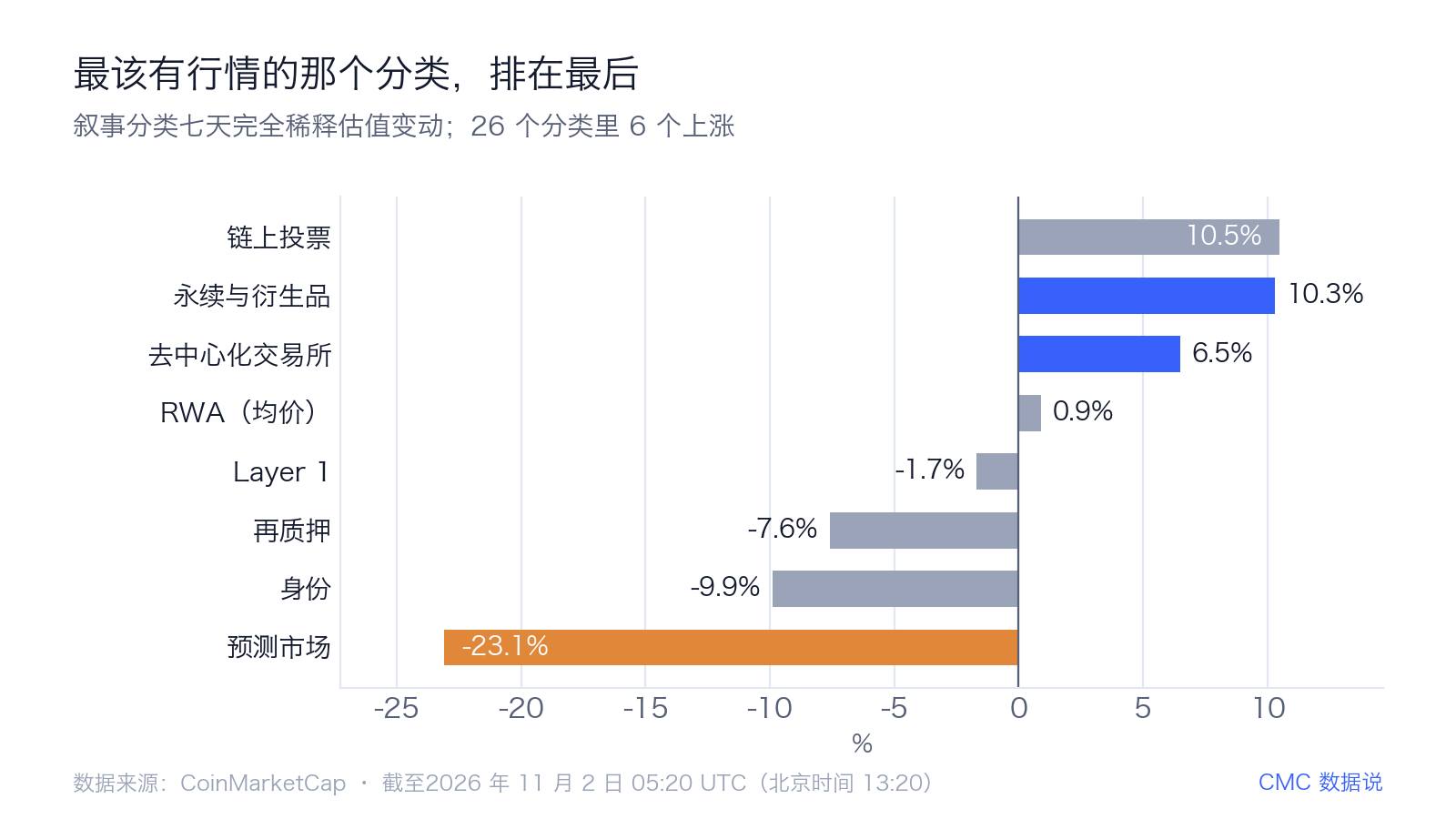
In the latest edition of CMC Data Talk, CoinMarketCap Head of Research Alice Liu wrote that, as of 13:20 Beijing time on Nov. 2, 2026, or 05:20 UTC, the prediction market category was down 23.1% on a seven-day fully diluted valuation basis. That put it last among 26 narrative categories. It was also the second straight edition in last place, and 3 percentage points worse than the previous Friday.
Liu said Nov. 3 is the U.S. midterm election, which she described as the busiest trading day of the year for prediction markets under normal conditions. Still, the category’s token prices did not rise into that event. She did not include odds from any prediction platform in the piece, saying the column uses only CoinMarketCap’s own data. Her point was narrower: attention and business activity did not move together this time.
No top-50 token cleared the outperformance threshold
Bitcoin was quoted at $78,164, up 0.59% over 24 hours and down 2.25% over seven days. It sat in the 19th percentile of its 30-day range. Weekend trading was quiet, and none of the top 50 tokens reached the report’s outperformance line.
Across 38 valid samples, the average one-day move was a decline of 0.78%, while the median was down 0.43%. Dispersion was narrow, at just 1.68 percentage points, which pushed the outperformance threshold up to +7.22%. The best single move on the day was only +2.84%. In the previous Friday edition, the leading token had cleared that line by 9 percentage points.
That is why Liu said the more important table on the day was not the price leaderboard, but the category table.
Prediction markets ranked last among 26 categories
The narrative rotation section ranks categories by seven-day fully diluted valuation performance. Prediction markets fell 23.1%, the worst reading in the group of 26.
Liu noted that breadth improved on paper. Six categories were up over seven days, equal to 23.1% of the total, compared with four categories, or 15.4%, in the previous Friday reading. But the rotation line labeled that improvement as concentrated in a few leaders, because the gap between first place and fifth place was 221 percentage points.
OKB led the day, but did not trigger a standalone signal
Because no token crossed the outperformance line, first place on the daily board was only a relative ranking and did not produce a separate analytical signal.
OKB, ranked No. 38 by market capitalization, traded at $113.80. It rose 2.84% over 24 hours, beating the top-50 average by 3.6 percentage points. It was up 5.27% over seven days, and volume jumped 107.5%, more than doubling.
Liu said the column’s screening model has a hard threshold: a move must clear the outperformance line before it can trigger a dedicated read. Since nobody reached that level, there was no extra judgment attached to the day’s top gainer. It was simply a rank.
The only outside information she mentioned was a report saying the number of listed companies opposing the tokenization of their own shares on a certain exchange had reached 50. She said the column could not verify that claim.
Liu tied that point back to her Oct. 29 edition. In that note, 14 of the 48 tickers on the community hot list were tokenized U.S. equities, but each had a market capitalization between $1 million and $101 million, leaving attention two to three orders of magnitude ahead of capital. The new element now, she wrote, is a third party: the companies being tokenized have started speaking up themselves. Her earlier question was when money would follow. Now she added another one: whether issuers agree at all.
TRON ranked third on the day at $0.3140, up 1.45% over 24 hours and down 4.80% over seven days, while its volume fell 69.3%. Liu said a top-three finish driven by shrinking volume mainly says something about the weekend tape.
Two of the top three categories were lifted by a single token
Breaking down the top three categories made the structure clearer.
On-chain governance was up 10.5% over seven days and ranked first. But it sits outside the top-50 universe and is a small-cap category. The rotation framework itself says to treat that kind of move as noise until breadth confirms it, and Liu said she handled it that way.
Perpetuals and derivatives rose 10.3%, ranking second. Within that basket, Hyperliquid traded at $87.63, up 15.1% over seven days and down 0.32% on the day. The other two components moved the other way: Aster traded at $0.698, down 0.8% over seven days, and Jupiter traded at $0.255, down 8.6% over seven days. One token was up. Two were down.
Decentralized exchanges gained 6.5% over seven days, ranking third. Uniswap traded at $7.22 and was up 4.3% over seven days. Aerodrome traded at $0.63 and rose 1.9% on the day. The third component, PancakeSwap, traded at $1.91 and fell 8.6% over seven days.
Liu said the more important point in that category was the gap between valuation and actual business activity. Daily on-chain volume on Ethereum was $1.22 billion, 49% below its 30-day baseline. Solana posted $443 million, down 70% from baseline. Arbitrum recorded $91 million, down 54%. All three chains were contracting.
Her conclusion was direct: the category was being priced off the valuations of two tokens, not off the business itself.
Zcash outperformed its privacy peers, but no verified catalyst was visible
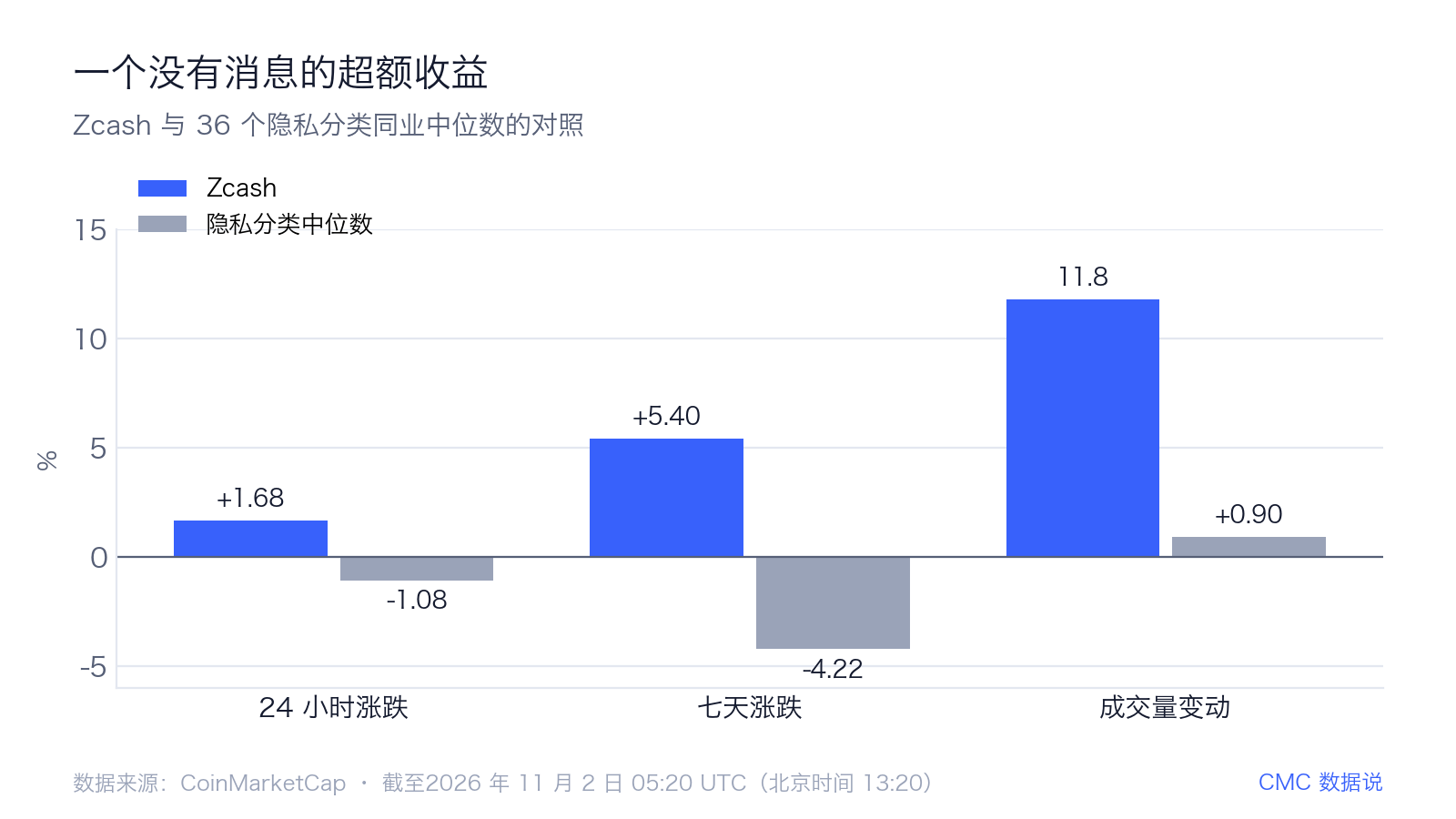
Zcash closed the day at $1,267.64, up 1.68% over 24 hours and 5.40% over the week. Volume rose 11.3%.
It sits in the privacy category, where the screen result was described as weak momentum with capital flowing out. Among 36 liquid peers, the median move was down 1.08% over 24 hours and down 4.22% over seven days.
That left Zcash with excess returns of 2.8 percentage points over 24 hours and 9.7 percentage points over seven days, marked as persistent by the framework. Volume also outperformed, rising 11.8% against 0.9% for the category.
On a longer horizon, Zcash was up 160% over 90 days and down only 3.9% over 30 days.
The problem, Liu wrote, was that the catalyst field was blank. In a three-day window of official updates, the report found no posts from project channels and no verifiable catalyst. What circulated outside official channels was a funding dispute involving stakeholders and an upcoming network upgrade, but neither had been confirmed by the team.
The piece also cited an outside on-chain data point: one institution tracked an address buying 3,052 Zcash spot, worth about $3.8 million, while also opening a 2x long position of 8,000 Zcash on a perpetual venue, worth about $10.2 million. Liu said that information came from outside the column and could not be verified internally, but included it because it completes the picture around a move that lacked a clear reason.
The framework’s durability judgment was that a position-driven rally without news support, inside a category that has not seen capital rotate in, rests on a weaker base than a catalyst-driven move.
Zcash was also the only name besides Hyperliquid in the top 10 that was still up on a weekly basis.
Sentiment fell more than price
The Fear and Greed Index stood at 37. It was 36 the day before, 43 a week earlier, and 67 a month earlier. That is a 30-point drop in one month.
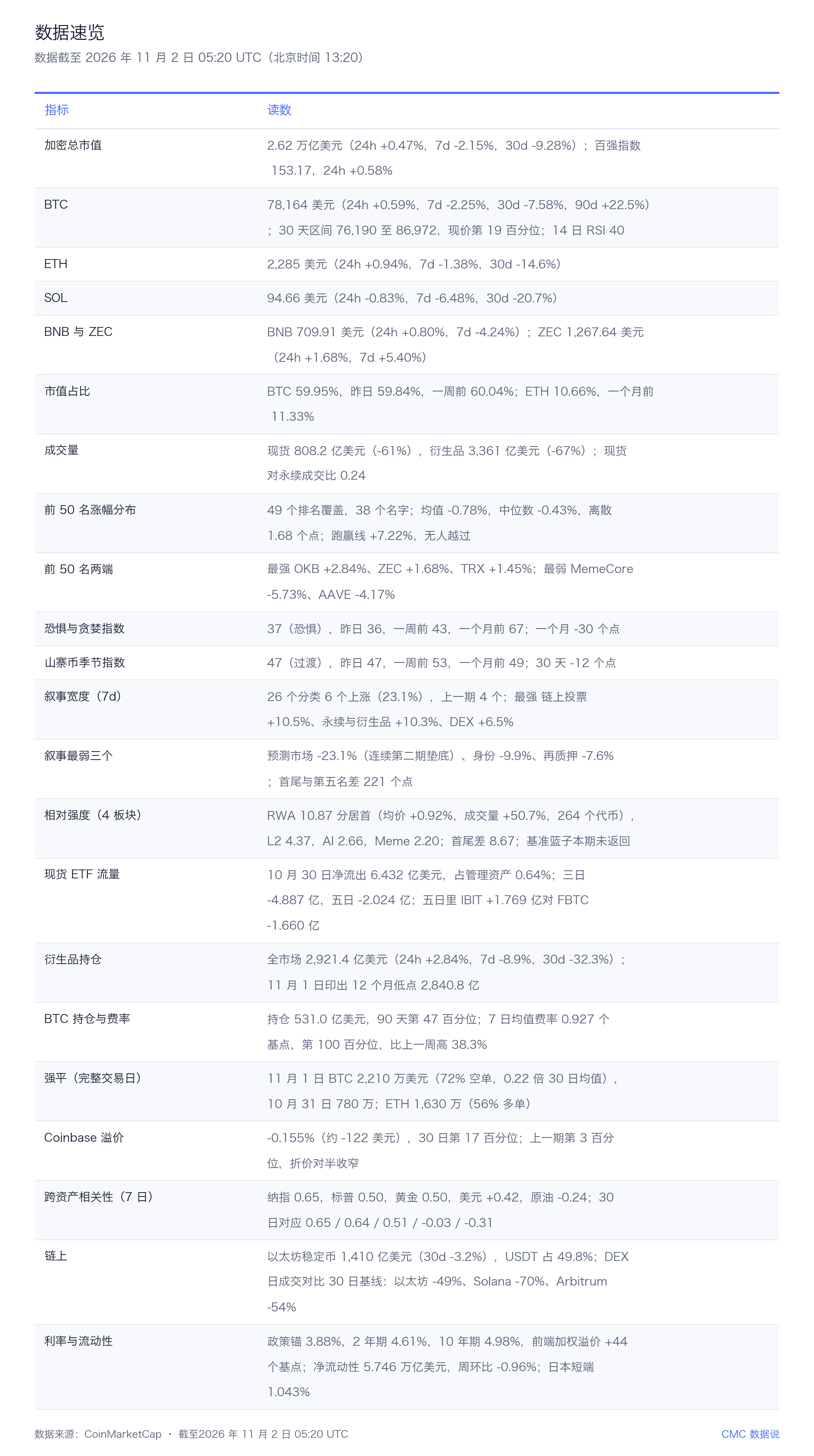
Over the same period, Bitcoin fell 7.58%.
Liu placed those two numbers side by side and argued that expectations, not the asset itself, had been repriced.
The Altcoin Season Index was 47 and labeled transition. It was also 47 the day before, 53 a week earlier, and 49 a month earlier, a 12-point drop over 30 days.
She also flagged a conflict in the current reading. The gold-oil ratio z-score was negative 1.76, which caused the risk-appetite field to be labeled risk-on. But the Fear and Greed Index at 37 was labeled fear. Liu printed both signals and did not force one into a final answer.
Market structure was clearer. Bitcoin was below its 20-day and 50-day moving averages, but above its 200-day moving average. Its 14-day RSI was 40, and the four-hour chart showed a sequence of lower highs. The 30-day low was $76,190, sitting 2.6% below spot. That low was made after last Friday and had not been broken yet. Overhead, a resistance cluster at $80,729 sat 3.2% above spot and had already been tested five times.
Five details from deeper in the tape
Positioning, fund flow and cross-asset data were current as of 05:20 UTC on Nov. 2. Liu highlighted five additional details.
- The biggest decliners were still many of the same names from last week. MemeCore traded at $0.8528, down 5.73% on the day and 13.9% over seven days, while volume rose 40.3%. Aave traded at $133.50, down 4.17% on the day. Worldcoin traded at $0.386 and was down 13.3% over seven days. The identity category fell 9.9% over seven days and ranked second from the bottom. Liu wrote that the names that broke lower have now failed to recover for three straight editions.
- Heat rankings moved back to large-cap majors. The leading categories were Layer 1, two regulation baskets, the 2017-2018 altseason basket, and the U.S. strategic crypto reserve basket. All were mega-cap combinations dominated by Bitcoin and Ether, and all were down 1.7% to 1.8% over seven days. Attention was not on the edge of the market, and the mainstream segment did not rise either.
- Relative strength was led by volume rather than price. In the four-sector composite, RWA scored 10.87 to rank first. But the breakdown showed average price up only 0.92% and volume up 50.7% across a sample of 264 tokens. Its large names were all red: Ondo fell 2.3% over seven days, and two gold tokens fell 2.8% and 2.6%. L2 followed at 4.37, AI at 2.66 and Meme at 2.20, leaving an 8.67-point gap between first and last. Because the benchmark basket did not return in this edition, Liu said the scores can only be read cross-sectionally, not as absolute levels.
- One gambling-themed category was excluded from the main table. It showed a 260% seven-day gain in the rotation column, but its size was only $1.16 billion and the move came from a single token. Liu said she left it out for the same reason as on-chain governance: the sample was too thin.
- Neither of the two screens produced a clean conclusion this time. On the perpetuals side, 200 snapshots were scanned, 176 qualified, 89 were flagged as abnormal, 15 moved into spot review, and five remained at the end. Only SEI had trend support, with open interest up 5.5% and a bearish skew of 0.50. BLUR was blocked because spot data pointed the other way, even though open interest rose 24.6% and funding was negative 0.058%. On the spot side, 2,000 names were scanned, 27 advanced, and seven passed all four gates. The leader, SDEX, rose 22.6%, volume surged 4,167%, and RSI reached 87. The second name, DEXT, rose 14.4%. Neither had a verifiable catalyst.
What the report is watching next
Liu listed the next dates on the calendar.
- Tuesday, Nov. 3: the U.S. midterm election. Monday’s spot Bitcoin ETF flow data will be published on Tuesday on a T+1 basis.
- Wednesday, Nov. 4, at 21:15 and 23:00 Beijing time: October ADP private payrolls and the ISM services index, expected at 54.8 versus 54.9 previously, with the prices component at 75.0 versus 74.0 previously. The next briefing is also due that day.
- Thursday, Nov. 5, at 21:30: initial jobless claims, expected at 195,000 versus 194,000 previously.
- Friday, Nov. 6, at 21:30 and 23:00: October nonfarm payrolls, expected at 65,000 versus 29,000 previously, with unemployment at 4.2% and average hourly earnings up 0.3% month on month, along with University of Michigan consumer sentiment and one-year inflation expectations at 4.7%.
Two rolling questions stand out in the report. The first is what happens to the prediction market category after the vote. It is down 23.1% over seven days and has finished last for two straight editions. If it remains last after the event passes, Liu wrote, the issue would not be the event itself but the category.
The second is whether Zcash can hold its excess return. In Liu’s framing, the move is being carried by positioning rather than news, and that makes it more fragile than a rally driven by a confirmed catalyst.
The unresolved point at the center of the note
Liu closed with one point she said she could not explain yet and could only record for now: the biggest prediction market event of the year is one day away, yet the prediction market category fell 23.1% in the week leading into it, ranking last among all 26 categories for a second straight edition.
The parts she said were easier to explain were these: breadth improved from four rising categories to six, but in perpetuals and derivatives only Hyperliquid was actually up; decentralized exchange tokens rose 6.5% while real on-chain volume across three chains ran 49% to 70% below baseline; and on-chain governance sits outside the top-50 universe, where the framework itself says to treat the move as noise until breadth confirms it.
In the top 50, no token crossed the +7.22% outperformance line. The best move was only +2.84%, after a leader had cleared the line by 9 percentage points in the previous Friday edition.
As for Zcash, Liu repeated that it beat the privacy category by 9.7 percentage points over seven days, while official channels produced no posts in the prior three days and no verifiable catalyst at all. She wrote that this kind of move does not usually end because of news.