

Prediction markets and perpetual DEXs have spent the past six months moving into each other’s territory.
In April, Polymarket said it would launch perps across crypto, U.S. stocks, and commodities. In late May, Kalshi rolled out CFTC-regulated crypto perpetual contracts. On the other side, Hyperliquid, the leading perp DEX, pushed into prediction markets through HIP-4, trying to extend its order book, account system, and liquidity base into trading tied to real-world outcomes.
The logic was straightforward. Prediction markets have drawn users focused on sports, esports, politics, and headline-driven events. Hyperliquid’s base is more native to crypto and more used to high-frequency and leveraged trading. Each side was trying to bring its strongest user base and trading behavior into the other’s home market.
So far, the results have been underwhelming. A platform can widen its product line quickly. User habits and liquidity do not move as easily.

Hyperliquid: active prediction markets fell from 125 to fewer than 20
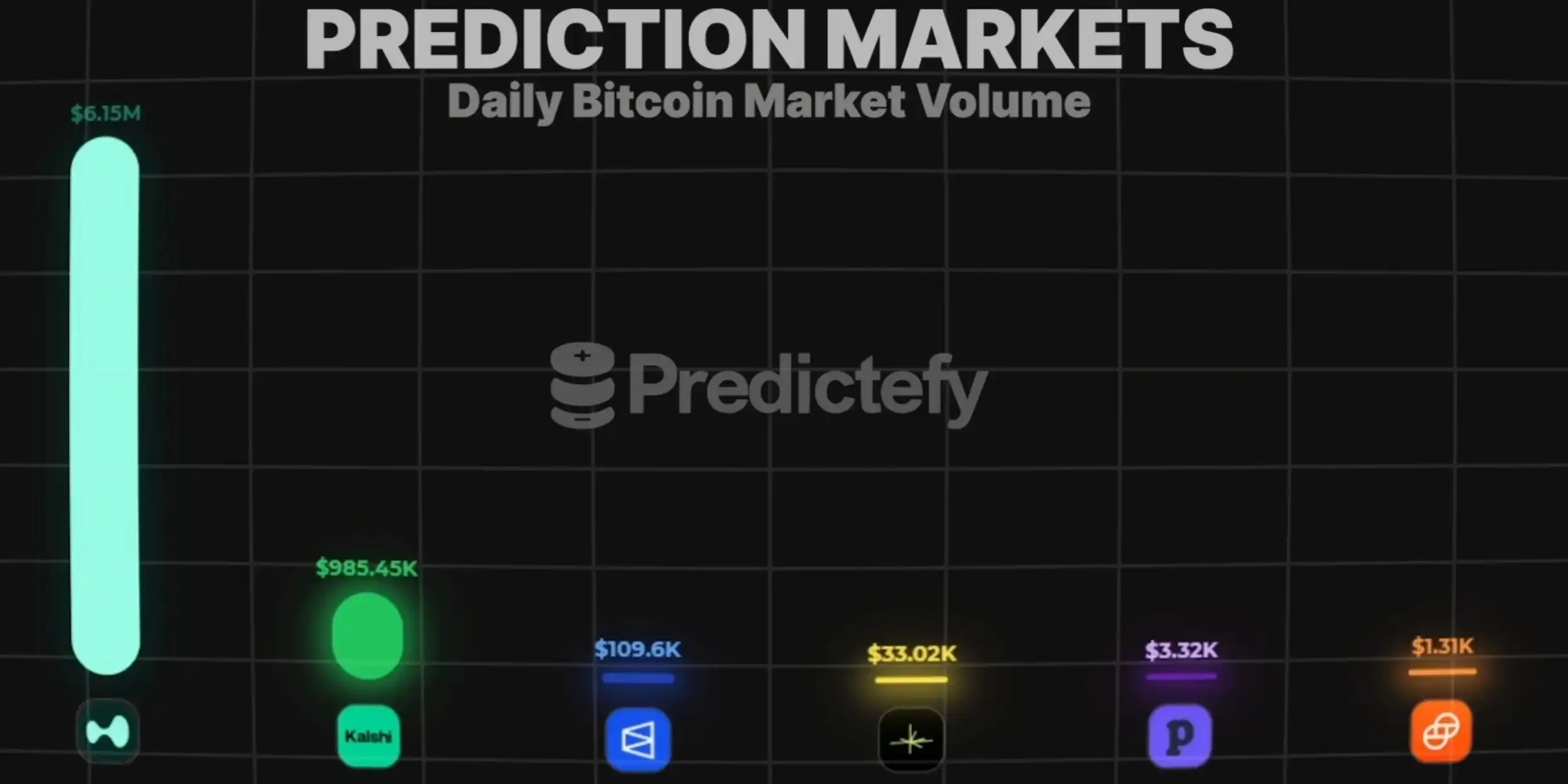
Hyperliquid launched HIP-4 Outcome Markets on mainnet on May 2, formally bringing outcome markets into its onchain trading system. The first listings were intraday BTC binary contracts. On day one, volume reached $6.15 million, well above comparable event contracts on Kalshi and Polymarket. The platform also recorded more than 54,000 trades and over 3,000 traders that day.
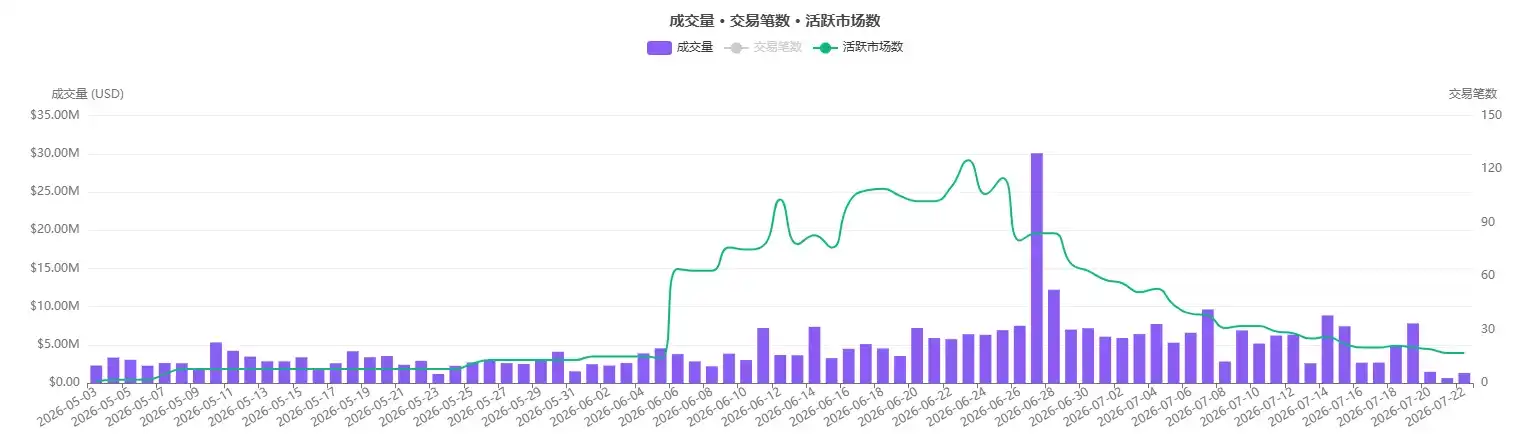
The World Cup amplified that growth. In early June, HIP-4 had only several dozen active markets. That quickly climbed past 100, with the peak exceeding 120. Volume rose in parallel: daily turnover approached $30 million on June 27 and remained above $10 million the next day. As sports, macro data, and crypto price events were added, HIP-4 briefly moved beyond its early concentration in short-duration BTC contracts and started to look more like a broader event-trading venue.
That expansion did not produce lasting demand. As the World Cup moved into its later stages, the number of active HIP-4 markets began to slide. It fell from the peak of 125 to around 50, dropped again to the low 20s by mid-July, and has recently slipped below 20. That is a contraction of more than 85% from the high. Volume weakened as well, with most days returning to the low millions and, more recently, at times dropping below $1 million.
The underlying issue is structural. Perpetual trading tends to stay concentrated in core assets such as BTC and ETH, allowing market makers, capital, and traders to remain in the same venues over time. Event contracts expire as matches end, data gets released, or political events resolve. Each new market has to rebuild attention and liquidity. Hyperliquid can reuse its matching engine, accounts, and capital infrastructure, but it cannot directly transplant perp liquidity or trading frequency into HIP-4.
Polymarket: daily perp volume slipped to about $18.2 million
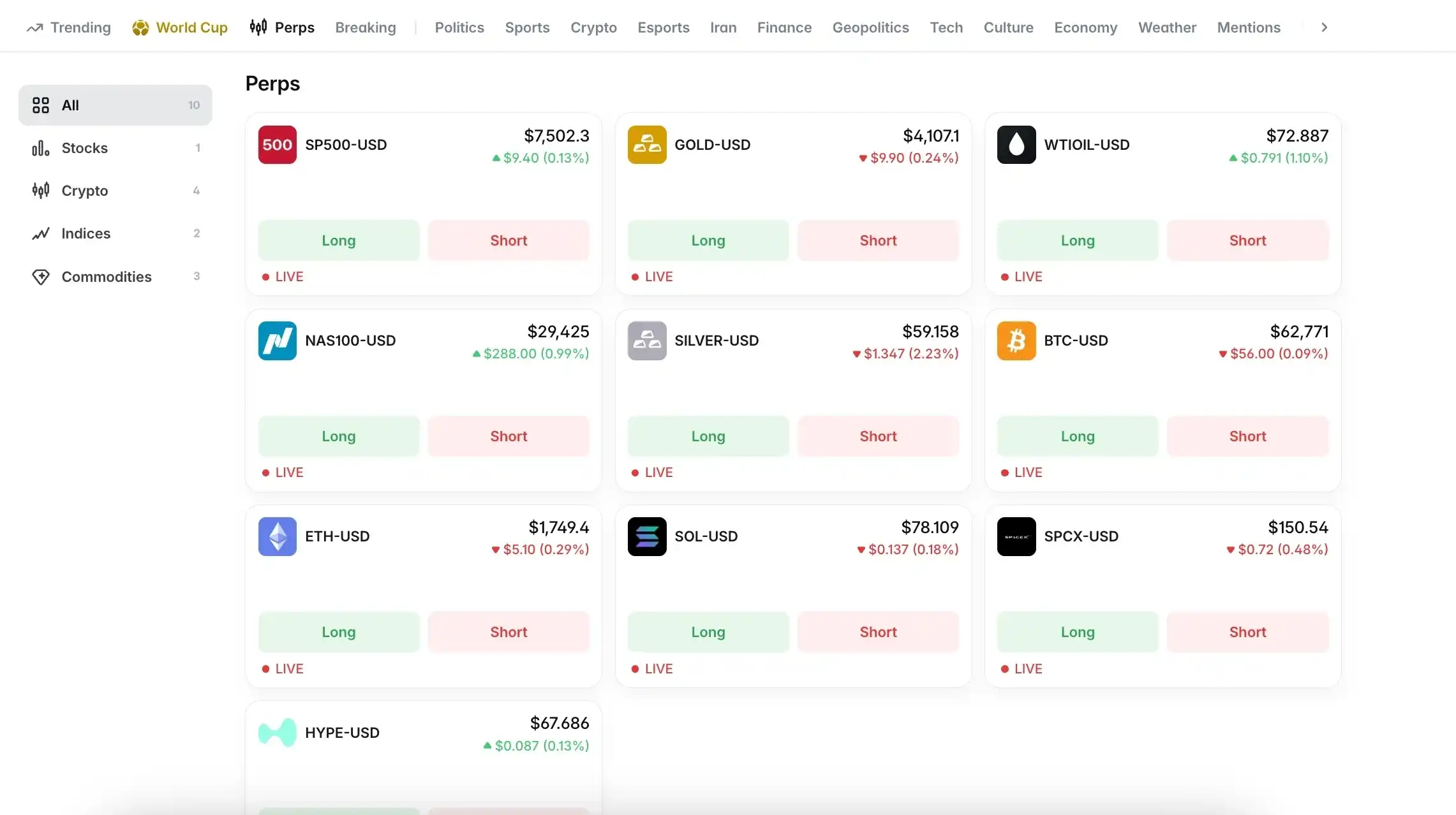
Polymarket announced its move into perpetuals in April and began opening the product to more users in July. The platform supports up to 20x leverage. For now, users still need an invite code or must join a waitlist. The product covers crypto assets including BTC, ETH, and SOL, and it has also expanded into selected equities and commodities.
At launch, Polymarket Perps reached about $48 million in 24-hour trading volume. That level did not hold. By late July, daily volume had fallen to roughly $18.2 million, while open interest stood near $26.4 million. OI in major pairs such as BTC and ETH was only in the low millions. Trading activity has clearly cooled from the initial rollout.
There is an important caveat. Polymarket Perps is still in an early access phase, with trading gated by invitations, so a head-to-head comparison with mature perp platforms is not entirely fair. Even with that adjustment, the gap remains large. During the same period, Hyperliquid’s open interest was about $7.7 billion and its 24-hour trading volume was about $1.58 billion. Polymarket Perps, by contrast, had OI of roughly $26.4 million, or about 0.3% of Hyperliquid’s level, and daily volume equal to only around 1% of Hyperliquid’s.
At this stage, Polymarket’s perp activity looks more like early users testing a new product than a market that has settled into stable habits and sustained discussion. Based on current data, the platform’s user base and brand strength in prediction markets have not transferred smoothly into perps.
Kalshi: $16.1 billion in six weeks, but recent volume has cooled sharply
Kalshi moved faster than Polymarket in perps. In late May, it formally launched CFTC-regulated crypto perpetual contracts covering assets such as BTC, ETH, SOL, and XRP. By July 9, about six weeks after launch, cumulative trading volume had reached $16.1 billion.
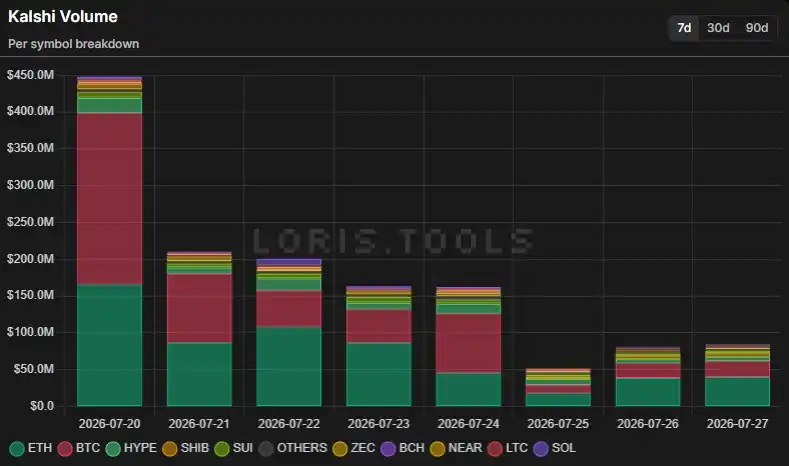
That early acceleration has since faded. According to Loris Tools data, daily volume in Kalshi’s perps segment still hit $448 million on July 20, but in the last two days it fell to about $80 million. That is a drop of more than 80% within just a few days.
Hyperliquid’s perp volume, meanwhile, is still running in the billion-dollar range each day. Even if Kalshi’s recent comparison uses the July 20 level of $448 million, it remains well below Hyperliquid. Once Kalshi’s daily volume slid to about $80 million over the last two days, that distance widened again.
The open-interest gap is even larger. Kalshi’s perps segment still has OI only in the tens of millions of dollars, while Hyperliquid has reached about $7.5 billion. Kalshi’s $16.1 billion in cumulative volume over six weeks suggests its cold start was not weak, but the recent slide in trading activity and still-low OI show it remains well outside the competitive range of mainstream perp venues.
Kalshi’s clearest differentiator is still its position as a compliant U.S. access point. For now, though, that advantage appears to answer one question more than another: it helps solve whether U.S. users can trade perps, but not yet why professional perp traders would keep trading on Kalshi over time.
Crossing over is harder than adding a new product tab
Across Hyperliquid, Polymarket, and Kalshi, the hardest thing to reproduce has not been product design or market listings. It has been the user behavior and liquidity each platform built over time in its original lane. Hyperliquid’s core users are used to high-frequency, leveraged, onchain derivatives trading. Polymarket and Kalshi users are more centered on sports, politics, and current events. A platform can launch a new category quickly. It is much harder to get users to change how they trade.
For Hyperliquid, going deeper in perps and onchain asset trading may matter more than proving it can list everything. For Polymarket and Kalshi, the scarce assets are still event supply, user mindshare, and prediction-market liquidity. Cross-category expansion can create a new growth story, but if the new category never forms independent demand, it can also dilute the platform’s strongest resources.
The idea of an everything exchange may not be decided by who lists the most categories. It may come down to who keeps compounding users, liquidity, and market depth in its core market.