
U.S. equities finished higher on Sept. 25, though the major indexes all rose by less than 1%. The Dow Jones Industrial Average gained 0.93%, the S&P 500 closed at 7,743.41, up 0.51%, and the Nasdaq ended at 27,068.72, up 0.48%. The Philadelphia Semiconductor Index added 1.4%.
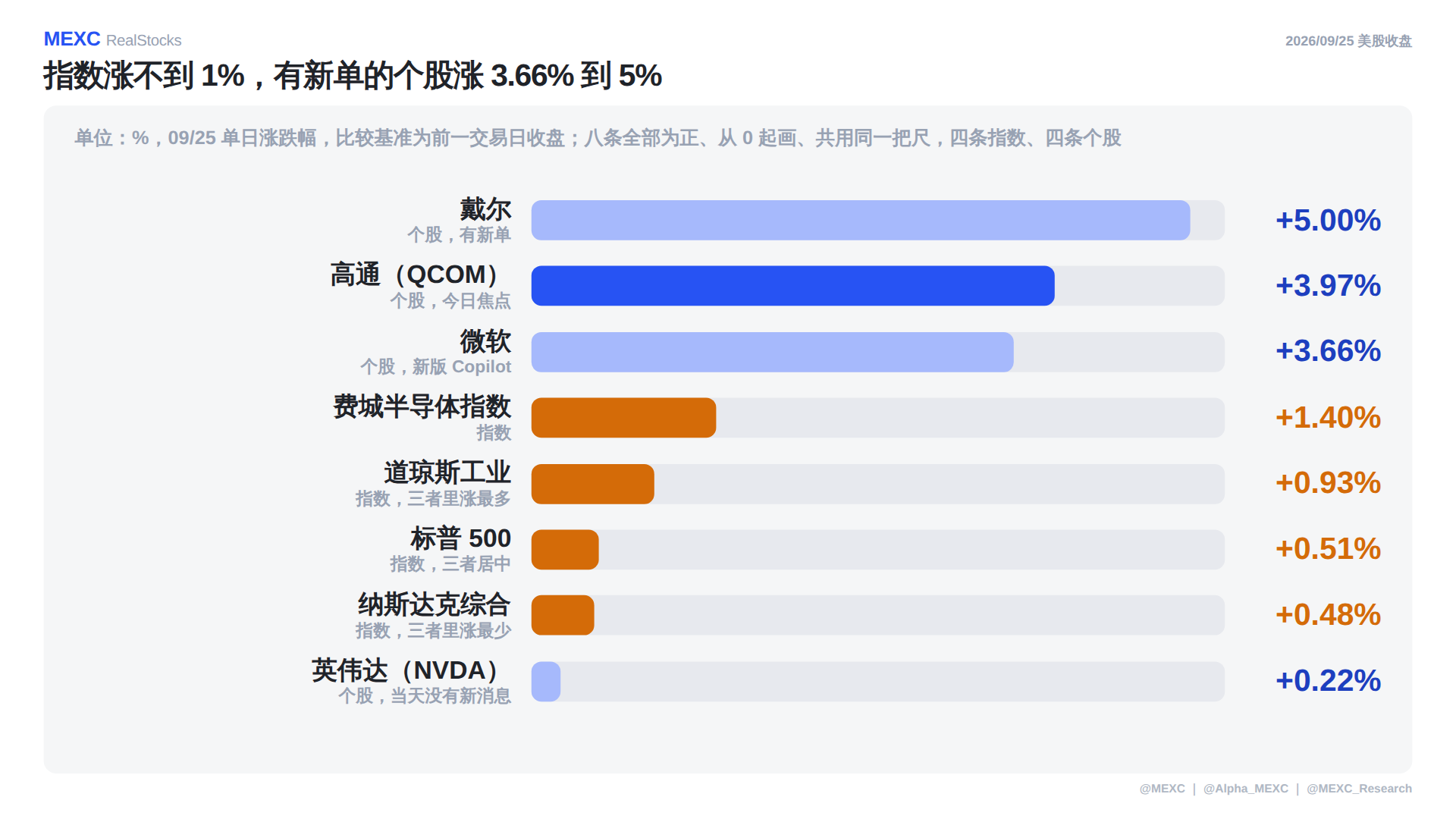
Against that backdrop, stocks tied to fresh developments moved much more sharply. Microsoft rose 3.66%, Qualcomm gained 3.97%, Dell added 5%, and Nvidia (NVDA) was up just 0.22%.
All figures in the article are based on the Sept. 25, 2026 U.S. market close, and the time references use UTC+8. For Sept. 28, the market is watching two Federal Reserve speeches and one manufacturing index release, but all three events fall after the 21:30 cash open, which makes them intraday catalysts rather than premarket events.
Indexes stayed below 1%, while stocks with fresh catalysts outpaced the market
The article separates index performance from stock-specific moves. On the index side, all four benchmarks mentioned closed in positive territory, but none rose by more than 1%. The Dow's 0.93% gain was the largest among the three major indexes. On the stock side, Dell's 5% gain, Qualcomm's 3.97% move, and Microsoft's 3.66% advance ran far ahead of the broader market. The semiconductor index's 1.4% increase placed it in the middle: strong enough to show sector support, but not enough on its own to explain Qualcomm's outperformance.
The piece says the dividing line was not sector classification but the presence of new orders or new information. Microsoft's 3.66% gain was linked to a new Copilot version that added code generation and AI agent functions. Nvidia's 0.22% rise, by contrast, was not described as a deterioration in fundamentals, only as a session without new company-specific news.

Rates remained the other central thread. The 10-year U.S. Treasury yield closed at 5.16% and touched 5.23% intraday, the highest level since 2007. The article's point is that a higher discount rate would normally weigh on valuations, but on that day AI-related orders and product news pushed back against that pressure.
It also notes that a U.S.-China summit reached eight points of consensus last week, with reciprocal tariff reductions of $30 billion on each side. The exchange covered agricultural goods and small household appliances, not technology products, while chip controls remained unchanged. In the article's framing, that tariff relief affected sentiment rather than fundamentals.
Qualcomm rose 3.97% as two developments arrived on the same day
Qualcomm (QCOM) was the session's focal stock. It closed at $201.97, up 3.97%. Two items landed the same day. First, the top-end version of Snapdragon 8 Elite was said to run a 30 billion-parameter large model locally on smartphones, and nine manufacturers had adopted it. Second, Qualcomm renewed its patent licensing agreement with Apple.
The renewal amount and expiration date were not disclosed. More detailed terms are expected in later filings.
Within the selected group of six large semiconductor stocks, Qualcomm's 3.97% gain ranked first. Lam Research (LRCX) was second at 2.62%, leaving a gap of 1.35 percentage points. Intel (INTC) was the weakest at -3.45%, which the article described as profit-taking, for a top-to-bottom spread of 7.42 percentage points.
The methodology matters here. The semiconductor industry average for the day was -0.10%, so Qualcomm's excess gain versus the industry came to 4.07 percentage points. But the article makes a point of saying that -0.10% was only a near-flat slight negative, not a broad sector sell-off. Lam Research, Applied Materials (AMAT), Arm (ARM), and Nvidia also finished higher, so it would be inaccurate to write that Qualcomm was the only chip stock rising. The cleaner description is that semiconductors were roughly flat overall and company-specific news widened the performance gaps.
Qualcomm's market capitalization was listed at $212.1 billion for the day, with roughly $8.1 billion added in one session. Trading volume, however, was only 1.10x average volume, which meant turnover did not expand meaningfully. The stock was positioned at 58% of its 52-week range.
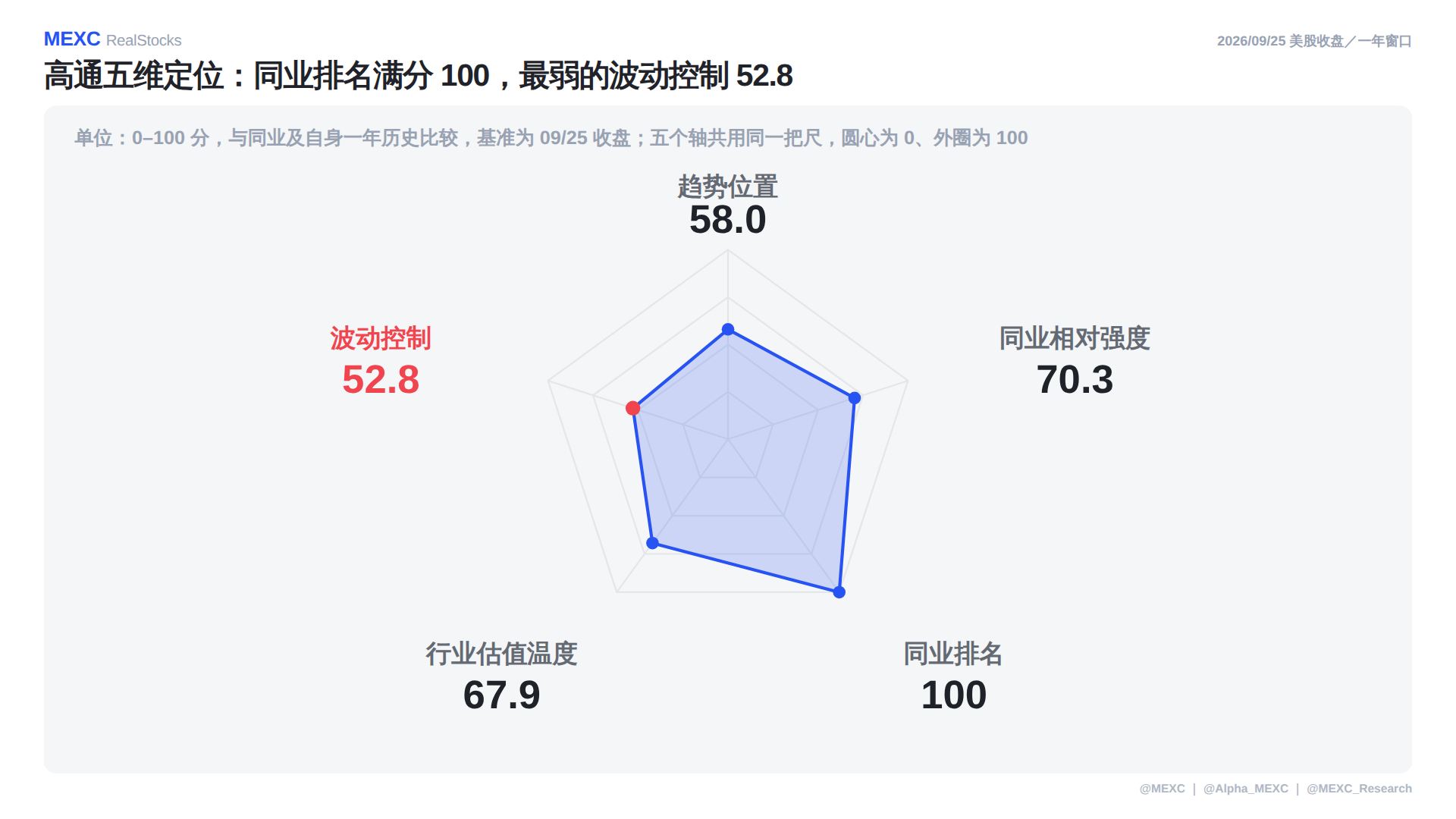
Five-factor positioning showed top peer ranking, weaker volatility control
The article also includes a five-dimensional framework based on the Sept. 25 close, measured against both peers and the stock's own one-year history. Qualcomm scored 100 on peer ranking, meaning it was the strongest performer that day within the six-stock semiconductor group. Its peer relative strength was 70.3, industry valuation temperature was 67.9, and trend position was 58.0, all above the midpoint. The weakest dimension was volatility control at 52.8, indicating larger price swings than most peers in the set.

Patent licensing revenue is tied to handset prices and accounts for about 15% of Qualcomm revenue
A short concept section in the article explains why the Apple renewal matters. Chip companies have two broad sources of revenue. One is chip sales, driven by shipment volumes multiplied by unit prices. The other is patent licensing income, which is collected as a royalty tied to the selling price of the other party's smartphone and does not depend directly on how many chips Qualcomm itself ships.
According to the article, licensing revenue makes up about 15% of Qualcomm's total revenue in the June quarter. The higher that share, the more weight a single renewal carries.
Licensing also has a distinct economic profile: high gross margin and stable cash flow, but contracts that often run for years. That makes each renewal a major variable outside the quarterly shipment story. It does not change one quarter's unit volume, but it does determine whether that roughly 15% slice remains in place over the coming years. For the latest Apple renewal, neither the amount nor the expiration date was disclosed, and the detailed terms are still pending.
Tonight's key events come after the open, with Fed speakers in focus
The September dot plot showed median policy-rate projections of 4.1% for the end of 2026, 4.1% for the end of 2027, 3.9% for the end of 2028, and a longer-run neutral rate of 3.2%. With the Fed having just raised rates by 25 basis points to 3.75%-4.00% in September, the article interprets the 2026 median of 4.1% as implying one more 25 basis point move this year, followed by no change in 2027 and a move down to 3.9% only in 2028. It also stresses that the dot plot is a forecast, not a commitment.
The line matters because it sets the scale for capital-spending payback periods. In the article's wording, high rates are a three-year issue, not a one-quarter issue.

The three scheduled events are Barr speaking at 22:05, the Dallas Fed manufacturing index at 22:30, and Barkin speaking at 01:30 the next day. All come after the 21:30 U.S. market open. The article explicitly notes that Barr and Barkin are two different officials, not one person speaking in two parts.
Its broader point is that the discount rate remains the foundation of AI valuations. If the expected rate path shifts, capital spending assumptions need to be recalculated.
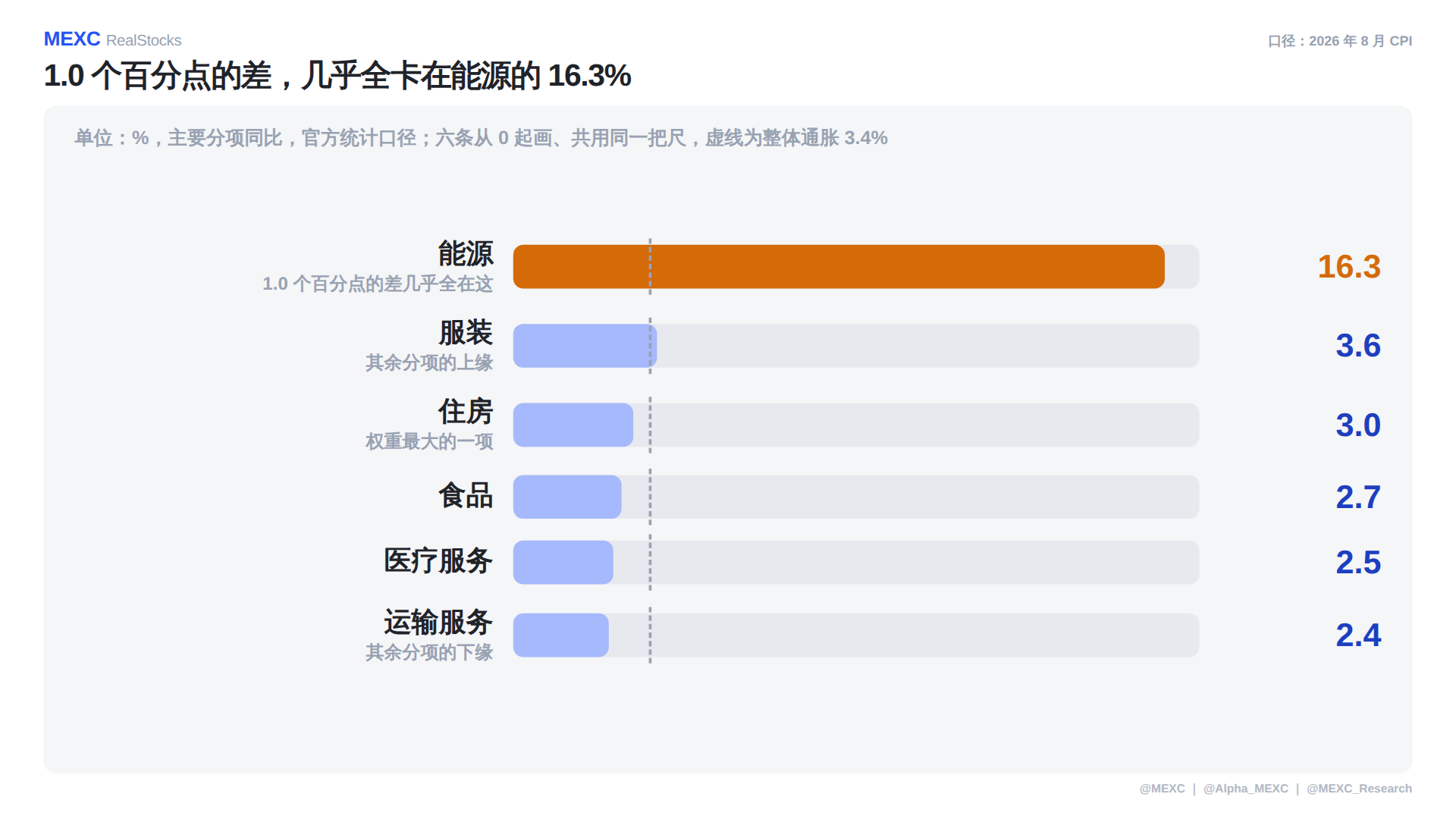
In August CPI, most of the gap between headline and core was concentrated in energy
Looking deeper into inflation data, the article cites August CPI component readings. Energy was up 16.3% year over year, far above the rest. Other components ranged from apparel at 3.6% to transportation services at 2.4%. Headline inflation came in at 3.4% and core at 2.4%, leaving a 1.0 percentage point gap. The article says that almost all of that gap was concentrated in energy, while the other components were clustered in a narrow band, suggesting core inflation was not especially hot.
That leaves two points to watch in officials' remarks. One is how they characterize energy inflation: as a one-off shock that can be looked through, or as something spilling into broader prices. The other is how they refer to the eight-point U.S.-China consensus. The article continues to frame that development as a sentiment easing rather than a shift in fundamentals.
The AI trade is splitting between cash collectors and debt-funded builders
In its market education section, the article uses drawdowns from 52-week highs to map different positions along the AI value chain. Based on the Sept. 25 close, Advanced Micro Devices (AMD) was down just 1.3% from its 52-week high, while Oracle (ORCL) was down 57.5%. The article also states clearly that this ranking is by drawdown only and is neither a quality score nor an investment ranking.
Its summary is simple: along the same AI theme, upstream companies are collecting cash, while downstream companies are borrowing to build. AMD sells CPUs and AI accelerators and gets paid as it ships. The article says AMD rose 9.9% that Friday and its market capitalization moved above $1.03 trillion for the first time. Micron Technology (MU), which sells DRAM and HBM memory, benefits when each additional AI server drives extra memory sales. It closed at $1,082.28, or 6.8x its 52-week low.
The farther a company leans on borrowed money for expansion, the farther it may sit from its highs, according to the article's framework. As one example, it cites a high-yield bond issued by SoftBank to invest in OpenAI, with the longest tranche carrying a 9.75% coupon. That, in the article's description, is the current price of borrowing to build AI capacity.
CoreWeave sells compute time, not chips
The article then singles out CoreWeave (CRWV). Its business is selling compute hours rather than semiconductor products. The company puts GPUs into its own data centers and rents that capacity by the hour to large-model customers.

For the same second quarter, CoreWeave posted $2.6 billion in revenue, up 112% year over year, with backlog of $104.2 billion.
Expansion, however, is debt-funded. Interest expense for the quarter was $640 million, which means roughly $1 of every $4 in revenue went to interest payments. The article says costs for this model move with Treasury yields.
It suggests a three-step way to look at this type of company: first calculate interest expense divided by operating revenue; then check new debt pricing, with SoftBank's 9.75% longest tranche used as a reference point; finally compare the duration of backlog with the duration of debt, because orders are realized over years while interest has to be paid each quarter.
How the article answers common questions
- Why call it a stock-specific session if the industry average was only -0.10%? Because -0.10% was nearly flat rather than a sector-wide drop, and four other names in the same group also finished higher. The dispersion came from company-specific news.
- Is a 3.97% gain with only 1.10x volume contradictory? The article says no. It is unusual enough to note, but not contradictory. Price moved without a matching surge in turnover.
- What number matters most in a patent-license renewal? Start with the share of revenue coming from licensing. The article puts Qualcomm's figure at about 15% in the June quarter. The amount and maturity of the Apple renewal were not disclosed.
- Can the 4.1% median in the dot plot be treated as a promise? No. The article says directly that the dot plot is a forecast, not a commitment.
- How should interest expense divided by revenue be used? It is meant to show whether expansion is being funded by earned cash flow or by borrowing. For CoreWeave, the quarter's revenue was $2.6 billion and interest expense was $640 million.
The disclaimer states that the piece was compiled by the MEXC RealStocks team based on public market information and does not constitute investment advice.