
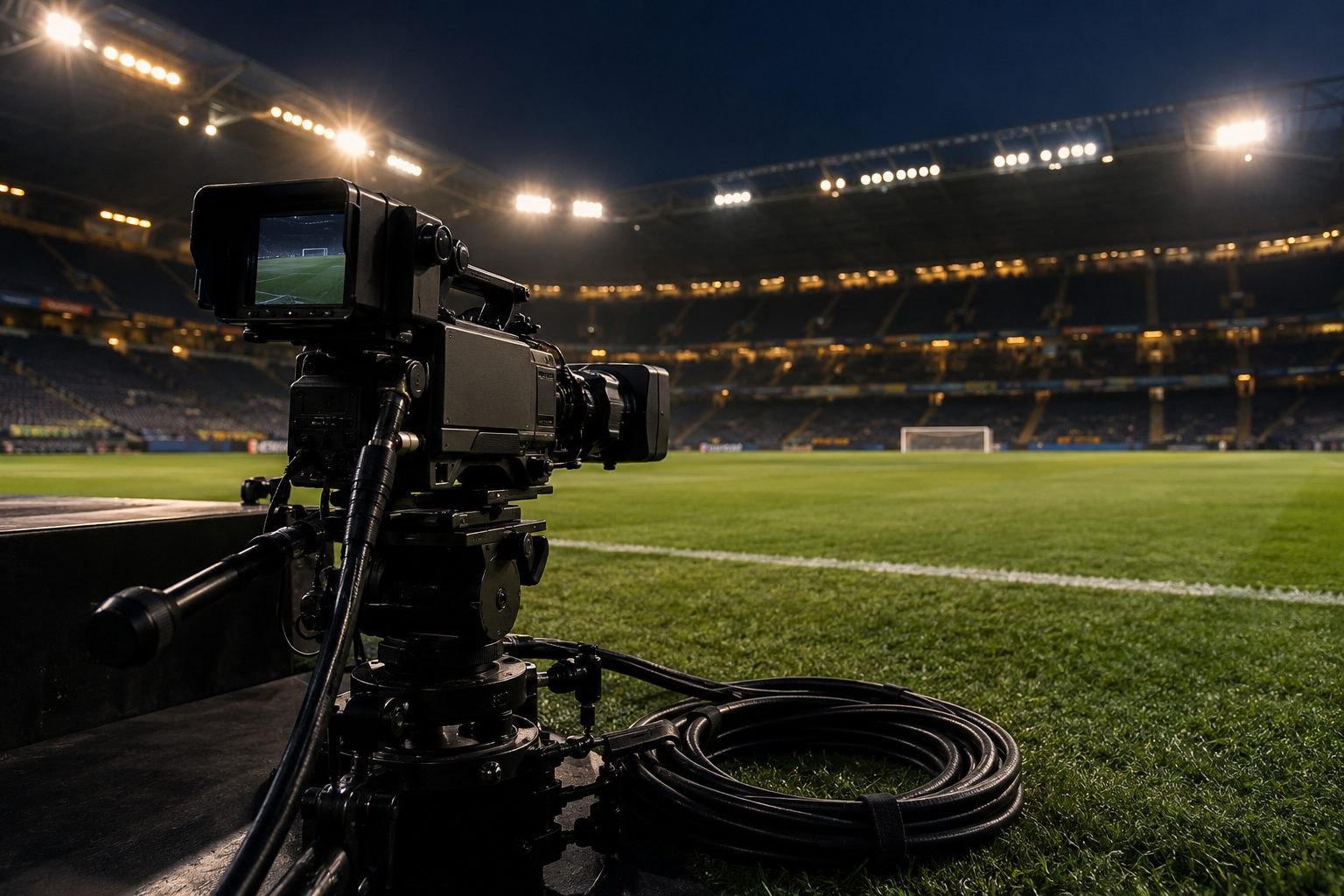
At every home Premier League match, a club must provide hardwired positions for cameras 1 to 41. It must also make space for extra ad hoc cameras that broadcasters add when needed.
Named camera positions
Here are the named camera positions.
| Cameras | Position | Where it sits |
|---|---|---|
| 1 | Main | Television gantry, exactly on the halfway line, facing away from the sun |
| 2 and 4 | Close-up | On the gantry beside the main camera, with a large lens |
| 3 | Pitch-side halfway | Pitch level on the halfway line, on the main camera's side, giving the fourth official an unobstructed view of the pitch and the benches |
| 7 and 8 | 18 yard | The main camera's side, level with it or higher, facing each 18 yard line |
| 9 and 10 | High behind goal | In the stands behind each goal, above the crossbar, taking in the far goal and all four corner flags |
| 11 to 14 | Low behind goal | Pitch level behind each goal line, from the six yard line outwards |
| 15 | Beauty-shot | Mounted high in the stadium, operated remotely, for a static panorama |
| 16 and 17 | Reverse angle | Opposite the main camera, on or close to the centre line, covering the benches and the managers |
| 18 and 19 | Pole | On pole mounts behind the goals, in front of the advertising boards |
| 24 to 27 | Corner | All four corners, about five metres above the pitch |
| 28 to 35 | Newsgathering | Eight portable cameras at pitch level behind each goal line |
| 36 to 39 | Hi motion or big lens | Pitch level between the six yard and 18 yard line, as close to the six yard line as reasonably possible |
| 40 and 41 | Analysis | On the gantry, or near it and within 20 metres of the halfway line |
The stadium layout on the master camera plan is indicative only: it shows where each position sits in relation to the pitch and its relative height above the pitch. The exact spot for each one is agreed with the club and then written into that club's technical specification.
Clubs must provide the fixed positions and the equipment needed to mount camera gear in them, including pods, hoists and camseats. If broadcasters do not need one of those positions, the club may use it itself with league approval given no less than 10 days before the match.
What every position has to provide
Every camera position has to give a full and clear view of the whole pitch. That view must still hold when supporters are standing with raised arms and when people are moving in stairwells or in the stands.
Each position should have a two metre by two metre working space, clear of structures and other obstacles, and protected from fan access unless a different arrangement is agreed with the league. The club is also responsible for safe mounting, hoisting, access and egress.
Most positions are manned. Camera 15 and cameras 18 to 23 are operated remotely; the rest are staffed in person.
Main, roaming and technical area cameras
The main camera sits on the television gantry exactly on the halfway line and faces away from the sun. Its ideal angle is 12 to 14 degrees from the gantry to the centre spot and 22 to 24 degrees to the near-side touchline.
Up to two hand-held uncabled roaming cameras can work on the main camera side of the pitch, one on each side of the halfway line. Their focus is the area between the goal line and the 18 yard line, they should not obstruct the view from the trainers' benches, and enough space must be left for players to warm up.
One uncabled roaming camera must be allowed into the tunnel before the match, at half time and after the match. Broadcasters are expected to use that footage for positive, non-controversial incidents, and must not use footage that may criticise, disparage, belittle or discredit the league, a club, an official, a player or a match official, or bring the game into disrepute.
During a goal, one uncabled roaming camera must be allowed on to the field of play to film the celebration, and it may not be a mobile phone. When requested, two remotely operated technical area cameras are also permitted, one in each technical area, and they cannot record or transmit audio.
Who provides and pays for extra systems
Clubs make ad hoc camera positions available, but the infrastructure and equipment for those extra positions are installed and paid for by the broadcasters, the league or Premier League Studios. The club must assist where that is reasonably practicable.
A stadium must be able to take a four point aerial cabled camera system. It must also be able, where reasonably possible and safe, to take at least one of two further systems: a wirecam running along a single suspended wire at about the height of the main camera, or a railcam running on a track fitted to the front of a tier or an advertising board.
Drones cannot fly over or across any part of the stadium. They are operated by providers approved by the Civil Aviation Authority, within safe fly zones allocated by that authority, and flights take place before the match, at half time, after the match and at agreed times during it. Each flight time must be listed on the countdown to kick-off, so the club and the match officials' body know the flight is approved.
The league or its appointed production partner may also install certain cameras on a permanent basis: the beauty-shot camera, an analysis camera on or near the gantry, and cameras in the interview room plus the pre-match and post-match media conference rooms.
FAQ
Where are the cameras at a Premier League stadium?
The main spread is across the gantry, pitch-side on the halfway line, behind both goals, in all four corners and on the opposite side from the main camera near the centre line. There are also portable newsgathering positions, analysis positions and optional cameras in the technical areas.
Are drones allowed at Premier League matches?
Yes, but only under tight controls. They cannot fly over or across any part of the stadium, and the operator must be approved by the Civil Aviation Authority and work inside approved safe fly zones and time windows.
What is the main camera at a football match?
It is camera 1, placed on the television gantry exactly on the halfway line. That camera provides the central match view and has a defined angle both to the centre spot and to the near-side touchline.
Who pays for Premier League match cameras?
The home club provides positions 1 to 41 and the supporting installation equipment for those fixed positions. Extra ad hoc positions are a different case: the broadcasters, the league or Premier League Studios install and pay for the infrastructure and equipment there.