
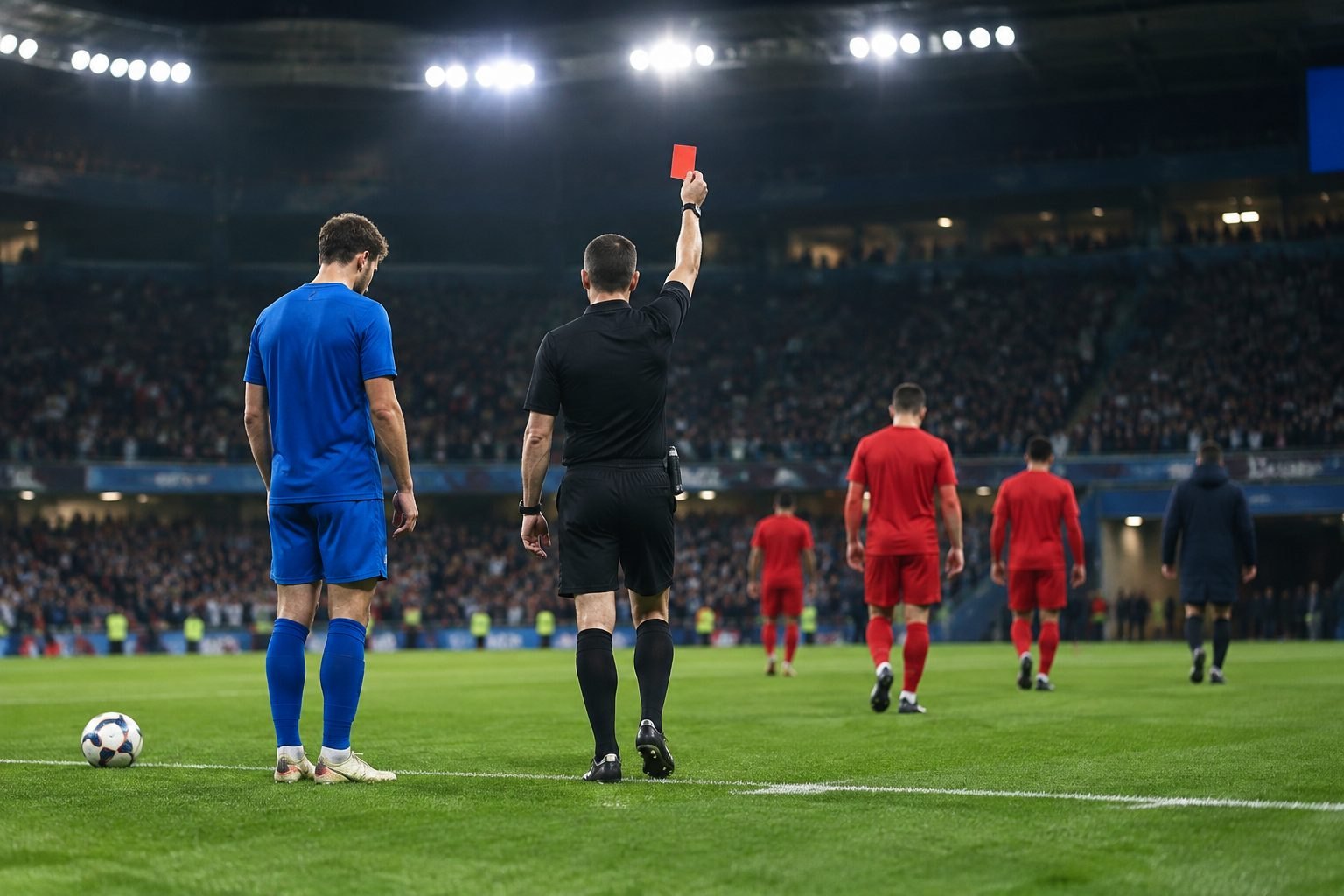
Yes. Under the IFAB Laws of the Game, a referee can still show yellow or red cards from entering the field at the start of the match until after it has ended, including during half-time, extra time and penalties, and still has disciplinary authority until leaving the field after the match.
Two time windows apply
Here is when the referee can act and when cards can be shown.
| When | What the referee can do |
|---|---|
| From entering the field for the pre-match inspection | Take disciplinary action: prevent a player who commits a sending-off offence from taking part, and report other misconduct |
| From entering the field at the start of the match until after the match has ended | Show yellow or red cards, including during the half-time interval, extra time and penalties |
| After the final whistle, until leaving the field | Take disciplinary action; a card may still be shown if it helps manage the situation or calm the player, and the offence must be reported |
Those are separate windows. Disciplinary authority starts earlier, from the referee's entry for the pre-match inspection. The power to show yellow or red cards starts later, from entering the field at the start of the match.
That distinction matters around kick-off and after full time. The match may be over, but the referee still has authority to deal with misconduct before leaving the field, and penalties are included in the overall time covered.
What happens before kick-off
Here are the exact outcomes for sending-off offences at different moments.
| Timing | Result |
|---|---|
| Sent off before the team list is submitted | Cannot be named on the team list in any capacity |
| Sent off after being named on the team list and before kick-off | May be replaced by a named substitute; that substitute cannot be replaced; the team's number of substitutions is not reduced |
| Sent off after kick-off | Cannot be replaced |
| Named substitute sent off before or after kick-off | May not be replaced |
If a player commits a sending-off offence before the referee enters the field at the start of the match, the referee can prevent that player from taking part. Any other misconduct in that period is reported.
A cautionable offence in the warm-up before the referee has entered the field at the start of the match cannot be punished with a yellow card. It is reported to the proper disciplinary authorities instead. A caution shown between the coin toss and kick-off is carried into the match, so a second caution during the match is a sending-off.
Cards can be shown at half-time and off the field
Half-time sits inside the card window. So do extra time and penalties. The referee does not lose the power to show cards just because play has stopped.
The offence does not have to happen on the field. During the half-time interval, a player who shows dissent on the way to the tunnel must be cautioned. A player who strikes an opponent in the tunnel is sent off for violent conduct, takes no further part, and cannot be replaced.
If the card for either offence is shown off the field, the referee must inform both teams and, where appropriate, make sure an announcement is made to spectators before the second half starts.
What the referee can do after the final whistle
After the final whistle, the referee still has authority to take disciplinary action until leaving the field. A card may still be shown if that helps manage the situation or calm the player.
Verbal dissent is a caution unless the words are offensive, insulting or abusive, in which case it is a red card. Whether or not a card is shown, the offence must be reported.
The referee sends the appropriate authorities a match report covering disciplinary action and other incidents before, during or after the match. The length of any suspension is set by competition rules or disciplinary rules, not by the Laws of the Game.
FAQ
Can a player be sent off before kick-off?
Yes. A player who is sent off before kick-off, for example during the warm-up on the field or in the tunnel, must not take part in the match. What happens next depends on whether the player had already been named on the team list.
Can a referee show a card at half-time?
Yes. Half-time is within the period when yellow and red cards may be shown. That includes misconduct that happens away from the field itself.
Can a player be booked in the tunnel?
Yes. During the half-time interval, a player who shows dissent on the way to the tunnel must be cautioned, and a player who strikes an opponent in the tunnel is sent off for violent conduct, takes no further part and cannot be replaced. If the card is shown off the field, the referee must inform both teams and, where appropriate, ensure that an announcement is made to spectators before the second half begins.
Can a referee book a player after the match?
Yes. After the final whistle, the referee keeps the authority to take disciplinary action until leaving the field. A card may still be shown if it helps manage the situation or calm the player, and the offence must be reported whether or not a card is shown.


