
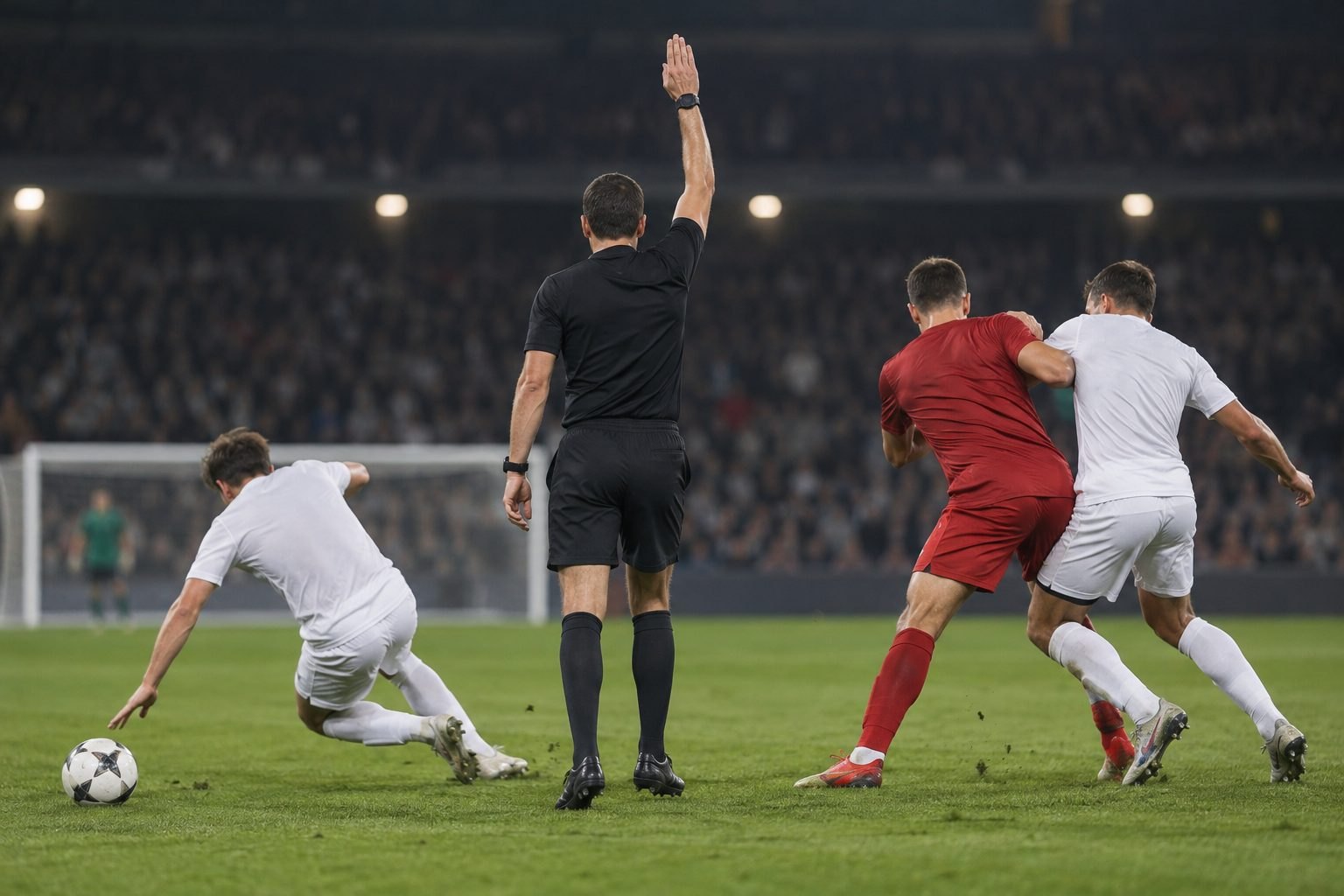
The split is simple: when the ball is in play, offences involving contact are punished by a direct free kick, while listed no-contact offences are punished by an indirect free kick. A handball offence also brings a direct free kick, except for the goalkeeper inside their own penalty area.
Offences punished by a direct free kick
These are the offences that bring a direct free kick.
- Charging, jumping at, kicking or attempting to kick, pushing, striking or attempting to strike including by head-butt, tackling or challenging, or tripping or attempting to trip an opponent when the referee judges it careless, reckless or using excessive force
- Handball offence, except for the goalkeeper inside their own penalty area
- Holding an opponent
- Impeding an opponent with contact
- Biting or spitting at someone on the team lists or a match official
- Throwing an object at the ball, an opponent or a match official, or making contact with the ball with a held object
The key line is contact. If the offence involves contact, the restart is a direct free kick. In challenge situations, the referee then grades the action as careless, reckless or using excessive force.
How a challenge is graded
Here is the grading for challenges and the required outcome.
| The manner of it | What follows |
|---|---|
| Careless | A direct free kick, and no disciplinary sanction is needed |
| Reckless | A direct free kick, and the player must be cautioned |
| Using excessive force | A direct free kick, and the player must be sent off |
Careless means a lack of attention or consideration when making a challenge, or acting without precaution. Reckless means acting with disregard to the danger to, or consequences for, an opponent. Using excessive force means exceeding the necessary use of force and/or endangering an opponent's safety.
Those three grades are separate and they carry different disciplinary outcomes. Careless needs no disciplinary sanction, reckless must bring a caution, and using excessive force must bring a sending-off.
Offences punished by an indirect free kick
These are the offences that bring an indirect free kick.
- Playing in a dangerous manner
- Impeding the progress of an opponent without any contact
- Dissent
- Using offensive, insulting or abusive language or actions, or other verbal offences
- Preventing the goalkeeper releasing the ball from the hands
- Kicking or attempting to kick the ball while the goalkeeper is releasing it
- Initiating a deliberate trick for the ball to be passed to the goalkeeper with the head, chest, knee or similar to get round the Law
- Any other offence not mentioned in the Laws for which play is stopped to caution or send off a player
Playing in a dangerous manner means an action, while trying to play the ball, that threatens injury to someone, including the player themself. It also covers stopping a nearby opponent from playing the ball because that opponent fears injury. A scissors kick or bicycle kick is allowed if it is not dangerous to an opponent.
Impeding without contact has its own definition. It means moving into an opponent's path to obstruct, block, slow down or force a change of direction when the ball is not within playing distance of either player. Being in an opponent's way is different from moving into the way. If the ball is within playing distance, a player may shield it by placing themself between the opponent and the ball, as long as the opponent is not held off with the arms or body; in that situation, a fair charge is allowed.
Goalkeeper offences inside their own penalty area
The goalkeeper has a separate group of indirect free kick offences inside their own penalty area.
- The goalkeeper touches the ball with the hand or arm after releasing it and before it has touched another player.
- The goalkeeper touches the ball with the hand or arm after it has been deliberately kicked to them by a team-mate.
- The goalkeeper touches the ball with the hand or arm after receiving it directly from a team-mate's throw-in.
- The last two points do not apply if the goalkeeper has clearly kicked, or attempted to kick, the ball to release it into play.
These are goalkeeper-specific indirect free kick offences. They sit apart from the general no-contact offences listed above.
FAQ
When is a free kick direct?
It is direct when the ball is in play and the offence is one of the listed direct free kick offences. The clearest guide is contact: if the offence involves contact, the restart is a direct free kick; handball also falls into this group, apart from the goalkeeper inside their own penalty area.
What is an indirect free kick?
It is the restart for a defined list of offences that do not depend on contact, such as dangerous play, impeding without contact, dissent and certain verbal offences. Some goalkeeper offences inside the goalkeeper's own penalty area also bring an indirect free kick.
What is the difference between careless and reckless in football?
Careless means the player has shown a lack of attention or consideration, or has acted without precaution, and no disciplinary sanction is needed. Reckless means disregard to the danger to, or consequences for, an opponent, and the player must be cautioned.
Is being in an opponent's way the same as impeding?
No. Impeding means moving into the opponent's path to obstruct, block, slow down or force a change of direction when the ball is not within playing distance of either player. Simply being in the way is a different situation.