
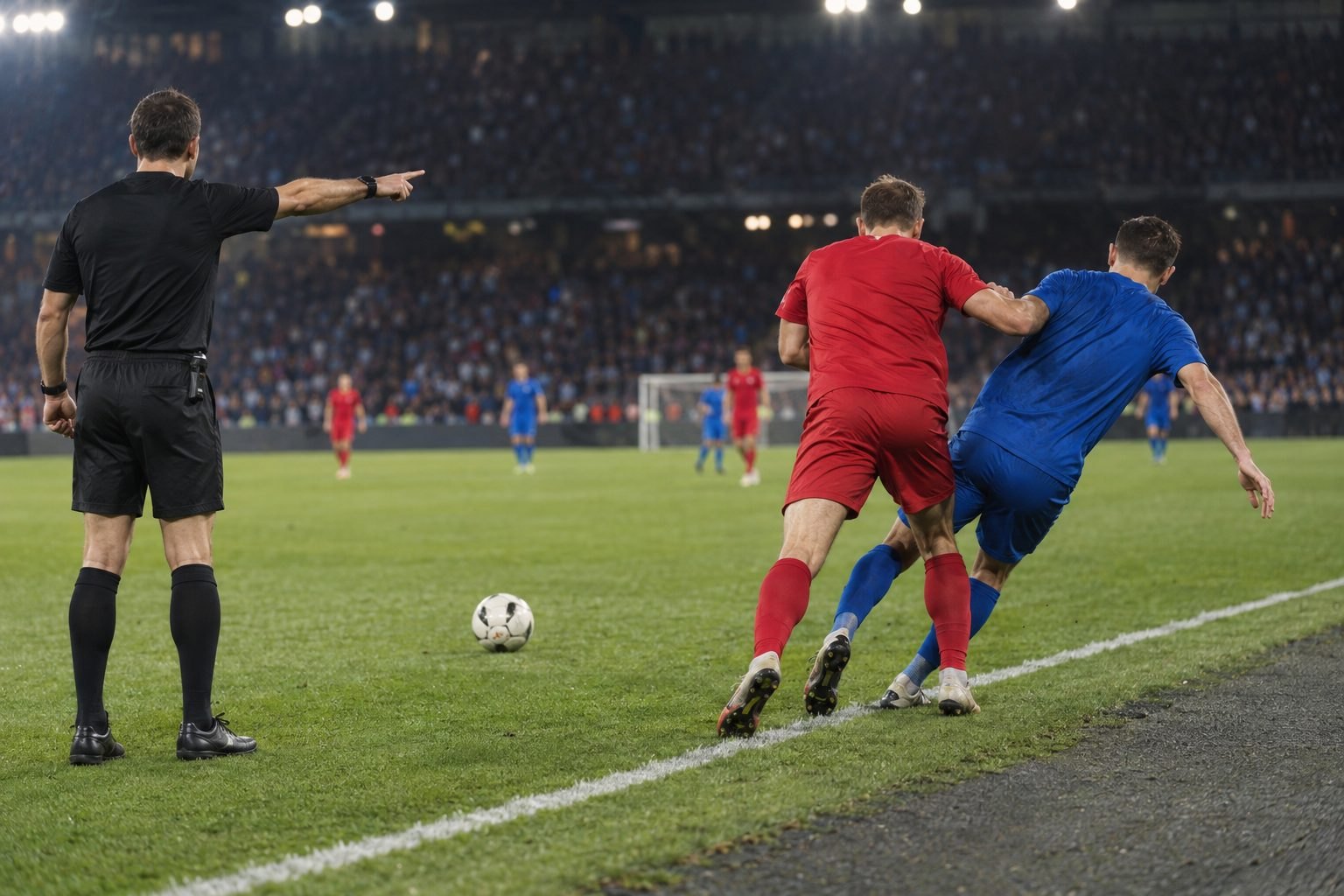
Under the IFAB Laws of the Game, when the ball is in play, an offence outside the field against an opponent or a match official brings a free kick on the nearest boundary line, or a penalty kick in some cases. If the ball is out of play, the restart follows the previous decision.
Out of play and in play are treated differently
When the ball is already out of play, an offence does not create a new free-kick restart. Play resumes with whatever had already been awarded before the incident.
For example, an attacker makes a reckless tackle after the ball has already gone out for a corner kick. The attacker is cautioned, but play still resumes with the corner kick because the ball was out of play at the time of the tackle.
When the ball is in play, the restart depends first on who committed the offence and against whom. An offence by a player outside the field against an opposing player, substitute, substituted or sent-off player or team official, or against a match official, brings a free kick on the boundary line nearest to where it happened. That nearest point can be on the touchline or the goal line.
A penalty kick is not triggered by the off-field location by itself. Two conditions have to be met together: the act must be a direct free kick offence, and the nearest point on the boundary line must be inside the offender's penalty area.
If the victim is from the offender's own side, the restart is an indirect free kick on the nearest boundary line. That branch covers a team-mate, substitute, substituted player, or team official of the same team.
When an offence against an outside agent brings an indirect free kick for leaving the field without the referee's permission, that kick is taken from the point on the boundary line where the player left the field.
Restarts for off-field offences while the ball is in play
Here are the main branches for offences outside the field while the ball is in play.
| What happened, with the ball in play | Restart |
|---|---|
| A player commits an offence outside the field against an opposing player, substitute, substituted or sent-off player or team official, or a match official | Free kick on the boundary line nearest to where it happened; a penalty kick for a direct free kick offence if that point is within the offender's penalty area |
| A player commits an offence outside the field against a player, substitute, substituted player or team official of their own team | Indirect free kick on the boundary line closest to where it happened |
| A player commits an offence against an outside agent | Dropped ball, unless an indirect free kick is awarded for leaving the field without permission |
| A substitute, substituted or sent-off player or team official commits an offence against, or interferes with, an opponent or a match official outside the field | Free kick on the boundary line nearest to where it happened; a penalty kick for a direct free kick offence if that point is within the offender's penalty area |
Thrown or kicked objects are handled by impact point
When an object is thrown or kicked, the restart is tied to where the object struck, or would have struck, the person or the ball. It is not taken from the place where the object was released.
Against an opposing player, the object is something other than the match ball. Against an opposing substitute, substituted or sent-off player, team official, match official, or the match ball, the object can include a ball.
- If a player on or off the field throws or kicks an object other than the match ball at an opposing player, play restarts with a direct free kick from where the object struck or would have struck that player.
- If a player throws or kicks an object, including a ball, at an opposing substitute, substituted or sent-off player, team official, match official, or the match ball, play restarts with a direct free kick from where the object struck or would have struck the person or the ball.
- If a substitute, substituted or sent-off player, a player temporarily off the field, or a team official throws or kicks an object onto the field and it interferes with play, an opponent, or a match official, play restarts with a direct free kick or a penalty kick where the interference happened, or where the object struck or would have struck the opponent, match official, or the ball.
In both of the first two cases, if that position is off the field, the free kick is taken on the nearest point of the boundary line; a penalty kick is awarded if this is within the offender's penalty area.
Near the touchline, the nearest boundary point decides the spot
In some challenges the contact happens outside the field. If the ball is still in play, the restart is based on the nearest point on the boundary line to the off-field contact.
For example, a player makes a reckless tackle while challenging for the ball on the touchline, with the contact happening outside the field while the ball remains in play. The player is cautioned and play restarts with a direct free kick on the touchline nearest to where the offence occurred.
FAQ
Can an off-the-pitch foul lead to a penalty?
Yes, but two parts must line up. The offence must be one that brings a direct free kick, and the nearest point on the boundary line must be inside the offender's penalty area.
What happens if a player throws something at an opponent?
The restart is based on where the object struck, or would have struck, the opponent rather than where it was thrown from. Against an opposing player, the object is something other than the match ball; if the impact point is off the field, the kick is taken from the nearest boundary point.
What if a substitute interferes from the touchline?
If a substitute, substituted or sent-off player, or a team official commits an offence against, or interferes with, an opponent or a match official outside the field, the restart is a free kick on the nearest boundary line. It becomes a penalty kick when the act is a direct free kick offence and that nearest point is inside the offender's penalty area. If the substitute throws or kicks an object onto the field and it interferes, the restart is a direct free kick, or a penalty kick, where it interfered with play or where the object struck or would have struck the opponent, match official or the ball.
What if the foul happens after the ball has already gone out?
The restart does not change to a free kick. Play resumes according to the earlier decision wherever the later offence happens; a corner kick, for example, remains a corner kick.


