
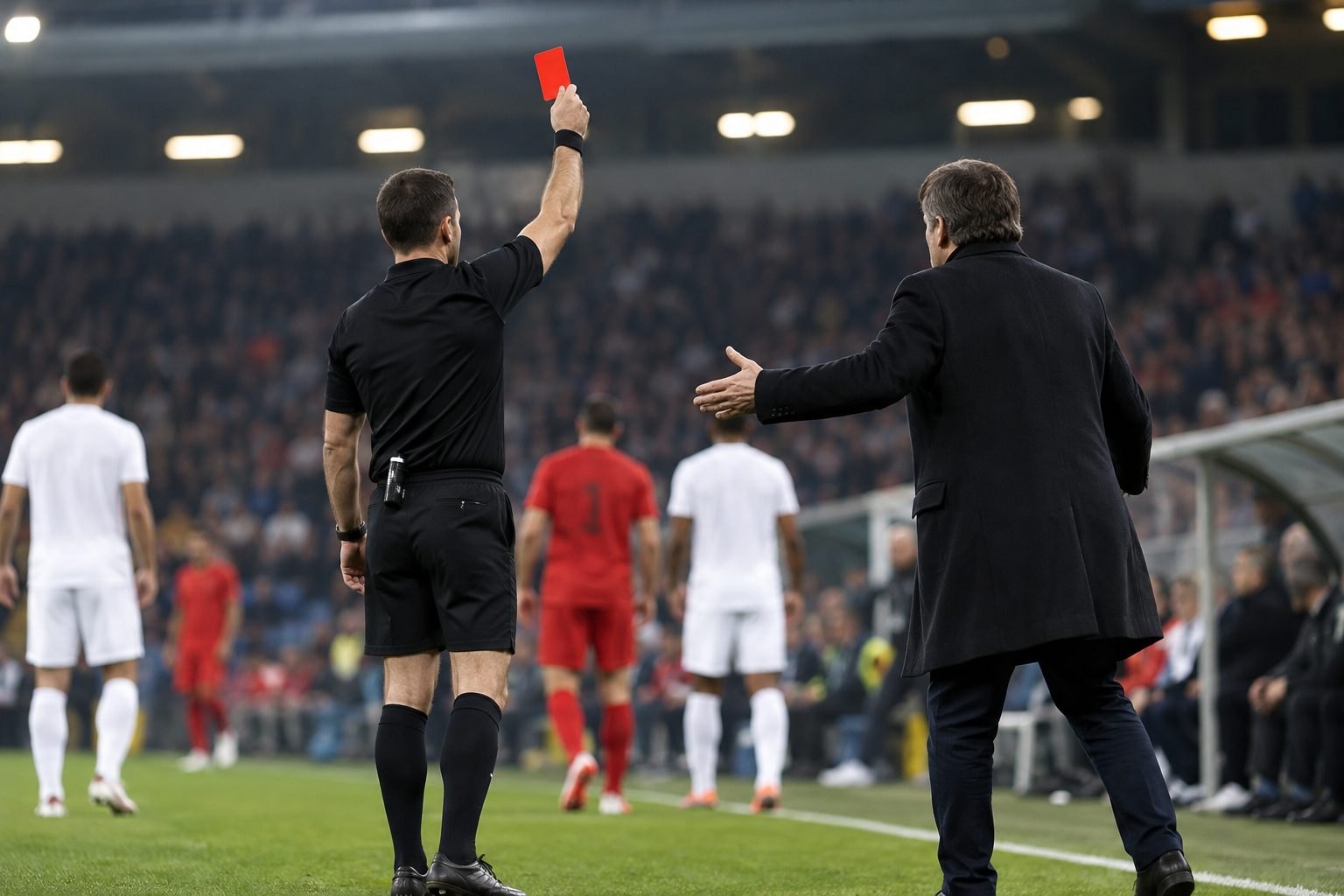
A manager, like any team official, can be warned, cautioned or sent off. Offences such as occasionally leaving the technical area should usually bring a warning, while delaying the opponents' restart or entering the field to confront a match official is a sending-off offence.
How discipline works for managers and other team officials
Under the IFAB Laws of the Game, the coach and the other officials named on the team list, apart from players and substitutes, are team officials, so the rules below apply to a manager. Only players, substitutes, substituted players and team officials may be shown the yellow or red card.
There are three levels. A warning carries no card, while the yellow card communicates a caution and the red card a sending-off. Some offences should usually bring a warning, but repeated or blatant offences should result in a caution or a sending-off.
Examples at each level
Here are examples of offences by team officials and the sanction each brings.
| Offence | Sanction |
|---|---|
| Occasionally leaving the technical area, with no other offence | Should usually be a warning |
| Minor disagreement with a decision, by word or action | Should usually be a warning |
| Throwing or kicking a drinks bottle in dissent | Caution |
| Sarcastic clapping or another clear lack of respect for the match officials | Caution |
| Delaying the restart of play by their own team | Caution |
| Entering the referee review area | Caution |
| Delaying the restart of play by the opposing team | Sending-off |
| Deliberately throwing or kicking an object onto the field of play | Sending-off |
| Entering the field of play to confront a match official | Sending-off |
| Entering the video operation room | Sending-off |
Warnings and cautions
Besides occasionally leaving the technical area and minor disagreement with a decision, the warning level also covers entering the field of play in a respectful, non-confrontational manner, and failing to cooperate with a match official, such as ignoring an instruction or request from an assistant referee or the fourth official. These should usually bring a warning, but repeated or blatant offences should result in a caution or sending-off.
Caution offences are not limited to the table. They also include clearly or persistently not respecting the confines of the team's technical area, deliberately entering the opposing technical area in a non-confrontational way, dissent by word or action, excessively or persistently gesturing for a yellow or red card, excessively showing the TV signal for a VAR review, acting in a provocative or inflammatory manner, persistent unacceptable behaviour including repeated warning offences, and showing a lack of respect for the game.
Sending-offs and the contrasts that matter
Sending-off offences are not limited to the table either. They also include deliberately leaving the technical area to show dissent towards, or remonstrate with, a match official, or to act in a provocative or inflammatory way; entering the opposing technical area in an aggressive or confrontational manner; entering the field to interfere with play, an opposing player or a match official; physical or aggressive behaviour, including spitting or biting, towards an opposing player, substitute, team official, match official, spectator or any other person; receiving a second caution in the same match; using offensive, insulting or abusive language or action; using unauthorised electronic or communication equipment, or behaving inappropriately as a result of using electronic or communication equipment; and violent conduct.
Three contrasts matter. Throwing or kicking a drinks bottle in dissent is a caution, while deliberately throwing or kicking an object onto the field of play is a sending-off. Delaying the restart by a manager's own team is a caution, while delaying the opposing team's restart is a sending-off. Entering the field respectfully and without confrontation should usually mean a warning, while entering it to confront a match official, including at half-time or full-time, is a sending-off.
FAQ
Who gets the card if the referee cannot identify the offender?
If the offence comes from the technical area and the offender cannot be identified, the senior team coach present in the technical area, usually the main coach, receives the sanction as the person responsible for the other team officials. The senior team coach can be sanctioned only for an unidentified offender in or from the technical area; if a player who cannot be identified commits an offence, the incident should be reported to the appropriate authorities after the match.
Can a coach get a yellow card for kicking a bottle?
Yes, if the act is dissent. Throwing or kicking a drinks bottle in dissent is a caution. If an object is deliberately thrown or kicked onto the field of play, it is a sending-off.
What happens if a manager walks onto the pitch?
The outcome depends on the nature of the entry. Respectful, non-confrontational entry should usually bring a warning, while entering the field to confront a match official or to interfere with play, an opposing player or a match official is a sending-off offence.
Can a referee warn a manager without showing a card?
Yes. A warning carries no card. Offences such as occasionally leaving the technical area or minor disagreement with a decision should usually bring a warning, but repeated or blatant offences should result in a caution or sending-off.


