
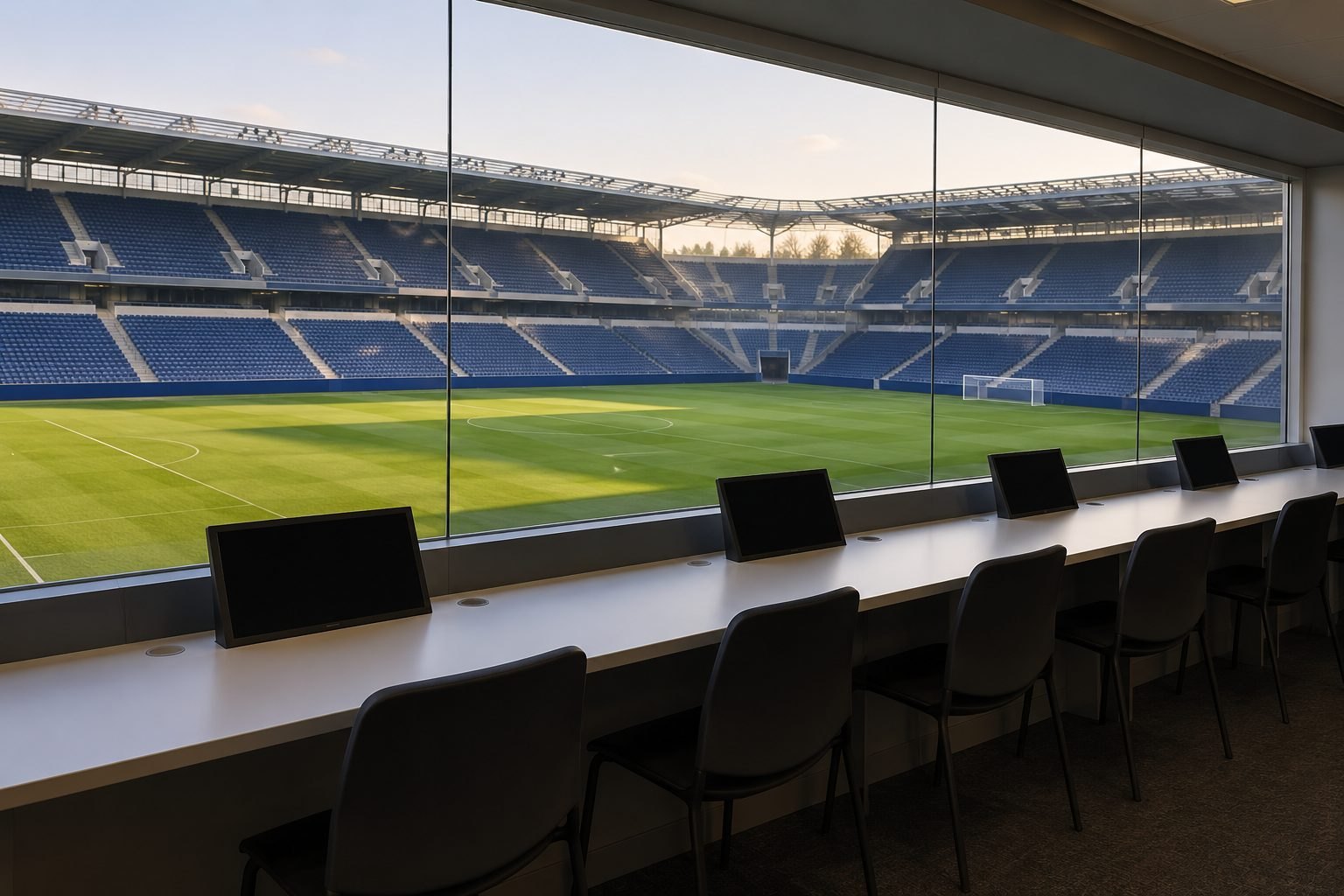
At every league match, a club must provide at least 50 seats for accredited media and data providers, pitch-side access for 20 accredited photographers and messengers, and a 20 square metre photographers' work area.
Minimum provision
Here is the minimum media provision a ground must make.
| Facility | Minimum |
|---|---|
| Seats for accredited media and data providers | 50 |
| Photographers and messengers with pitch-side access | 20 |
| Photographers' working area or wire room | 20 square metres |
| Power points in that working area | 16 |
What the press seats must include
Those seats have to be near the media working room and placed so they give a clear view of the whole pitch. The requirement covers accredited media representatives and the league's data providers.
Each seat needs a desktop, an electricity supply, a clear view of a television monitor, a telephone point and internet connectivity. The setup is built for live reporting and data work from a fixed position.
Pitch-side access and the photographers' work area
Pitch-side access is for both photographers and messengers. The club must also provide pitch-side wiring and wireless internet connectivity.
The photographers' working area, or wire room, must be 20 square metres. It also needs internet connectivity, 16 power points, a television monitor, shelves for laptops and refreshment facilities.
Accreditation, bibs and where club photographers may stand
Accreditation for media representatives and photographers is handled by the league or by an appointee acting on behalf of the league and the clubs. Access to these areas is therefore tied to that central accreditation process.
Photographers wear bibs marked "Photographer" on the back, with consecutive numbers shown on both the front and the back. Messengers wear bibs in a different colour marked "Messenger", with numbering shown the same way.
A club's own photographers must stay off the pitch in static positions from the moment the players leave the tunnel until the match ends. After the match, they may be anywhere off the pitch.
Before kick-off, one club photographer may go on to the pitch to photograph the players and the manager and to meet the club's commercial obligations. The club must take all reasonable steps to prevent any interference with a broadcaster's transmission.
FAQ
How many press seats does a Premier League ground need?
The minimum is 50 seats for accredited media representatives and the league's data providers. Those seats also need to be near the media working room and give a clear view of the whole pitch.
How many photographers are allowed pitch-side in the Premier League?
The club must provide pitch-side access for 20 accredited photographers and messengers. That access comes with pitch-side wiring and wireless internet connectivity.
Who accredits Premier League photographers?
The league handles it directly or uses an appointee acting on behalf of the league and the clubs. The same accreditation arrangement also applies to media representatives.
Can club photographers go on the pitch in the Premier League?
One club photographer may go on to the pitch before kick-off to photograph the players and the manager and to meet commercial obligations. From the moment the players leave the tunnel until the match ends, club photographers must remain off the pitch in static positions.