
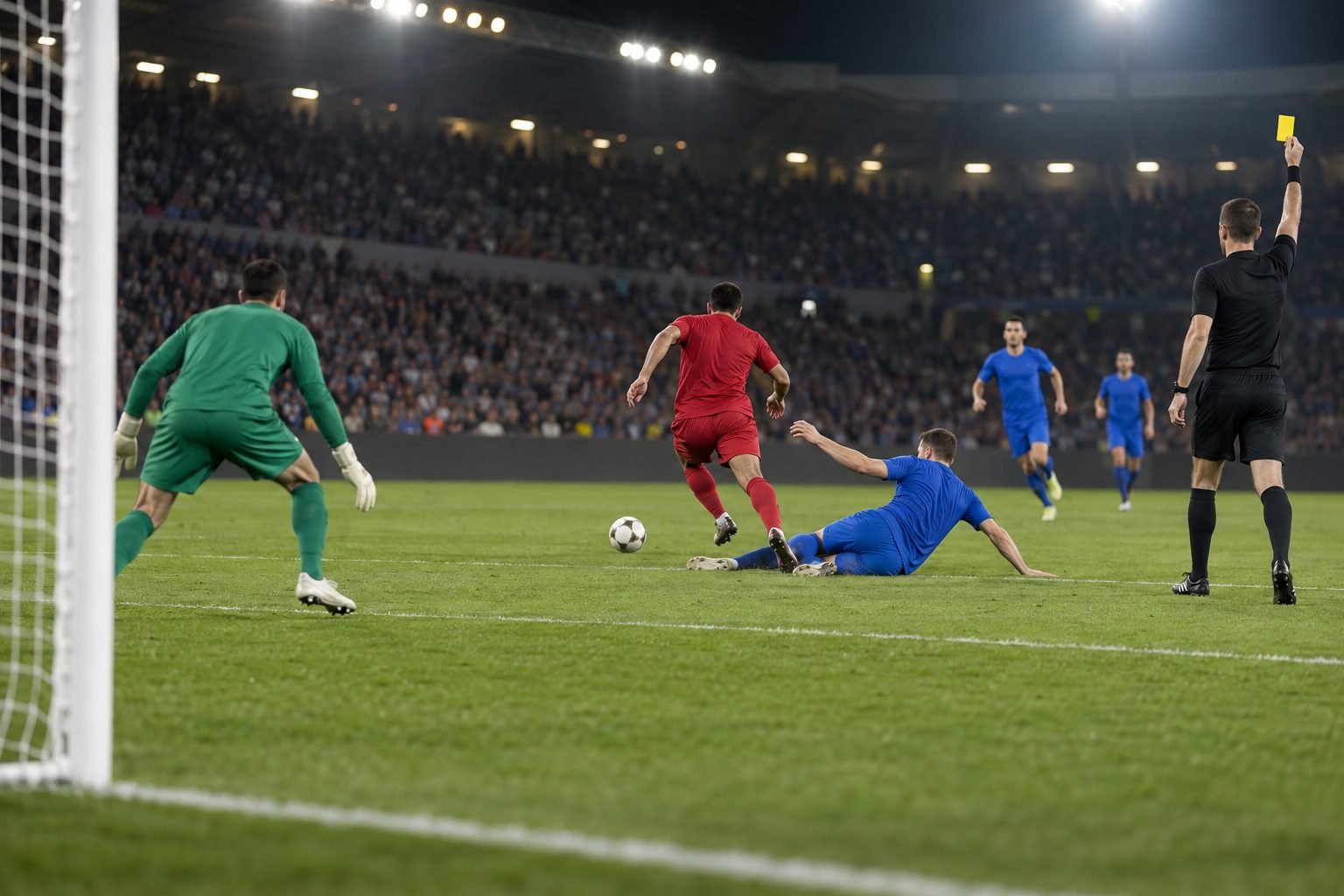
To decide whether an offence denied an obvious goal-scoring opportunity (DOGSO), the referee must consider the distance between the offence and the goal, the general direction of the play, the likelihood of keeping or gaining control of the ball, and the location and number of defenders and attackers. How and where it was denied sets the sanction.
How referees judge an obvious goal-scoring opportunity
The referee must consider these four points.
- The distance between the offence and the goal
- The general direction of the play
- The likelihood of keeping or gaining control of the ball
- The location and number of defenders and attackers
How the sanction changes with the way the chance was denied
Here is how the sanction depends on the way the chance was denied.
| How it was denied | Sanction |
|---|---|
| An offence punishable by a free kick against an opponent whose overall movement is towards the offender's goal, unless a penalty kick is awarded | Sending-off |
| An offence in the offender's penalty area that was an attempt to play the ball or a challenge for it, with a penalty kick awarded | Caution |
| Any other offence against an opponent in the offender's penalty area, such as holding, pulling or pushing, with a penalty kick awarded | Sending-off |
| A deliberate handball, anywhere (except a goalkeeper in their own penalty area) | Sending-off |
| A non-deliberate handball outside the offender's penalty area | Sending-off |
| A non-deliberate handball for which a penalty kick is awarded | Caution |
For an offence punishable by a free kick, the core rule is this: denying a goal or an obvious goal-scoring opportunity to an opponent whose overall movement is towards the offender's goal is a sending-off offence. That rule is still subject to the penalty-area branch, so the same denied chance does not always lead to the same card inside the box.
Inside the offender's own penalty area, the dividing line is the nature of the offence. When an offence against an opponent there denies an obvious goal-scoring opportunity and the referee awards a penalty kick, the offender is cautioned if the offence was an attempt to play the ball or a challenge for it. In all other circumstances, for example holding, pulling, pushing or no possibility to play the ball, the offender must be sent off.
Handball has its own DOGSO treatment
Handball is split into two separate branches. Deliberate handball that denies a goal or an obvious goal-scoring opportunity is a sending-off offence wherever it happens, except for a goalkeeper within their own penalty area.
Non-deliberate handball works differently. If it denies a goal or an obvious goal-scoring opportunity outside the offender's own penalty area, it is a sending-off offence. If the referee awards a penalty kick for a non-deliberate handball that denied the chance, the offender is cautioned instead.
Entering without permission and interfering can also be DOGSO
DOGSO is not limited to normal challenges between players who are already on the field. A player, sent-off player, substitute or substituted player who enters the field of play without the referee's permission, interferes with play or an opponent, and denies the opposing team a goal or an obvious goal-scoring opportunity commits a sending-off offence.
All three must be present: entry without the referee's permission, interference with play or an opponent, and the denial of a goal or an obvious goal-scoring opportunity.
FAQ
What does DOGSO mean in football?
DOGSO is the shorthand for denying a goal or an obvious goal-scoring opportunity. It describes the result of the offence rather than one fixed type of foul.
Is a professional foul always a red card?
Not automatically. “Professional foul” is an informal label; what matters is whether the offence denied a goal or an obvious goal-scoring opportunity and, if it did, how and where. Inside the offender's own penalty area, when a penalty kick is awarded for an offence that was an attempt to play the ball or a challenge for it, the offender is cautioned instead.
Why is a foul in the box sometimes only a yellow card?
Because of the penalty-area rule for an obvious goal-scoring opportunity. When an offence against an opponent in the offender's own penalty area denies an obvious goal-scoring opportunity and the referee awards a penalty kick, the offender is cautioned if the offence was an attempt to play the ball or a challenge for it; in all other circumstances, for example holding, pulling or pushing, the offender must be sent off.
Is a deliberate handball on the line a red card?
If a deliberate handball denies a goal or an obvious goal-scoring opportunity, the sanction is a sending-off wherever the offence occurs. The exception is a goalkeeper within their own penalty area.


