
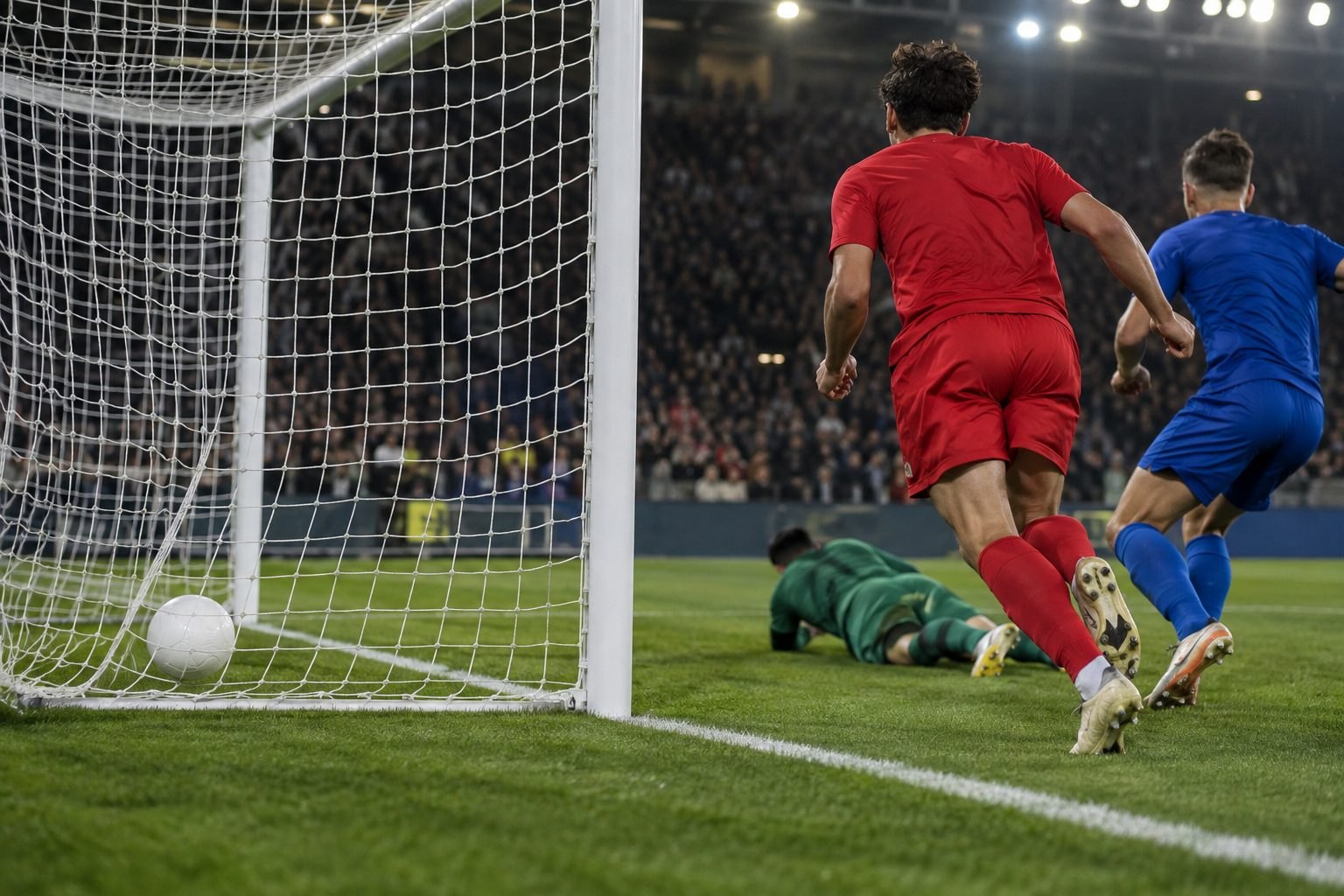
Yes. A goal is scored only when the whole of the ball has passed over the goal line, between the goalposts and under the crossbar, and the team scoring has committed no offence.
What makes a goal count
Those conditions all apply together. It is not enough for part of the ball to be over the line, close to the line, or inside the frame of the goal.
The lines belong to the areas of which they are boundaries. That means the goal line is part of the field of play, so a ball that has not wholly passed over that line has not left the field. The goal lines must also be the same width as the goalposts and the crossbar.
When the ball goes in
Here are the decisions for the main situations.
| Situation | Decision |
|---|---|
| The whole ball passes over the goal line between the posts and under the crossbar, with no offence by the scoring team | Goal |
| Part of the ball has not yet passed over the goal line | No goal; the ball has not left the field |
| The goalkeeper throws the ball directly into the opponents' goal | Goal kick |
| The goalkeeper accidentally throws the ball into their own goal | Goal |
| The referee signals a goal before the whole ball has crossed the line | Dropped ball |
Why a ball on the line is not a goal
The key point is the whole of the ball, not whether any part of it touches the goal line. If any part of the ball remains on the line or has not fully passed beyond it, the ball has not left the field.
The same standard applies whether the ball is on the ground or in the air.
Three separate special cases
These situations are close in appearance but not in outcome, so they have to be kept apart.
- Goalkeeper throws the ball directly into the opponents' goal: no goal; the restart is a goal kick.
- Goalkeeper accidentally throws the ball into their own goal: goal.
- Referee signals too early: if the whole ball had not yet crossed the line, play restarts with a dropped ball.
If the scoring team commits an offence, there is no goal. That point stands alongside the line-crossing requirement and does not replace it.
FAQ
Is it a goal if the ball is on the line?
No. The whole ball has to pass over the goal line for a goal to be awarded.
Because the line belongs to the field of play, a ball that is still on it has not left the field.
Can a goalkeeper score by throwing the ball?
Not by throwing it directly into the opponents' goal. The decision is a goal kick.
What happens if the referee signals a goal too early?
If the signal comes before the ball has passed wholly over the goal line, the goal does not stand. Play restarts with a dropped ball.
Both things are true here: the referee signalled a goal, and the ball had not yet passed wholly over the goal line.
What if a goalkeeper throws the ball into their own net?
If a goalkeeper catches a shot, gets up and accidentally throws the ball into their own team's goal, the referee awards a goal.
The outcome is different from a direct throw into the opponents' goal, even though both actions start with the goalkeeper's throw.