

Prime Intellect announces Series A and new revenue figures
Prime Intellect said on July 8, 2026 that it closed a $130 million Series A at a $1 billion valuation. The round was led by AI-focused venture firm Radical Ventures, with participation from NVIDIA Ventures, Intel Capital, and Dell Technologies Capital. The company said its total funding now exceeds $150 million.
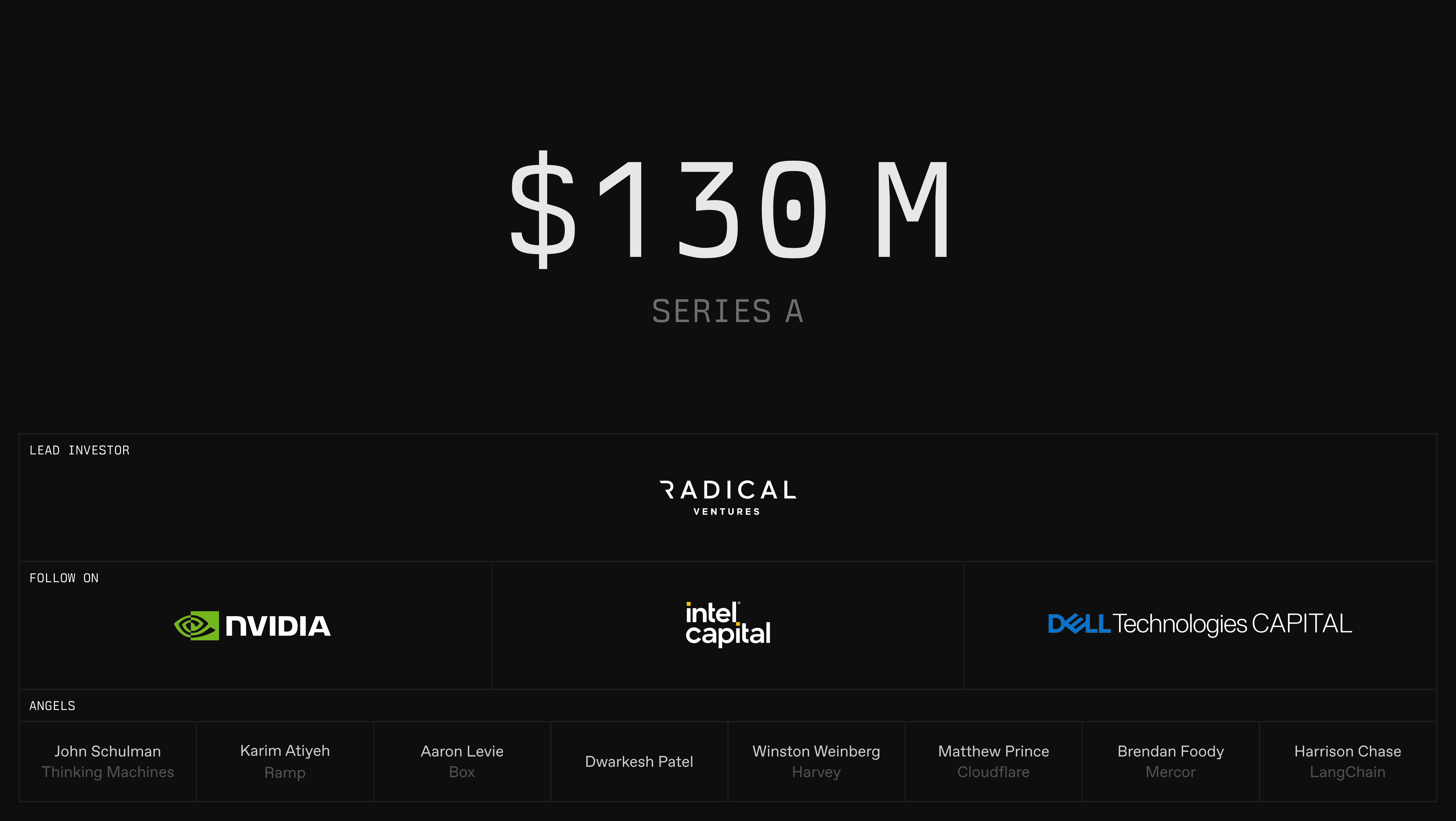
At the same time, Prime Intellect said its annual recurring revenue, or ARR, has risen to more than $100 million in less than a year. It also said the platform now serves more than 6,000 enterprise and startup customers.
Founders and earlier funding
According to Foresight News, Prime Intellect was founded in January 2024 by Vincent Weisser and Johannes Hagemann.
Weisser, the company’s CEO, has worked at the intersection of decentralized science and AI. He previously co-founded Bio Protocol, VitaDAO, and CryoDAO, and served as head of ecosystem and AI at Molecule. CTO Johannes Hagemann previously worked as an AI research engineer at German AI company Aleph Alpha, focusing on distributed AI, semi-automated engineering, and brain-computer interfaces.
In October 2025, investor Ash Arora joined Prime Intellect as head of Applied GTM, covering product strategy, commercialization, revenue, and application AI products in post-training and reinforcement learning. Arora recently said the company has reached 40 full-time employees.
Before the latest round, Prime Intellect raised a $5.5 million seed round in April 2024 led by Distributed Global and CoinFund, with Hugging Face CEO Clem Delangue among the angel investors. In March 2025, it raised another $15 million in a round led by Peter Thiel’s Founders Fund. Investors in that round included Andrej Karpathy, Tri Dao, Emad Mostaque, and others from the AI field.
From distributed training research to commercial products
One of Prime Intellect’s early technical milestones was showing that long-distance, heterogeneous GPUs could train together.
In late November 2024, the company released INTELLECT-1, a 10 billion-parameter model trained across nodes in five countries and three continents. Prime Intellect said the run reached 83% overall compute utilization across continents, and 96% utilization when training used only nodes located across the United States.
Less than six months later, it released INTELLECT-2 and pushed the target to global distributed reinforcement learning at 32 billion parameters. To support that work, the team built the asynchronous reinforcement learning framework PRIME-RL, SHARDCAST for model weight propagation, and TOPLOC to verify whether inference nodes were completing assigned work as claimed.
A more important step came with INTELLECT-3. In November 2025, Prime Intellect released a 106 billion-parameter MoE model based on Zhipu’s GLM-4.5-Air, trained with supervised fine-tuning and reinforcement learning. The model was trained for about two months on 64 nodes and 512 NVIDIA H200 GPUs. Model weights, the training framework, data, RL environments, and evaluation methods were all open-sourced.
Foresight described that release as validation of a full production stack rather than just another model launch. PRIME-RL handled asynchronous training, Verifiers and Environments Hub provided tools to build and host RL environments and evaluations, Prime Sandboxes isolated code generated by agents, and the compute orchestration layer handled clusters, storage, and monitoring.
Lab, prime-rl, and system-level optimization
In February this year, Prime Intellect launched Prime Intellect Lab, a full-stack AI training platform for individuals, engineers, and AI companies that want to train and optimize their own models, especially agentic models, without building expensive GPU clusters. Lab exited testing and became generally available on May 7.
In June, the company released prime-rl 0.6.0. It said the update pushed the engineering ceiling to trillion-parameter-scale MoE models. Prime Intellect also said that on GLM-5 software engineering tasks, 28 H200 nodes could process sequences of up to 131,000 tokens with per-step training time below five minutes.
The company tied those gains to joint optimization of training and inference systems. On the inference side, it uses low-precision FP8 compute as well as DeepEP and DeepGEMM to improve throughput, separates prefilling from decoding, and uses tiered KV cache offloading to increase concurrency. On the training side, it also uses block-scaled FP8, applies Router Replay to reduce routing differences between training and inference in MoE models, and combines that with FSDP, expert parallelism, and context parallelism.
In July, prime-rl added a unified algorithm layer with six built-in methods: GRPO, MaxRL, On-Policy Distillation, self-distillation, SFT Distillation, and ECHO. It also lets users choose different algorithms for different environments within the same run. Foresight wrote that this pushes Prime Intellect closer to an extensible RL operating system.
NVIDIA ties extend beyond investment
The report said the relationship with hardware companies now runs deeper than capital alone.
On the hardware side, Prime Intellect said its training and serving workloads already use NVIDIA Blackwell, Blackwell Ultra, and NVL72 rack-scale systems, which it described as more efficient than earlier Hopper clusters.
On the software side, NVIDIA Dynamo is used for global inference orchestration, autoscaling, request routing, and KV cache offloading, alongside Prime Intellect’s large-scale LoRA deployment. NVIDIA’s own technical blog confirmed that Prime Intellect has deployed Dynamo in production workflows and took part in co-designing and integrating LoRA Adapter support.
Prime Intellect also said in March that it would test RL sandbox workloads around NVIDIA Vera CPUs and planned to move some sandboxes after Vera becomes publicly available, while offering GPU sandboxes on Vera Rubin systems. In company testing, each Vera CPU socket could stably run 176 virtual machines in parallel. Under its RL sandbox workload setup, throughput with multithreading enabled was on average about 30% higher than an AMD Zen 5 baseline on AWS using only physical cores.
The report added an important limit: those figures came from joint testing and the comparison environments were not identical, so they should not be treated as independent general-purpose performance conclusions. It also said Vera Rubin and GPU sandboxes should be described as planned deployments rather than large-scale commercial use today.
Commercial use and the Ramp example
Prime Intellect said fintech company Ramp used Prime Intellect Lab to train a retrieval sub-agent called FastAsk for Ramp Labs. Ramp turned its AI spreadsheet editor, Ramp Sheets, into a trainable RL environment and used Qwen3.5-35B-A3B as the base model for reinforcement learning.
According to results published by Prime Intellect, FastAsk reached 66.25% accuracy, above Claude Opus 4.6 at 61.88%, while average latency was about 27% lower. The report noted that the test set and evaluation were defined by the two partners, so the result does not show that the 35B model is stronger than Opus in general use. What it does show, according to the article, is that enterprises can train smaller models into specialists for specific workflows.
What the $100 million ARR figure does and does not say
Foresight noted that Prime Intellect used the phrase “more than $100 million in annual recurring revenue,” not that it had already generated $100 million in revenue over the past year.
ARR usually annualizes the revenue pace from a recent month or quarter. When a business is growing quickly, that number can be higher than actual revenue from the previous 12 months. For usage-based GPU, training, and inference businesses, the figure also does not mean customers have signed annual auto-renewing contracts of the same size.
Based on Prime Intellect’s announcements and live products, the report said the company’s revenue comes from four main areas: a compute marketplace for hourly GPU instances, multi-node clusters, and reserved clusters; Lab hosted training priced by model input, output, and training tokens; inference and hosted evaluation tied to usage volume; and Sandboxes charged by CPU, memory, disk, and runtime.
The article said the growth logic is straightforward. GPU clusters carry high ticket sizes and ongoing hourly consumption. Prime Intellect is also extending customer spend from renting GPUs into building environments, running inference, doing evaluation, reinforcement learning training, and deployment. Agentic reinforcement learning also consumes more compute than standard API question answering because it requires large parallel rollouts, long-context inference, and isolated sandboxes.
Still, the report said several limits remain. Prime Intellect is a private company and has not published audited financial statements, the monthly or quarterly revenue figures behind ARR, paid conversion rates, revenue breakdown, or customer concentration. It also has not explained whether compute marketplace revenue is recognized as total customer spend or net platform revenue.
The company’s compute marketplace does not currently offer a formal service-level agreement, or SLA. Prime Intellect said that is because the underlying infrastructure comes from multiple suppliers. It recommends Secure Cloud for users with higher stability requirements, and says supplier-side failures may lead to refunds or platform credits.
Web3 language disappears from documentation
The report closed with a shift in how Prime Intellect presents itself. As the company entered the $1 billion valuation club and announced ARR above $100 million, wording that previously appeared in official documentation with a stronger Web3 tone had been removed. That included references to contracts deployed on Base Sepolia testnet, a future migration to a proprietary chain, and token rewards distributed to compute pools through a RewardsDistributor contract based on active time.
Foresight said signs of that shift were already visible in an official post from early March 2025, when Prime Intellect announced its $15 million round led by Founders Fund. That investor list included Andrej Karpathy, Clem Delangue, and Balaji Srinivasan.
The article argued that Prime Intellect still keeps the network topology of distributed, peer-to-peer model training, but decentralization is no longer presented through a token narrative aimed at retail participants. Instead, it is framed more as a way to dispatch idle compute globally for enterprise customers. In the report’s description, Prime Intellect now looks much more like an AI SaaS company.