
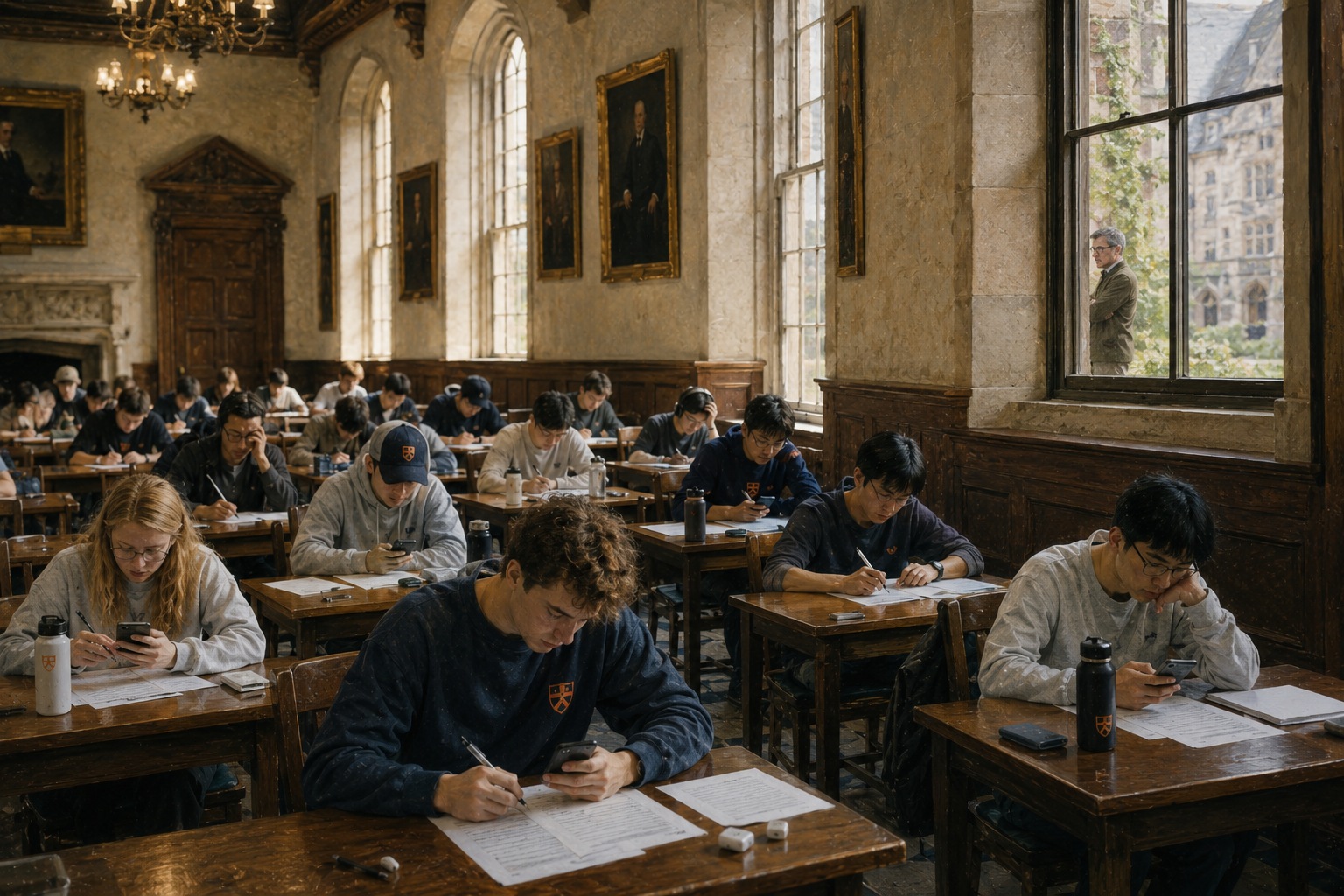
Princeton University faculty have voted to bring back proctored exams in 2025, ending an unproctored testing tradition that dated to 1893. For 133 years, the school’s Honor Code rested on a simple premise: students would complete exams without supervision and affirm that they had neither given nor received unauthorized help.
That framework came under heavy strain after the commercial release of ChatGPT. The article argues that Princeton’s long-running default of trusting students is being replaced by systems built around prevention, with professors returning to exam rooms and assessment design shifting toward verification rather than assumption.
Survey data shows both cheating and silence
The numbers cited in the piece are stark. In the 2024–25 academic year, 82 students were found responsible for academic dishonesty, up from 50 three years earlier. An anonymous survey of the graduating class by the student newspaper collected 501 responses; 30% said they had cheated, and 28% said they had used ChatGPT without permission.
Another figure stands out. 45% of respondents said they knew classmates had cheated but did not report it. In a system that relied on peer enforcement as a final safeguard, that level of non-reporting cuts at the core of the Honor Code. The article also says take-home exams fell by more than two-thirds over the past year.
Oral defenses, blue books, and document tracking
Departments and professors are already changing how students are evaluated. Princeton’s economics department plans to require students to orally defend research papers, using live questioning to test whether the work is actually theirs. History professor David Bell has replaced take-home exams with in-class blue-book tests and moved short writing assignments into Google Docs so he can review the drafting process, including edits, pauses, and abrupt polished passages.
Bell’s remarks in the article point to a broader cost. Students can tell these changes are aimed at blocking AI use, and they also understand what that implies about faculty trust. Once a system shifts from “students are trusted” to “students are presumed suspect,” the article suggests the spirit of the Honor Code has already been broken, even if the label remains.
The dispute is also about what exams are meant to prove
The commentary pushes beyond misconduct statistics and asks what exams are actually measuring. If the purpose is to prove that a student can produce work alone, without outside assistance, AI directly weakens that model. If the purpose is to judge whether someone can get the job done, the focus may move away from whether every sentence was typed unaided and toward whether tools were used effectively.
The piece also draws a parallel with the crypto industry’s trust-minimizing logic. It notes that the Bitcoin white paper proposed cryptography as a substitute for trust in financial intermediaries. In education, the argument goes, once technology drives the cost of cheating close to zero, systems built on moral self-restraint lose their footing. At Princeton, that shift is no longer theoretical; it is now reflected in exam rules.