
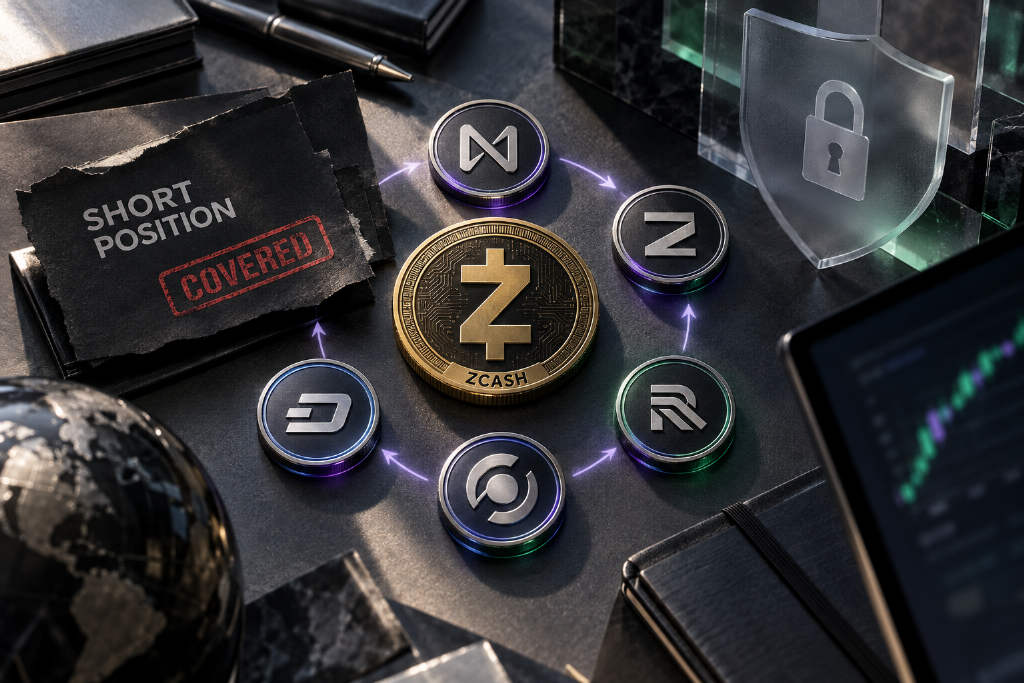
PANews has published a detailed review of the privacy-token segment, arguing that capital in the sector has been rotating through a clear sequence as traders move from liquid flagship names to infrastructure and then to higher-beta application plays. The article also points to a notable position change by Garrett Jin, identified in the piece as the "10.11 insider whale" and known for holding a large ZEC spot position while also running a short. According to the report, he closed his ZEC short in one move after it had been showing a $30 million unrealized loss.
The piece says ZEC has surged sharply from its lows and at one point saw its all-time high approach $1,600, helping turn it into one of the standout tokens in the current run and fueling fresh FOMO around the privacy theme. It also cites a recent interview in which Ethereum co-founder Vitalik Buterin said, "I won’t give up on privacy."
Four-step capital rotation in the privacy segment
The PANews article breaks the flow of funds into four steps:
- First, buy tradable privacy assets such as ZEC.
- Second, buy routing layers that make privacy the default user experience, represented by NEAR.
- Third, buy infrastructure that enables encrypted computation on public blockchains, represented by ZAMA.
- Last, move into application plugins and legacy beta names such as RAIL, ZEN and DASH.
ZEC and NEAR: pricing core and traffic entry points
ZEC
The article describes ZEC, or Zcash, as the preferred large-capital allocation in this cycle and calls it the leading compliant privacy coin. The data cited in the piece puts ZEC at $1,508.87, up 42.20% over seven days, with a fully diluted valuation of about $25.55 billion.
PANews says ZEC’s appeal rests on several points. It supports view keys, which the article says makes it compatible with audit requirements and anti-money-laundering expectations. It also notes the existence of a Grayscale trust channel, which the author presents as a compliant route for large investors seeking exposure to the privacy narrative. The report adds that ZEC’s circulating ratio is close to 100%, leaving little overhang from early venture unlocks, and says its market value and liquidity rank near the top of the privacy segment, giving it room to absorb large inflows and outflows.
NEAR
NEAR Protocol is presented as the chain-abstraction routing layer that fits the ZEC trade. The article lists NEAR at $4.19, up 81.20% over seven days, with a fully diluted valuation of about $5.47 billion.
According to the report, NEAR uses chain abstraction and multi-chain signing to embed privacy-preserving interaction into the routing layer, allowing users on Ethereum and Solana to operate without switching to a dedicated wallet. PANews argues that this lets NEAR capture cross-chain interaction flow while also benefiting from its role as public-chain infrastructure and from the overlap of AI, chain abstraction and privacy narratives.
The article also highlights the NEAR@3.33 mechanism. It says the design pushed airdrop TVL to $70 million and triggered the first snapshot. Eligibility required users to keep more than $100 in a NEAR privacy account and complete at least one private swap. The tokens remain locked and convert into circulating NEAR only after NEAR’s three-day VWAP rises above $3.33. The report notes that NEAR’s market price is already well above $3.3.
ZAMA and RAIL: infrastructure and plugin names with higher elasticity
ZAMA
ZAMA is described as infrastructure for fully homomorphic encryption, or FHE, on public blockchains. The article lists the token at $0.0862, up 83.20% over seven days, with a circulating market capitalization of about $213 million and a fully diluted valuation of about $973 million.
PANews says Zama leads development of fhEVM and positions that work as a step beyond zero-knowledge systems that only verify, rather than compute on encrypted data. The article says the project is aimed at problems such as MEV resistance and confidential DeFi. It also describes ZAMA as an early leader in the FHE track with a high technical barrier and broad narrative room. At the same time, the report notes that only about 21.8% of the supply is circulating, which gives the token higher elasticity during a strong uptrend but leaves unlock schedules as a risk to watch later.
RAIL
RAIL, or Railgun, is framed as a native EVM smart-contract privacy plugin. The article puts the token at $3.04, up 52.20% over seven days, with a fully diluted valuation of about $182 million.
The report says Railgun is deployed directly as a contract on Ethereum mainnet and major Layer 2 networks, allowing users to make zero-knowledge private transfers without taking on bridge risk. It also says Vitalik has publicly used and recommended the tool multiple times. With the token already 100% unlocked and the market cap still relatively small, PANews presents RAIL as an application-layer beta play for the stage when capital spills over from larger names.
XMR: strong privacy, weak liquidity access
Monero, or XMR, is grouped into a different category. The article calls it a top-tier anonymity asset whose liquidity is heavily constrained. The figures cited show XMR at $571.95, up 9.20% over seven days, with a fully diluted valuation of about $10.75 billion.
PANews says Monero’s default mandatory privacy and stealth-address design gives it very strong censorship resistance, but the same features leave it unable to meet FATF travel rule expectations. The article says that has led to delistings from most major centralized exchanges globally. As a result, entry and exit are more dependent on DEX venues and OTC markets, and institutional capital cannot scale into the asset easily. In the author’s view, that helps explain why XMR has shown much less price elasticity than the rest of the privacy segment during the latest rally.
ZEN and DASH: older privacy names lag newer narratives
ZEN
Horizen, or ZEN, is listed among the older names that the article says have become disconnected from the current privacy-tech cycle. The report gives ZEN a price of $7.70, a seven-day gain of 23.90%, a circulating market capitalization of about $141 million and a fully diluted valuation of about $162 million.
According to PANews, Horizen previously removed its Shielded Pools in order to reduce delisting risk on exchanges, effectively shifting toward a general modular EVM-chain model and away from native privacy competition. The article says its recent move has been driven mainly by low-market-cap rebound dynamics and residual sector memory rather than by a standalone fundamental catalyst. It also notes that the circulating ratio has reached 87.3%.
DASH
Dash is placed in the same group. The article lists DASH at $56.60, up 6.00% over seven days, with both circulating market capitalization and fully diluted valuation at about $726 million.
PANews says Dash still relies on a masternode-based CoinJoin model. Compared with newer zero-knowledge and FHE approaches, the article argues that this design lacks a modern cryptographic edge, is easier to track through on-chain analysis and still faces scrutiny from centralized exchanges. In the report’s framing, DASH has clearly lagged the broader privacy-sector rally and remains a low-attention name in the current rotation.