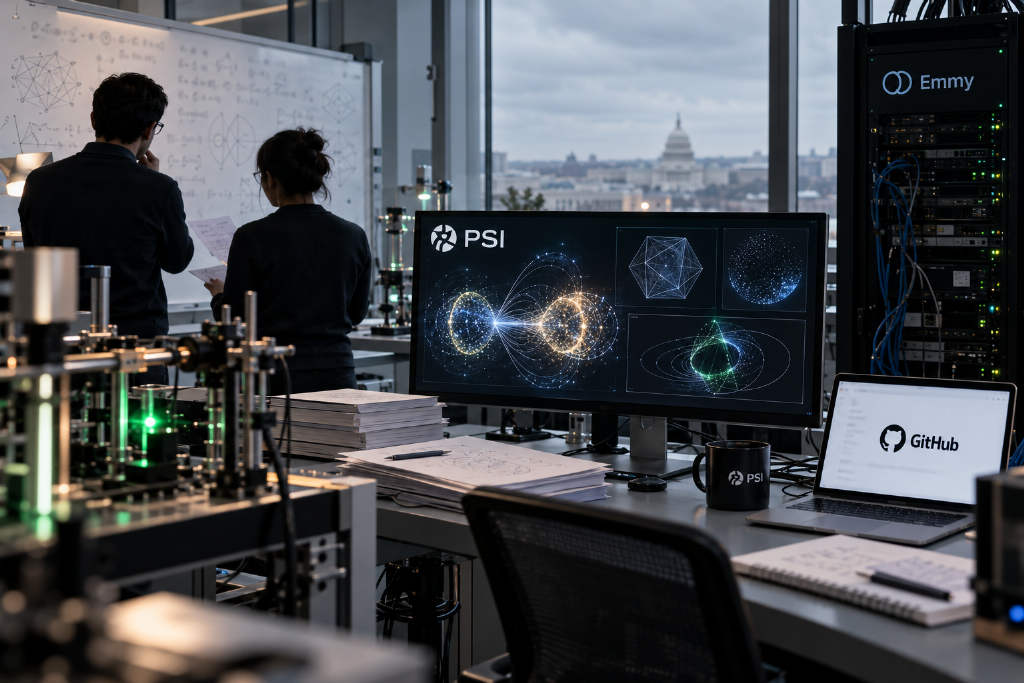
AI research company PSI said it has made progress on five open problems in quantum information theory with help from its in-house AI system, Emmy. The company said the related paper, Lean formal proofs, and verification code have been released on GitHub. According to PSI, the five problems come from an open quantum problems catalog established in 1999 and span entanglement distillation, quantum field theory, high-dimensional quantum communication, quantum channel capacity, and quantum causality. PSI also said that when it emerged publicly in September this year, it announced a $58 million seed round led by Breakthrough Energy Ventures. The company plans to launch the deep-space probe Fermi Explorer before 2029. The item was cited by Techub News and attributed to QbitAI.
Techub News reported that AI research company PSI said it had made progress on five open problems in quantum information theory with the help of its in-house AI system, Emmy. The company said the related paper, Lean formal proofs, and verification code have been published on GitHub.
PSI said the five problems come from an open quantum problems catalog established in 1999. They cover entanglement distillation, quantum field theory, high-dimensional quantum communication, quantum channel capacity, and quantum causality.
When PSI emerged publicly in September this year, it announced a $58 million seed round led by Breakthrough Energy Ventures. The company also said it plans to launch the deep-space probe Fermi Explorer before 2029.
The item was attributed to QbitAI.
This article was originally published by Bit.Fan. For more cryptocurrency news and market insights, visit www.bit.fan. Disclaimer:
The market information, project data, and third-party content displayed on this platform are for industry information sharing only and do not constitute any form of investment advice or return commitment.
Cryptocurrency trading carries high risks. Users should fully assess their risk tolerance and make independent decisions. All profits, losses, and legal responsibilities are borne by the users themselves.