
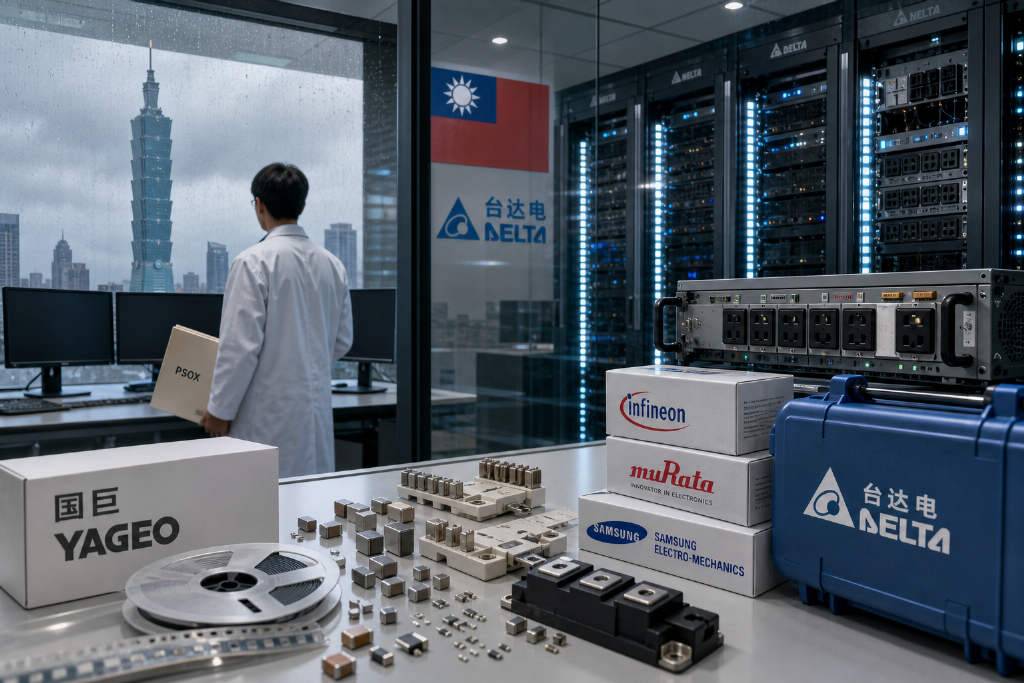
Tema ETFs launched the Tema MLCC & PowerSemi ETF, ticker PSOX, in August 2026 on the CBOE BZX Exchange. The actively managed fund is built around two components used in AI server power systems: multilayer ceramic capacitors, or MLCCs, and power semiconductors.

PSOX was established on Aug. 17, 2026 and carries a total expense ratio of 0.75%. Because the ETF only recently began trading, assets under management stood at $868,000 at the time cited in the report, a size that ABMedia said leaves the fund with relatively higher volatility and liquidity risk.
ABMedia said PSOX follows the same collaborative approach used in Tema’s earlier memory-focused ETF, DISK, which targeted demand growth in DRAM and NAND. PSOX was also launched with semiconductor research firm SemiAnalysis and combines active stock selection with sector research, this time focusing on a part of AI infrastructure that the report described as often overlooked: the power-component supply chain.
Top holdings and country weights
Based on holdings data dated Aug. 27, 2026, PSOX’s 10 largest positions were listed as follows, with weights subject to market-price changes:
- Delta Electronics (2308): 10.62%
- Infineon: 10.12%
- Murata Manufacturing: 9.81%
- Samsung Electro-Mechanics: 9.15%
- Yageo (2327): 8.56%
- Renesas Electronics: 4.54%
- Bloom Energy (BE): 4.49%
- Holy Stone (3026): 4.46%
- STMicroelectronics: 4.45%
- Navitas Semiconductor: 4.44%
Taiwan accounted for the largest share of the portfolio at 29.84%, followed by the United States at 21.76%, Japan at 19.91%, Germany at 14.55%, and other countries combined at 13.94%.
The report said PSOX does not make a concentrated bet on a single country or one dominant company. Instead, it spans both major MLCC names and power semiconductor makers. Murata, Yageo, Samsung Electro-Mechanics and Holy Stone represent the passive-component side, while Infineon, Renesas and STMicroelectronics sit on the power-semiconductor side. Delta Electronics, according to the article, stands out because its business touches both power management and energy systems, giving it exposure to both themes.

Why MLCCs and power semiconductors matter
The article says MLCCs stabilize and regulate electrical current, while power semiconductors handle power conversion and control. Both are described as essential parts of server motherboards and power-supply chains, even if they receive less attention than other AI hardware categories.
As AI data centers move toward 800V DC architecture to handle rising rack power consumption, SemiAnalysis estimates that MLCC demand for AI servers will grow fivefold by 2027. Mirae Asset Securities, also cited in the article, estimated that the cost share tied to power semiconductor usage in a single rack could increase by more than 11 times. The report argues that those trends could turn both component groups into potential bottlenecks during the AI hardware upgrade cycle.
ABMedia also pointed to high barriers to entry. Manufacturing MLCCs and power semiconductors requires heavy capital spending and precise process know-how, making it difficult for new entrants to catch existing leaders on yield and production capacity in a short period. On that basis, the article said established companies such as Murata, Yageo, Infineon and STMicroelectronics may be better positioned to maintain market share.
Who the fund is for
ABMedia described PSOX as a thematic ETF focused on the AI power-infrastructure supply chain. By concentrating on suppliers in the MLCC and power-semiconductor segments, the fund gives investors a way to take part in a less crowded but still important part of the AI hardware upgrade cycle, rather than focusing only on GPUs, memory or Neoclouds.
The article also noted the risks. PSOX is newly launched, has a small asset base and is highly concentrated in a specific industry group. If the economic or sector cycle turns, the fund could see larger swings. In the report’s framing, the ETF is more suitable for investors with higher risk tolerance who agree with the view that AI servers will keep upgrading their power architecture and that demand for MLCCs and power semiconductors will rise together.