
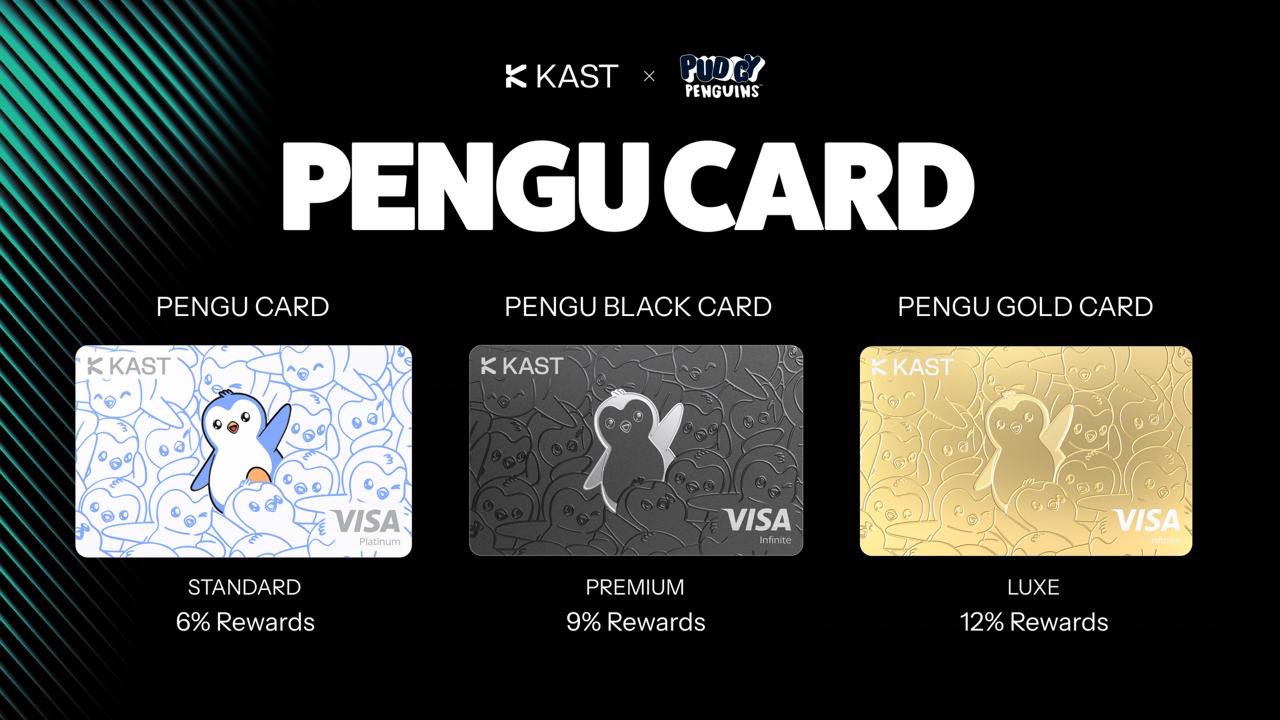
Pudgy Penguins announced this morning on X that 'Pengu' has officially entered consumer finance. The NFT project partnered with Visa and crypto payments startup KAST to launch Pengu Card, enabling users to spend stablecoins and crypto directly without converting fiat via centralized exchanges.
How Pengu Card Works: Three Layers of Brand Packaging
Built on KAST's infrastructure—a fintech firm focused on stablecoin payments and Visa-network crypto debit cards—Pengu Card adds three layers of brand customization:
First, the reward mechanism: up to 12% cashback on spending and up to 7% yield on assets, depending on card tier. While 12% far exceeds typical 1-3% from traditional credit cards, high cashback is not rare in the crypto debit card space, often paid in native tokens subject to market performance.
Second, a three-tier card system: Standard, Black, and Gold, each with different reward rates and feature sets.
Third, a community referral mechanic: waitlisted users receive referral codes; more invites mean higher ranking, and the top 10 referrers get a Black Card directly. This is a classic Web3 growth strategy—leveraging network effects over traditional ad spending.
From Toy Shelves to Financial Products: The Expansion Logic
Pudgy Penguins, born in 2021, has long outgrown being a set of JPEGs. Over two years it blazed a trail few in NFTs have replicated: physical consumer goods. Its plush penguin toys have sold over 1 million units, generating more than $13 million in retail revenue, stocked at Walmart, Target, and 2,000 Walgreens across the U.S. From 2023 to 2025, toy revenue CAGR hit 123%.
2026 sees even bolder moves: a cross-IP collaboration with DreamWorks' Kung Fu Panda, an Asian retail push via Suplay Inc., and a target of going public by 2027 with annual revenue above $50 million.
Pengu Card is the latest extension of this expansion line. The logic is clear: plush toys got Pudgy Penguins into physical retail; the debit card gets it into financial services. An IP brand is steadily building its own consumer ecosystem.
A Crowded Crypto Debit Card Arena: Can Pengu Card Stand Out?
Pengu Card is not alone. Coinbase's Visa card, Crypto.com's CRO card, and Binance-Mastercard co-branded cards already cover multiple markets. The differentiator isn't technology—it's brand and community. Pudgy Penguins boasts one of the most active communities in crypto. For them, this card is less a standalone financial product and more an anchor for community stickiness. But which model proves more sustainable remains an open question.
High cashback rates often prove unsustainable. Early generous subsidies aim at customer acquisition; once they shrink, retention suffers. Crypto.com's CRO card is a cautionary tale—a sharp reward cut in 2022 sparked massive community backlash.
Pudgy Penguins has brand, community, and physical retail revenue as a foundation. But transitioning from an NFT brand to a financial services provider requires more than a Visa card—it demands compliance costs, risk management, and long-term user trust. How far this penguin goes depends on how long its brand holds.