Pump.fun has launched Diamond, a rewards algorithm that runs alongside its existing program, now renamed Degen. The new system expands incentives beyond trade generation, assigning weight to holding time, higher-market-cap tokens and assets beyond Solana. Whether those rewards can attract genuine long-term holders remains uncertain: an algorithm can measure balances and duration, but it cannot readily tell whether a position is hedged or whether its holder believes in the asset.
This article was written by Fugui and published by Foresight. Its central question is what happens to user retention when the subsidies stop.
Why the rewards now favor holders
On November 6, 2026, Pump.fun co-founder Alon announced on X that the platform had introduced Diamond. The previous algorithm was renamed Degen, and both programs would operate in parallel.
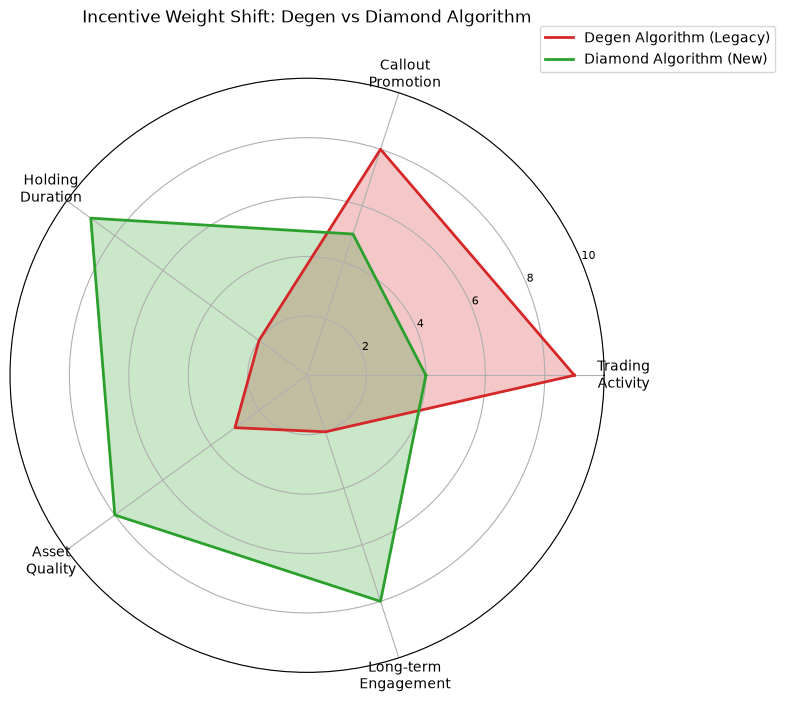
Degen rewards users who promote tokens and generate trading activity. The more volume a Callout brings in, the more USDC its author can receive. Diamond takes a different approach: it adds multipliers to Callouts for higher-market-cap tokens and gives greater weight to perps, EVM-chain assets and assets outside Solana. The focus shifts from bringing in trades to rewarding longer holding periods and users who are less quick to sell.
That is a notable change for a platform built on rapid trading, frequent token launches and fees from repeated turnover. The article argues that Pump.fun has not suddenly embraced long-term investing; its earlier growth model is running into limits.
Diamond Hands predates Pump.fun
“Diamond Hands” was not coined by Pump.fun. The phrase emerged on Reddit’s r/WallStreetBets during the 2021 GameStop episode, as retail traders used it to describe holding through institutional shorting and sharp price swings. Its counterpart, “Paper Hands,” referred to people who sold at the first sign of volatility. The phrase later entered crypto culture and merged with HODL, becoming an identity marker for long-term holders.
Pump.fun is also not the first to turn holding into a measurable incentive. Virtuals Protocol launched its Diamond Hand Bonus in 2025. Holders of tokens in the Genesis ecosystem could earn extra points every 24 hours, with longer holding periods bringing more points. The program was later upgraded so users had to stake to receive rewards, turning passive holding into an active lockup.
In September 2026, BNB Chain ran a $4 million Meme season built around its HODLer Index. The index scored participants by holding size and duration, deducted points for selling along the way, and required at least $100 in holdings to qualify for rewards. Moonshot takes a different route: it allocates 80% of new-token issuance fees, with 70% of that allocation going to the first 50 holders. The structure is intended to let early supporters share in a token’s long-term price gains. BONKRewards, part of the BONK ecosystem, pays users a share of trading fees for locking tokens; longer lockups bring a larger share.
Others have also tried to put a price on social attention. Kaito’s Yaps system uses AI to score crypto content based on information added, the weight of those engaging with it, and its influence within a particular narrative—not simply the number of posts or likes. Users accumulate Yapper Points, which are linked to project allocations and airdrops. The model is an example of InfoFi: treating information and attention as assets that can be traded.
The article’s view is that Pump.fun did not invent Diamond Hands. It brought social recommendations, trading outcomes, asset market capitalization, holding time and cross-chain incentives into a single Callout Rewards system. Earlier platforms often rewarded token issuers, traders and content creators separately. Pump.fun is trying to combine those roles: users who create widely shared content, hold assets with their own money and generate actual trading outcomes can earn the most. That moves the platform beyond a token-launch tool.
From launch tool to trading social network
Pump.fun’s original model was straightforward. For a few dollars, anyone could issue a Meme token through a Bonding Curve. Buying pushed the price up; selling pushed it down. Once liquidity reached the required level, a token “graduated” and began trading on PumpSwap, an automated market maker (AMM), while the platform collected a fee on each trade. The model depended on a constant supply of new tokens and speculative opportunities, with users moving quickly from one token to the next.
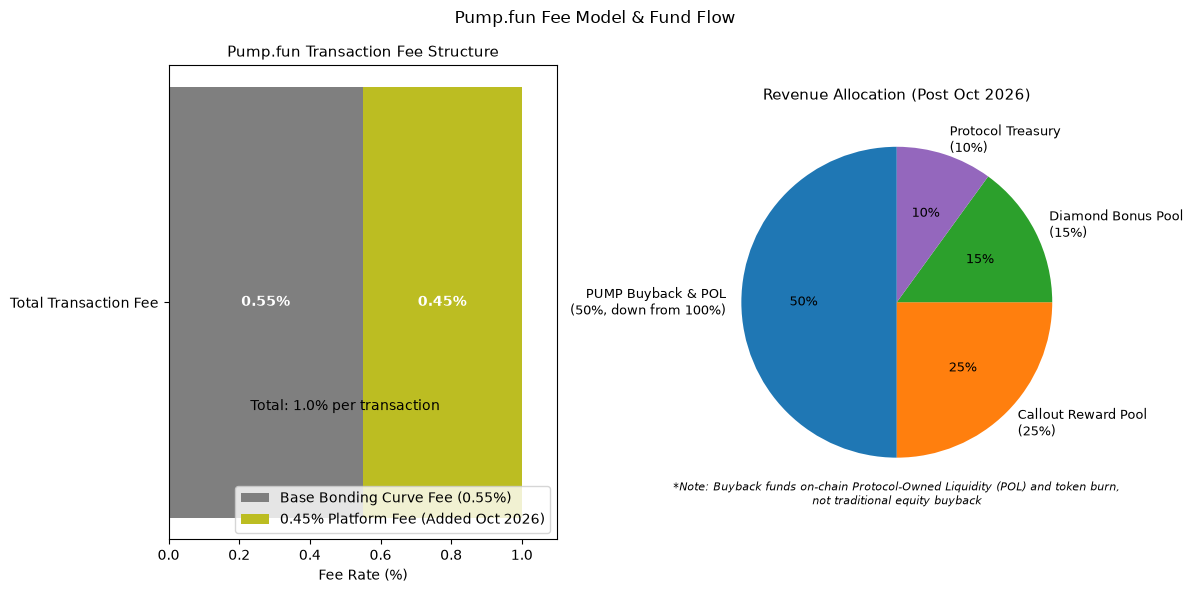
The weakness was just as clear: tokens had short lifespans, users arrived and left quickly, and the platform struggled to retain either people or capital. Pump.fun added products over time. PumpSwap took over trading liquidity for graduated tokens. Callout Rewards paid creators whose recommendations generated trades. Terminal, a trading interface, a mobile app and perps followed. On October 17, 2026, the platform added a 0.45% platform fee, reducible to 0.40% with a referral code. Diamond now directs more rewards toward higher-market-cap assets, cross-chain assets and holding.
The two reward tracks target different users. Degen continues to serve existing customers who favor small tokens and high-frequency trading. Diamond is meant to attract perps traders, EVM-chain users and participants willing to hold larger-market-cap assets.
PumpSwap has become Pump.fun’s largest source of revenue. It generated about $107 million in fees in October 2026, or 61% of fees across all products. Pump.fun is no longer earning only from token launches. It wants to cover the chain of activity around an asset: discovery, discussion, trading and holding.
Callout is central to that trading-led social model. On X, a user who sees a KOL recommendation must go elsewhere to trade and may not know when the promoter sells. On Pump.fun, a Callout sits within the platform’s system: the author’s holdings, trading history and the volume generated by recommended tokens can be checked on-chain, and the platform pays cash rewards directly.
That model differs from X, which earns through advertising; Farcaster, which relies on ecosystem applications; and Hyperliquid, which earns trading fees. Pump.fun wants content, assets, trading and rewards to operate in one product loop.
The contest is shifting from launch speed to capital retention
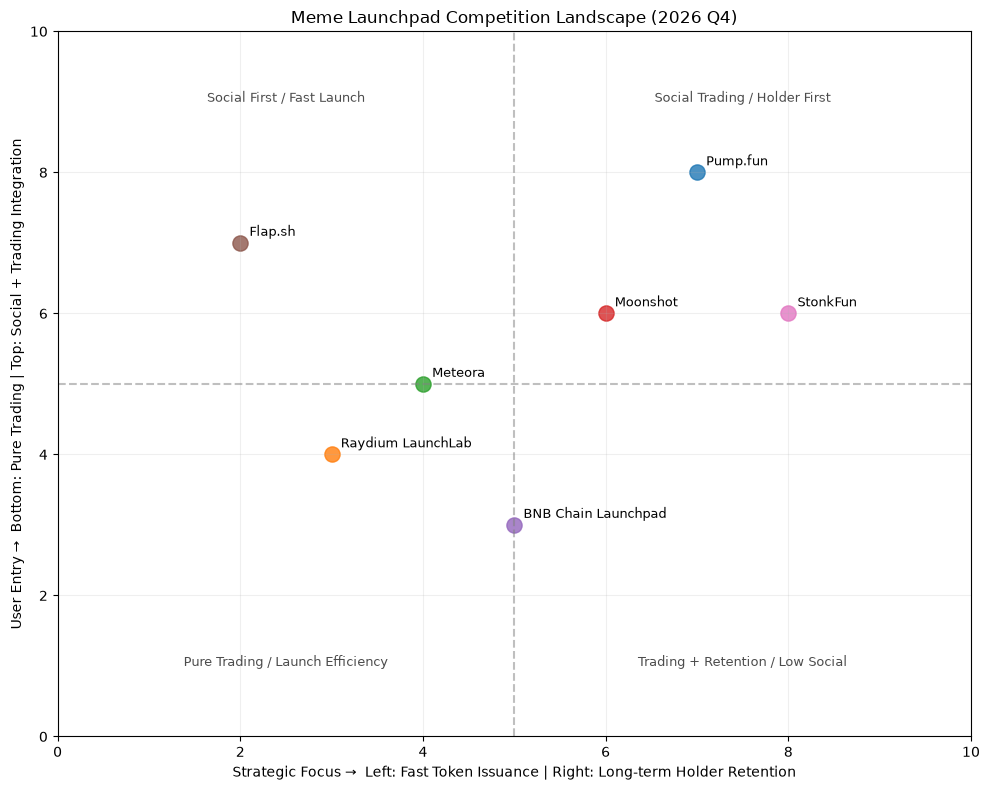
The article places Pump.fun’s strategy in a broader competitive shift. Rivals have continued to pursue token launches. Raydium introduced LaunchLab, using its Solana AMM liquidity to capture new launches and trading after graduation. Meteora differentiates itself with Dynamic Bonding Curve, focused on launch curves and liquidity management. StonkFun pairs Meme tokens with stock narratives. Flap.sh offers similar one-click token launches on BNB Chain and other networks. Ponsfamily, which appeared in 2026, recorded daily revenue above Pump.fun’s for several days.
Those competitors are still contesting the established business: which platform makes launches easier, offers lower trading slippage or gives creators a larger share. The article sees a deeper change in the effort to keep users and money on-chain. BNB Chain’s $4 million Meme season asks how long users and funds remain on the network. Moonshot shares issuance fees with early holders to align their interests with a token’s longer-term performance. Virtuals requires staking to collect holding rewards. BONK lets locked-up users share fees across its ecosystem.
Platforms once competed on issuance efficiency: whoever let a user launch a token in one minute had an advantage. Now the contest is about retention—keeping users in a token and their capital in an ecosystem for longer. The first model needs a steady supply of speculative assets, like a casino opening new tables. The second needs to give users a reason to stay.
As of November 2026, Pump.fun still held about 74% of Solana Launchpad fee market share and around 49% across all chains. It remained the leader. Its share of new-token trading volume, however, had fallen from a peak above 90% to a low of 52%, and was being gradually eroded.
Record fees, cooler trading
Pump.fun’s fees across all products reached a record $175 million in October 2026. PumpSwap contributed $107 million, while the Bonding Curve and the website generated $61.91 million.
Recent figures show a different side of the business. Launchpad fees over the latest 30-day period were about $50.2 million, down 15% from the preceding 30 days. Protocol revenue was about $35.6 million, also down 15%. Weekly fees fell from roughly $15.9 million in early October to $9.88 million in the first week of November, a decline of nearly 40% in a month. Daily revenue dropped from more than $1.5 million at its peak to $841,000 on November 10.
Trading volume weakened more sharply. From the first week of October to early November, Pump.fun’s own weekly volume fell about 46%; the other seven launchpads combined were down 74%. Pump.fun proved more resilient than its rivals, but trading activity across the sector was cooling. Launchpad spot volume over the latest 30 days was about $3.88 billion, with daily volume ranging from tens of millions to $100 million. That was far below the frenzy of early 2025.
Why did fees still set a record? The article points to two reasons. First, the 0.45% platform fee added on October 17 sits on top of the existing 1.25% Bonding Curve fee, increasing what the platform earns per trade. Second, PumpSwap supported revenue: trading in graduated tokens generated more than half of fees, so the business no longer depended entirely on new launches.
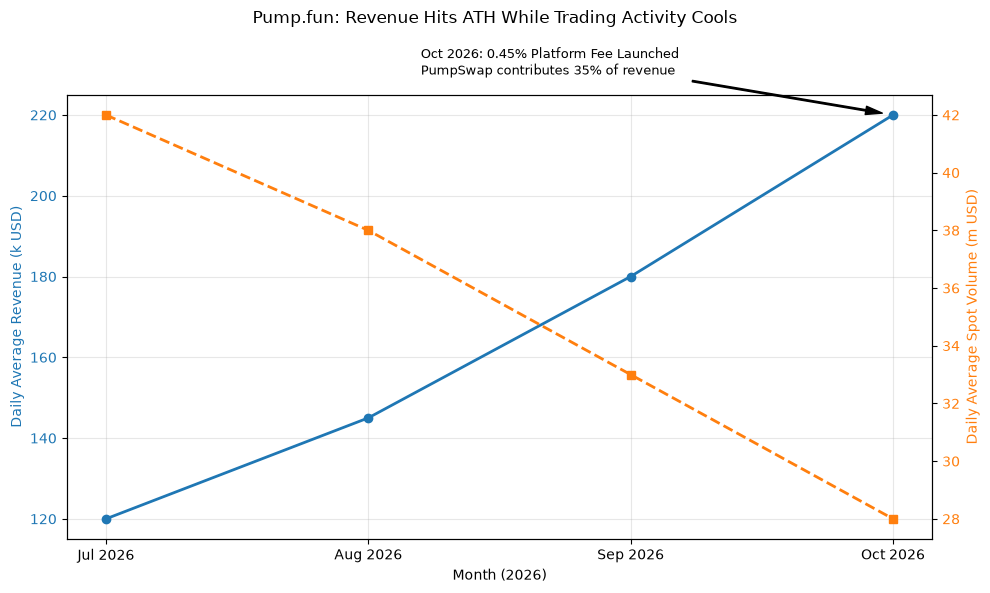
In effect, Pump.fun used a higher take per unit of trading to offset shrinking volume. Rising fee revenue does not mean more users are arriving or trading more often. It reflects greater revenue from each transaction and a newer business line absorbing some of the decline in the older one. There are limits: fees cannot keep rising indefinitely, and PumpSwap volume still depends on overall market activity.
Four pressures on Pump.fun
The article argues that Pump.fun is not in immediate danger, but its old growth model is nearing a ceiling. The first pressure is fatigue in the Meme market. Meme assets depend on attention, which can fade quickly. If users lose money repeatedly and see most new tokens go to zero, they may stop rushing in. Without new wealth effects, even an easy-to-use launch tool may fail to bring people back.
The second pressure is the risk of losing the trading entry point. Pump.fun built Terminal, an app and perps partly to stop users from trading its tokens in other terminals. If they do, Pump.fun may collect only issuance fees, missing later trading revenue and user data. The article argues that the trading entry point matters more than the issuance entry point: money tends to flow toward the product users open each day to trade.
The third pressure is creator retention, and the difficult balance built into Callout Rewards. The reward pool is funded from fees collected across the platform, with some PUMP token issuance returned on top. It redistributes platform revenue; it is not a direct cut of followers’ copy trades, nor a performance-fee arrangement in which an exchange shares the outcome of a trader’s calls. The platform pays the rewards from its overall trading income.
If incentives are too small, successful KOLs may take their calls elsewhere. If they are too large, the program may attract people who wash volume, post low-quality content and leave after collecting rewards. Community members have proposed scrapping Callout rewards, arguing that the subsidies may be creating airdrop hunters rather than creators. Blockchain analytics firm Bubblemaps estimated that a top KOL could earn about $125,000 from a bundled recommendation: $80,000 from the platform reward pool and $45,000 by selling a position accumulated in advance. The article says the new algorithm has not fully closed that route.
The fourth pressure is the value of the PUMP token. The article distinguishes this buyback from a public company’s share repurchase. Here, buybacks are an on-chain protocol revenue-distribution mechanism. The money comes from platform fees, and the tokens are used mainly to add to Protocol-Owned Liquidity (POL) and, in part, to be burned. It is not a repurchase of equity from shareholders.
In July 2026, the platform completed a large unlock of 82.5 billion PUMP. The share of protocol revenue allocated to the buyback pool fell from 100% to 50%. Buybacks totaled about $22.4 million over the latest 30 days, equal to 45% of revenue. Higher platform earnings do not mean token holders receive an equivalent amount; the selling pressure from unlocked tokens remains, weighing on fundamentals. After Diamond launched, PUMP’s 24-hour futures volume rose 92%. The article stresses that this reflects futures speculation, not stronger real demand in spot markets.
The bigger contest extends beyond Meme launchpads
The article argues that the more serious threat to Pump.fun may not come from another Meme launchpad. Robinhood Chain went live on mainnet in July 2026. It is an Ethereum Layer 2 built on Arbitrum, with Uniswap and Pleiades among its first partners. Its stated areas include Stock Tokens, real-world assets (RWA), DeFi lending and on-chain derivatives.
Robinhood has 28 million retail customers across 38 countries and territories. Many, the article says, have not used on-chain Meme products, but already trade stocks, ETFs and crypto on Robinhood. They can now trade stock tokens, Meme tokens and DeFi products in the same wallet, without switching between platforms.
Coinbase’s Base is also trying to bring social activity and trading together. The exchange-incubated Layer 2 has more than $5 billion in total value locked (TVL), and monthly active addresses have reached as high as 38 million. Base App combines a wallet, trading, social features and DeFi. Since 2025, Base has hosted substantial Meme and SocialFi activity. From Friend.tech onward, Base has been testing ways to connect social interaction with trading.
Neither rival needs to copy Pump.fun’s one-click launch page to compete. They are after a more important prize: the user’s financial activity and trading entry point. Pump.fun is expanding outward from crypto-native communities, looking to bring in more asset classes and traders. Robinhood and Base are moving on-chain from traditional finance and exchange users, aiming to put stocks, crypto and Meme tokens into one trading experience. The approaches run in opposite directions, but seek a similar outcome: users discovering, discussing, trading and holding assets within one product.
Diamond’s higher reward weights for perps, EVM assets and non-Solana assets also expand Pump.fun’s asset boundaries. The article poses a direct challenge: if users can trade an Nvidia stock token, Bitcoin and Meme tokens on Robinhood, will they still make a separate trip to Pump.fun to launch and trade?
Rewards can encourage holding, but not conviction
The first major design risk in Diamond is risk-free arbitrage. A large trader could hold tokens in spot markets across multiple addresses, meet Diamond’s requirements for holding time and market capitalization, and qualify for the highest reward multiplier. At the same time, the trader could open an equivalent short position in perps or a deep PumpSwap pool, neutralizing the token’s price exposure, or Delta. The result would be a spot position with little net price risk that still earns platform subsidies.
The article also lists other possible strategies: on-chain MEV front-running, wash trading between related addresses, and using flash loans to meet a holding snapshot temporarily. The algorithm can see on-chain balances, but not whether a position has been hedged; it may also fail to identify addresses linked through several layers. The article warns that professional market makers and arbitrage teams could capture much of the subsidy, leaving ordinary holders with less.
The second problem is the conflict of interest between creators and users. Rewards come from the platform’s fee pool, not directly from followers’ copy trades. Even so, when a creator’s platform rewards and gains on a position built in advance both depend on a recommendation, users may wonder whether the creator genuinely likes the token or is already positioned and waiting for buyers to take the other side. Social platforms depend on trust, and direct financial incentives can make that trust harder to build.
The article contrasts Pump.fun Callout creators with creators on X, who earn through ads and subscriptions and are not directly tied to followers’ trading outcomes. A Pump.fun creator does not need to receive a direct copy-trading fee to have an incentive to bring followers in and support the creator’s own position and rewards.
The third problem is that subsidies do not guarantee real demand. Users may hold a token for a while to earn incentives, but if the asset lacks value or genuine community support, selling may resume once the rewards end. A few days of rewards do not turn Paper Hands into Diamond Hands. Professional users who earn subsidies through hedging may feel no conviction in the token; after receiving rewards, they can unwind the hedge and leave. Subsidies can produce short-term holding data, but not necessarily long-term belief.
The underlying limitation remains: the algorithm can measure holding time and address balances, but it cannot see the hedges behind a position or recognize genuine conviction.
What the next generation of platforms is competing for
The article describes three stages in Meme-platform competition. First came issuance volume: the fastest platform, or the one enabling the most launches, led. Then came trading volume, liquidity depth and slippage. The contest is now turning toward holding time, social connections and the entry point for asset discovery.
Pump.fun’s stated ambition is to move beyond a place where users launch tokens, make a quick bet and leave. It wants to become an on-chain social finance platform where users discover assets, discuss them, buy and hold with real money, and keep trading without leaving the product. If that works, its competitors will include not only other launchpads but trading communities, terminals, social trading apps and companies such as Robinhood and Coinbase.
The central question still has no answer: will users stay when USDC payments to Callout creators, holding multipliers and other rewards disappear? If people stay only to earn money and collect incentives, Pump.fun will have replaced subsidies for launches with subsidies for holding. It would still be buying traffic with rewards. If users stay because assets are worth discussing, creators are trusted and the trading experience works well, the platform may become a genuine trading social network.
The article’s closing point is that Diamond Hands cannot simply be paid into existence. A true Diamond Hand is someone willing to keep holding when no reward is on offer.
Disclaimer: Markets carry risk, and investors should exercise caution. This article is not investment advice. Readers should consider whether any opinions, views or conclusions in the article suit their circumstances and bear responsibility for investment decisions made on that basis.