

Pump.fun and Fomo are locked in a growing battle over speculative trading, one of the most widely used products in crypto. In the article, David Christopher says the fight is really about who controls the user entry point for meme-coin trading.
Fomo, the piece argues, has shown what a strong consumer-facing experience can do for a trading product. It makes trading social, public, and trackable. Users can follow traders, view positions, copy trades, or take the other side, while watching the full process in real time.
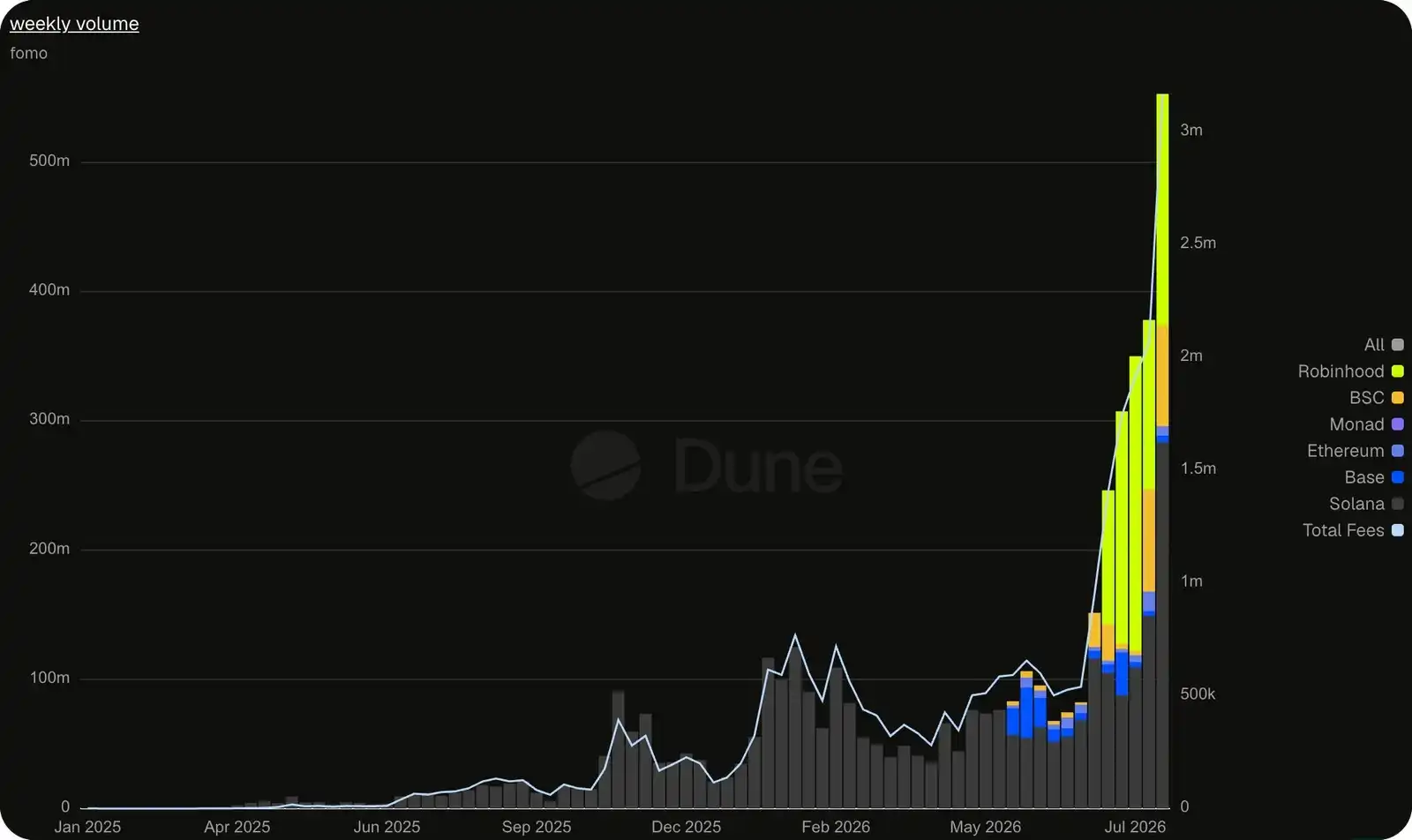
That design helped drive fast growth. As speculative appetite returned, Fomo became a central venue for joining the meme-coin wave on Robinhood Chain, and the platform’s weekly fees and trader count jumped with it.
The article refers to a Dune chart showing Fomo’s weekly trading volume. Growth was gradual from the start of 2025, then accelerated sharply after May 2026. Robinhood Chain was described as the main engine behind that rise, while total platform fees also reached a record high.
Even so, Solana remains the main base for speculative trading in crypto, and Pump.fun sits at the center of that market. The article says Pump.fun has little interest in sharing that pie.
Fomo built its growth on infrastructure owned by Pump.fun. With a better front end, Fomo effectively positioned itself between Solana’s speculative trading rails and retail speculators. The article makes clear that calling Fomo a middleman is not meant as criticism. Users have shown they are willing to pay for the product experience, and the platform’s continued fee generation is part of that evidence.
Still, most of what Fomo built can, in theory, be replicated by Pump.fun. The article says that is exactly what is happening now, with Pump.fun adding more social features to its own app as it tries to become the home page for speculative trading.
That leaves the two platforms in an unusual position. They are partners at the infrastructure layer, but direct rivals in the battle for front-end users. Fomo has user traffic, while much of the infrastructure that powers execution belongs to Pump.fun.
Now Pump.fun wants both. To get there, the article says the platform has reportedly offered contracts worth tens of thousands of dollars a month to pull top traders away from Fomo and shift their activity onto Pump.fun. The writer notes that this is neither illegal nor a scandal by industry standards. It is simply a cash-rich platform paying to attract core users who already bring their own audience.
Pump.fun has also rolled out a zero-fee policy on the front end. According to the article, it can afford that subsidy because it already makes money through its bonding-curve mechanism and PumpSwap. Fomo, by contrast, does not have the same ability to copy that model.
Some market participants have criticized Fomo for charging fees, but the article says that misses the point. What users are paying for is the full trading package: finding traders worth following, checking what they hold, tracking performance, receiving market alerts, and using an interface that lowers the friction of operating in crypto.
In that framing, fees are Fomo’s core source of revenue, and the user experience is its actual business. Pump.fun can open similar features for free because its underlying business already generates steady income.
Infrastructure is moving up the stack
The author highlights two broader takeaways.
First, this is another example of a mature crypto infrastructure project moving up the stack to compete for end-user traffic. The article points to a similar pattern involving Uniswap on Robinhood Chain. After becoming core on-chain trading infrastructure, Uniswap has begun pushing its own launchpad instead of serving only as a back-end tool for other platforms.
The same logic, the writer argues, now applies to Pump.fun on Solana. It already controls the infrastructure for speculative trading and now wants the consumer-facing layer used by ordinary traders.
Trust may decide the winner
The second point is trust. The article argues that the eventual outcome between Pump.fun and Fomo may depend less on features alone and more on which platform can maintain user confidence.
Because Pump.fun has long been at the center of the meme-speculation market, its reputation in crypto is mixed. The reported effort to pay heavily for trader defections, the article says, has added to that image problem.
Fomo, on the other hand, launched later and carries less historical baggage. Its product was designed around transparent, traceable trading behavior, with social trading at the center.
But the value of social trading depends entirely on the credibility of the signals traders put out. A trader can buy publicly with one wallet and quietly sell with another. A trader can also build a position before calling it out, then dump into followers later. Blockchain transparency makes data visible on-chain, but it does not guarantee that the trader behind the wallet is trustworthy.
In the end, the article says users will decide where to trade based on which platform can do the better job of protecting the authenticity of the information shown to them. If traders coordinate, hide activity through multiple wallets, and extract value from followers, confidence in the signals will break down. If trust collapses, the value of the social trading layer both platforms are now fighting over will weaken with it.
The article closes by saying it is worth watching what steps the two platforms take next to protect user trust.