
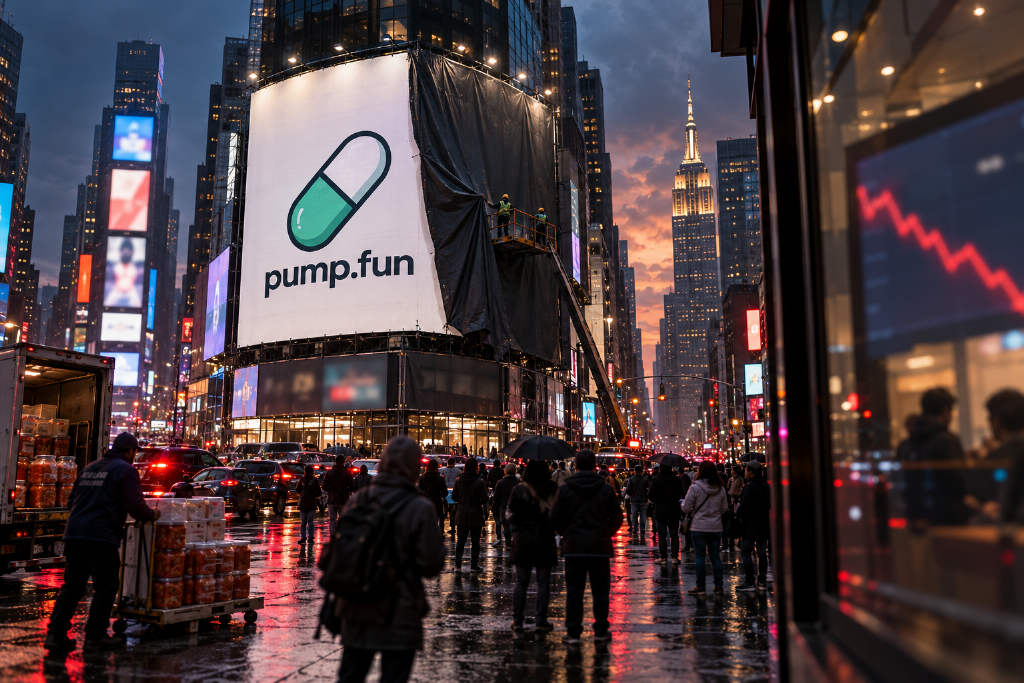
PANews, citing BlockBeats, reported that pump.fun launched a token called KIMCHI on Oct. 20. According to the article, the first trade used 87 SOL to buy about 793 million tokens, equal to 79.3% of total supply. Less than a minute after the token was minted, pump.fun’s official account posted three images showing New York billboards with the phrases “PILL YOUR FRIENDS” and “be the next kimchi.”
The report said that 57 seconds after launch, about 750 million tokens were transferred to another address. On pump.fun’s profile page, that address was labeled “Kimchi,” and the token’s creator fees were permanently directed to it. Nineteen minutes later, pump.fun co-founder Alon reposted the billboard images and wrote: “Kimchi is the first person to truly bridge crypto and pop culture, the first example of turning a trader into a celebrity. The next wave of users won’t come from crypto Twitter, it will come from the mainstream. We’re honored to have him help shape our creative direction.”
BlockBeats said Kimchi’s X bio also added pump.fun, making the partnership appear explicit. Within an hour, the token’s market capitalization reached about $35 million to $40 million, and the address labeled Kimchi held 75.32% of the token supply.
BlockBeats tied the partnership to competition for trader attention
The article said Kimchi became known through claims that he made $40 million on the TRUMP token, and described his social feed as filled with luxury cars and watches. In BlockBeats’ framing, pump.fun needed influencer traffic, especially as it competed with Fomo.
According to the report, Fomo launched in May 2025, raised $94 million, and was valued at more than $550 million. From Sept. 2 to Sept. 16, Fomo posted higher revenue than pump.fun on 13 days, taking 60% of the combined revenue between the two platforms over that half-month period. The article also referred to a leaked August agreement that allegedly offered a $20,000 signing bonus and $30,000 per month, on the condition that users move their funds, switch to a new wallet, bind their X account, publicly declare that wallet as their only wallet, and permanently delete their Fomo account.
BlockBeats added that pump.fun redesigned its app on Aug. 7. The home page, it said, shifted away from a waterfall feed of newly launched tokens and toward trader activity. Over the past 30 days, the article put pump.fun’s launchpad revenue at $45.4 million and Fomo’s at $19 million. It also said pump.fun’s share in October recovered to 75% from 50% in September. The cost, according to the piece, was a daily $900,000 buyback and burn of its own token, totaling 490.7 million.
On that basis, the article argued that signing Kimchi was an understandable traffic play for pump.fun.
“Project kimchi” poster was followed by a rapid collapse
BlockBeats said another token, called project kimchi, appeared in the early hours of Oct. 22. A few hours later, Kimchi posted an image of a New York street poster carrying the words “project kimchi” and “same internet, different outcome.” A large QR code sat in the middle, with the Pump.fun logo and App Store and Google Play download badges below it.
Alon reposted that image. The article said the repost helped send the new token’s market capitalization to roughly $10 million to $15 million. The posts were later deleted. Kimchi removed @pumpfun from his bio, and Alon also deleted his repost. After that, the token fell from above $10 million to less than $300,000, a 98% drop, according to the report.
BlockBeats also wrote that the KIMCHI token launched on Oct. 20 fell 49% after the episode, leaving its market capitalization at $12.71 million. From its peak, the decline was about 70%.
On-chain claims focused on early buyers and PUMP transfers
The article cited on-chain data saying that three addresses that bought before the ad was posted made $100,000 in about nine minutes. It also said the address labeled Kimchi not only held 75.32% of KIMCHI supply but also collected creator revenue, which had reached more than 900 SOL, or about $100,000.
In addition, BlockBeats cited an on-chain analyst who said the same address received 1.35 billion PUMP from Binance and OKX hot wallets over a three-hour period, worth about $6.25 million to $6.43 million. The source of those funds was described as unclear. Based on that, the article wrote that the address had gained more than $10 million on paper in three days.
The report also said pump.fun generated $1.61 million in revenue on Oct. 20.
Article framed retail investors as the main losers
BlockBeats argued that the partnership and the related promotion left retail traders carrying most of the losses, and described the episode as something that was “close to turning into a scam.” PANews, however, noted that the piece represented the views of a contributing author, did not reflect PANews’ position, and did not constitute investment advice. The input also states that the judgments and some of the figures were disclosed by the author and on-chain analysts, rather than jointly confirmed by all parties involved.



