

PUMP, the native token of Pump.fun, hit its first major post-TGE cliff unlock on July 14. Based on figures cross-checked across Tokenomist, on-chain monitoring and multiple data platforms, the article said the theoretical maximum number of tokens unlocked that day was 82.5 billion, or 8.25% of the 1 trillion total supply. At a price of about $0.00159 at the time, that worked out to roughly $131.35 million, equal to about 20.23% of the circulating supply before the unlock.
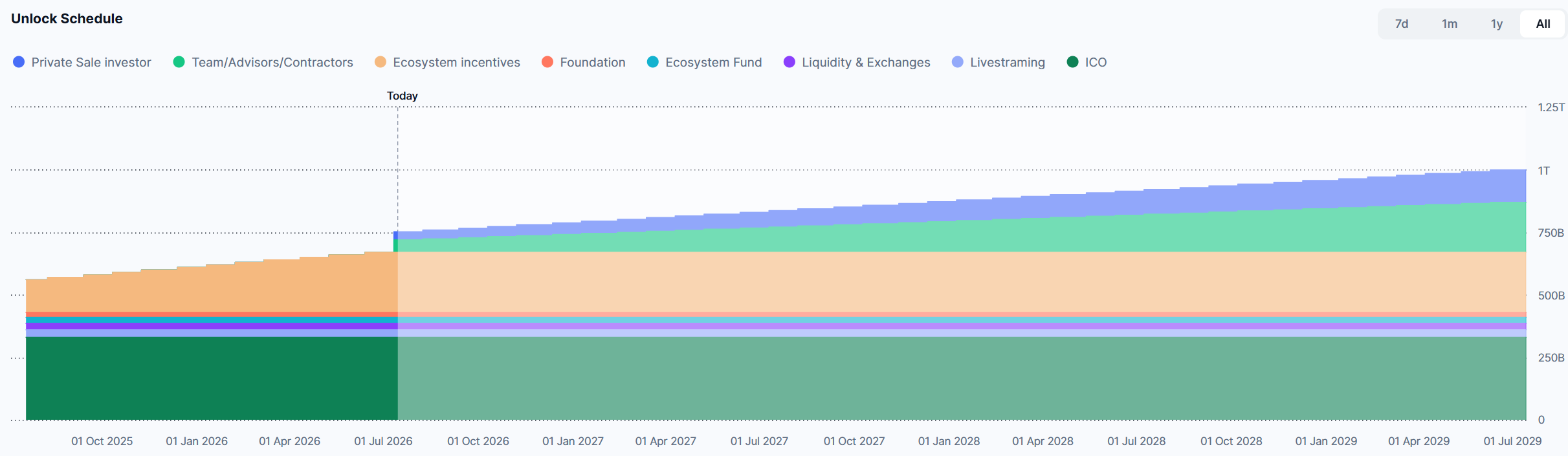
This was the first unlock covering two allocation buckets: team/advisors and private investors. Private investors were set to receive 32.5 billion tokens, while team and advisor allocations accounted for 50 billion.
Early on July 15, Arkaham on-chain tracking data showed that 57.279 billion tokens had been distributed to 121 wallets after the unlock. PUMP’s current market capitalization was about $650 million, with fully diluted valuation at about $1.6 billion, according to the report.
Pump.fun is still one of Web3’s top earners
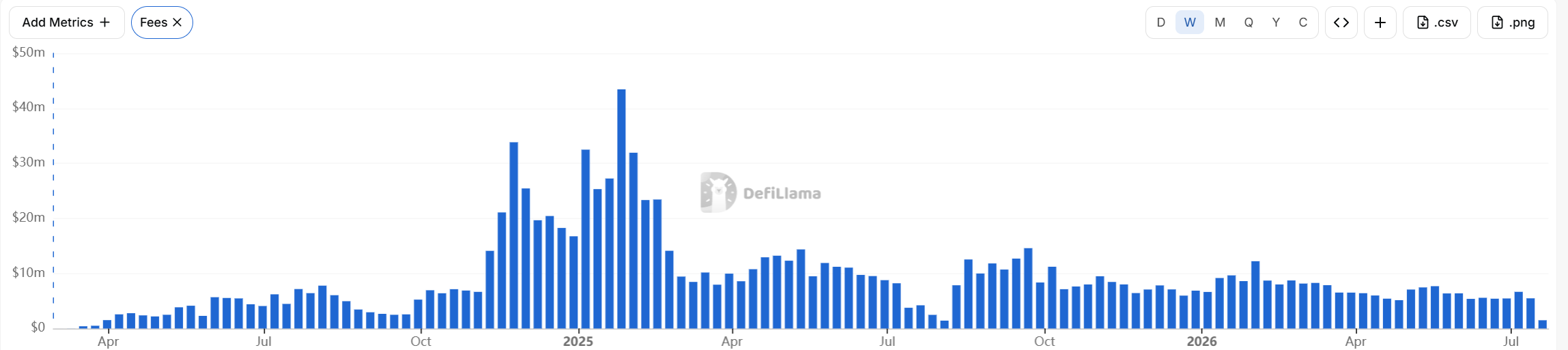
The unlock landed while Pump.fun remained one of the most profitable applications on Solana and across Web3. DefiLlama data cited in the article showed protocol revenue of $24.52 million over the past 30 days, second only to Hyperliquid at $43.93 million and above Polymarket at $22 million. Cumulative revenue had passed $1.05 billion, and the platform had issued more than 12 million tokens in total.
Even in what the article described as a deep bear market, Pump was still generating around $5 million in weekly revenue.
That level of income has not translated into price support. PUMP fell from a high of $0.008980 to around $0.001628, where it has been trading in a lower range.
Why the buyback-and-burn model has not supported the token
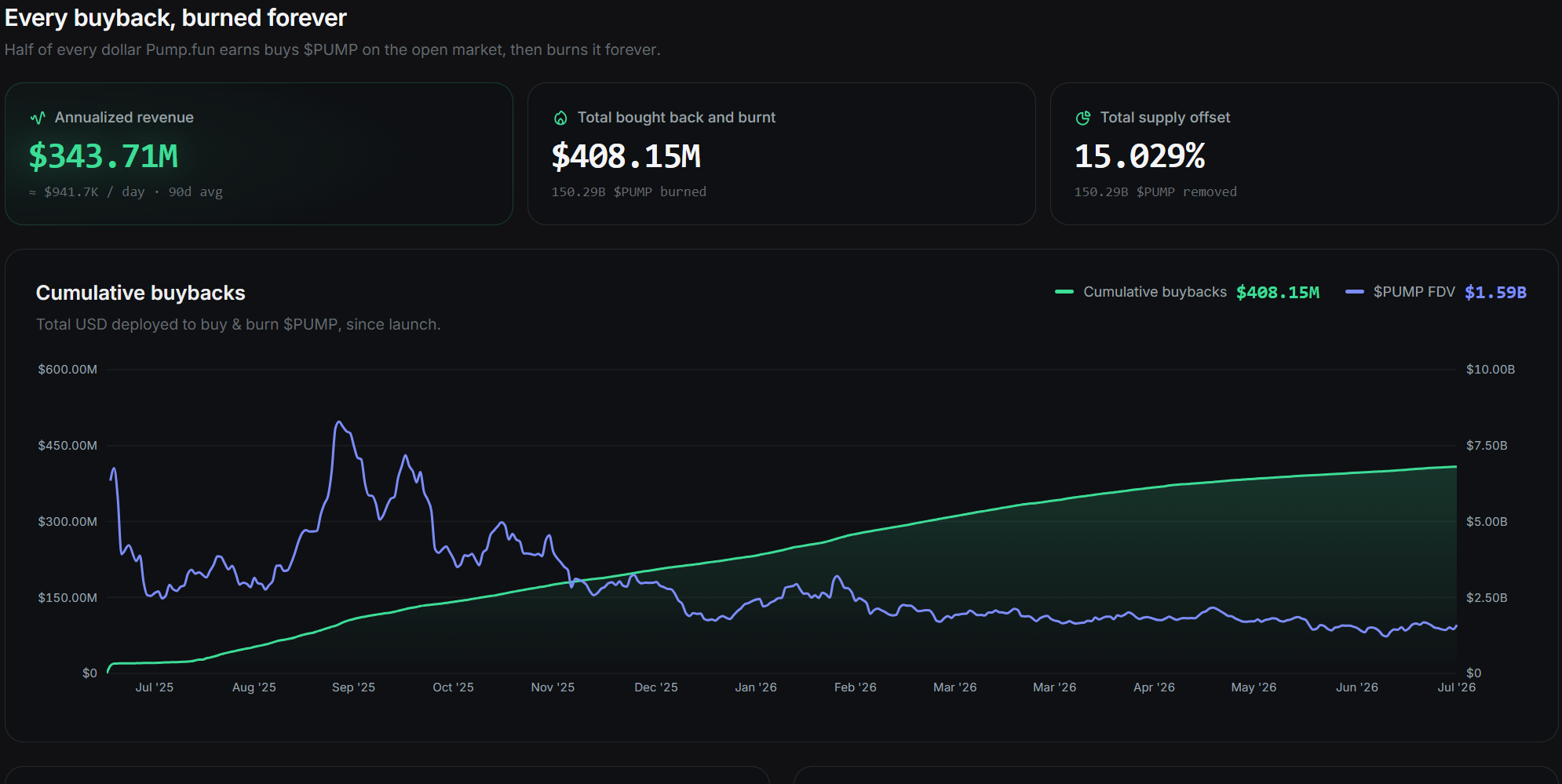
Pump.fun’s core value-capture mechanism is to use protocol fees to buy back PUMP and burn it permanently. Official platform data cited in the article put annualized revenue at $343.71 million, with average daily revenue over the past 90 days at $941,700. Total buybacks and burns had reached $408.15 million, and the cumulative number of tokens destroyed amounted to 15.029% of total supply.
After PUMP’s TGE in July 2025, the project initially used 100% of net protocol fees to buy PUMP on the open market and burn it. The report said that covered revenue from the bonding curve, PumpSwap, Terminal and cross-chain operations, after referral fees and cash rebates were deducted.
That changed on April 28, 2026. From that point, 50% of net revenue was programmatically locked for buybacks and burns for one year, while the other half was directed to hiring, marketing and product development. All repurchased tokens were permanently burned rather than locked.
The article argues that the reduced intensity of repurchases is one reason price support has weakened. With only 50% of net revenue now going to buybacks instead of 100%, the direct bid in the market has dropped. It compares PUMP with HYPE, which it says sends close to 99% of fees into buybacks, and with Lighter, which recently used all of its revenue to buy back and burn tokens. Against those examples, the report says PUMP’s program looks less forceful and is struggling to absorb unlock-related selling pressure.
Legal pressure and the platform’s profile add to the overhang
The report also points to collective litigation facing Pump. It says U.S. plaintiffs have described the platform as an “illegal digital casino.” In that context, the article argues that diverting part of the treasury toward hiring and compliance-related costs has sparked criticism from token holders in the secondary market.
It also says there is still a major question over whether buybacks will continue after the current one-year arrangement ends.
At a deeper level, the article links PUMP’s weak market reception to what it calls the token’s “casino gene.” Pump.fun is fundamentally a meme launchpad, and the report describes it as being shaped by PVP betting behavior and casino-style culture, with sharp volatility and limited appeal for institutional buyers. In the article’s framing, compliance risk, reputational pressure and a lack of stronger utility have kept mainstream capital away, leaving the token more dependent on retail and speculative flows.
Can the market absorb the unlock?
On-chain observations cited in the article show that some of the wallets that received distributions had already begun moving tokens on the day of the unlock and the following day. The report says this did not trigger a collapse, but it did make short-term volatility and a liquidity test hard to avoid.
PUMP’s current utility is also described as limited, centered mainly on ecosystem incentives and potential governance. For that reason, the market is treating it more as an “income-sharing certificate” than as a strict utility token, the article says. In a bear market, that makes the token more sensitive to supply overhang.
The piece compares Pump with other high-revenue protocols. Hyperliquid generates higher monthly revenue but carries a market cap near $15 billion, more than 20 times PUMP’s. Polymarket has similar revenue, has not yet issued a token, and has reportedly reached a financing valuation in the $15 billion range. The article says both have already shown stronger persistence in their revenue story, while Pump could see revenue weaken if the broader market turns down further and meme coin activity cools.
A stress test, not necessarily an end point
Still, the report does not frame this unlock as a one-off death blow. Team and investor allocations are released over three years rather than dumped all at once. It notes that some projects and early investors have historically chosen to hold or sell gradually in order to preserve reputation and longer-term interests.
It also says tokens released to ecosystem incentives and the foundation may be used for growth rather than immediate selling. Pump.fun has expanded beyond a single launchpad into PumpSwap, multi-chain support and livestreaming, building a broader ecosystem. As the native token, PUMP stands to benefit directly from that expansion.
The article describes the 82.5 billion-token unlock as the real stress test for PUMP’s transition from a “100% buyback honeymoon” to a stage that is more sustainable but also more restrained. In the short term, over the next several weeks to one or two months, it says price swings will be determined by the balance between selling pressure and buyback strength. If the market absorbs the supply without a liquidity squeeze, that could reinforce the narrative around high-revenue protocol tokens.
Longer term, the piece says PUMP’s path will be decided less by this single unlock than by whether Pump.fun can keep making money as core infrastructure for the meme economy. If the revenue flywheel keeps spinning, buybacks and burns will continue to shrink supply. If revenue falls sharply, future unlocks could become a much heavier burden.