
Weekly protocol revenue reaches $7.2 million
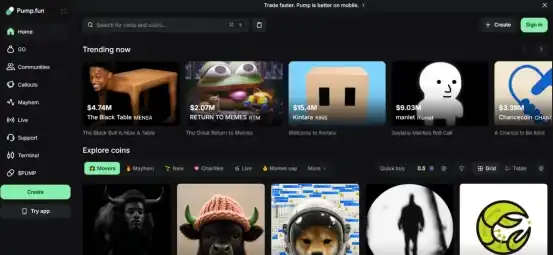
pump.fun has released new weekly figures showing that protocol revenue hit $7.2 million from June 29 to July 5. The disclosure offers one of the clearest looks yet at the platform’s underlying monetization engine. According to the update, revenue was mainly generated by three business segments: Bonding Curve, PumpSwap, and Terminal, suggesting that pump.fun’s business model is becoming more diversified than a simple meme-token launch product.
Bonding Curve accounted for a weekly trading volume of $553 million. This remains the core mechanism behind pump.fun, allowing token issuance and pricing to be handled automatically through the curve model. Users can trade without supplying their own liquidity, while the platform captures fees from each transaction. That structure has made Bonding Curve both a distribution gateway for new tokens and a reliable fee generator for the protocol.
PumpSwap posted $1.65 billion in weekly volume over the same period. As more users execute trades inside the platform rather than routing elsewhere, PumpSwap is increasingly functioning as the liquidity center of the broader pump ecosystem. At the same time, Terminal has been expanding its role through analytics, search, and developer-facing features, giving pump.fun additional revenue exposure beyond pure token launch activity.
Based on current weekly numbers, a simple annualized estimate would place pump.fun’s theoretical protocol revenue close to $300 million. That does not imply the platform can sustain the same level throughout the year, especially given crypto’s cyclical nature. Still, the figures point to a meaningful shift: pump.fun now looks less like an early-stage venture dependent on fundraising and more like a Web3 platform generating real operating cash flow.
Half of net revenue goes to PUMP buybacks and burns
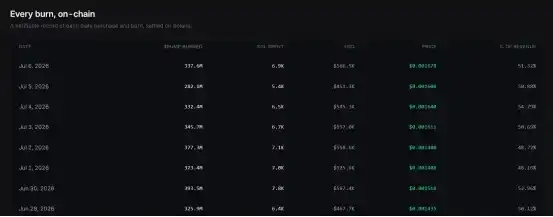
The more consequential part of the disclosure may be how that revenue is being used. pump.fun said 50% of net protocol revenue is allocated to buying back and burning PUMP. Over the last seven days, the platform repurchased and burned about $3.7 million worth of the token. In aggregate, the project says it has already burned 41.8% of circulating supply.
The logic resembles a traditional equity buyback model. Users generate fees through trading activity, the platform collects protocol revenue, and part of that revenue is used to repurchase tokens from the market and remove them permanently from circulation. In an industry where token holders have often seen limited connection between platform growth and token value, pump.fun is attempting to build a more direct feedback mechanism.
If business activity continues to expand, protocol revenue could rise alongside buyback capacity, creating a positive loop in which revenue growth supports larger repurchases and lower circulating supply. Under that framework, the value proposition of PUMP becomes more closely tied to the platform’s operating performance rather than relying purely on speculative sentiment or short-lived narrative momentum.
That said, the mechanism is not a guarantee of token price performance. If trading activity weakens in the future, protocol revenue would likely decline and buyback intensity would ease as well. The long-term significance of the model therefore depends less on burn optics and more on whether pump.fun can continue to produce durable, recurring revenue across market cycles.
Product expansion points to a broader Solana infrastructure play
Beyond headline financials, the weekly update also suggests pump.fun is actively pushing into a wider operating footprint. The new Pump App has launched an upgraded Swap service, and the platform said execution speed has improved from roughly 1–2 seconds to 300–400 milliseconds. In fast-moving on-chain trading environments, especially on Solana, lower latency can translate into reduced slippage and better trade execution.
On user onboarding, pump.fun said a lower-KYC fiat deposit channel helped drive roughly 21% growth in average daily fiat inflow transaction volume. The result indicates that reducing friction in fiat onboarding remains an effective way to attract new users, and it also suggests the platform is putting more emphasis on usability for mainstream participants rather than only crypto-native traders.
For developers, Terminal continued to add functionality, including offline token labeling, wallet filtering, and OG filters, while reducing the size of its JavaScript package by 35%. These upgrades are important because they improve the odds of third-party integrations and tooling being built around pump.fun, which can strengthen ecosystem stickiness and network effects over time.
Community incentives have also become a visible growth pillar. According to the platform, content views tied to the GO feature have surpassed 18 million. pump.fun has created around 3,000 bounty tasks so far, received 18,000 submissions, and distributed more than $600,000 in rewards. By tying incentives to creator output, development work, and community participation, the platform is trying to convert engagement into a more durable content and contribution pipeline.
The team also removed its previously introduced Tokenized Agent launch option after community feedback. While the product tweak may appear minor on its own, it signals a more mature operating approach centered on rapid experimentation and fast iteration rather than blindly following hype cycles. Taken together, the latest data indicates that pump.fun is moving beyond a meme launchpad toward a broader Solana ecosystem platform spanning issuance, trading, developer infrastructure, and community operations.