
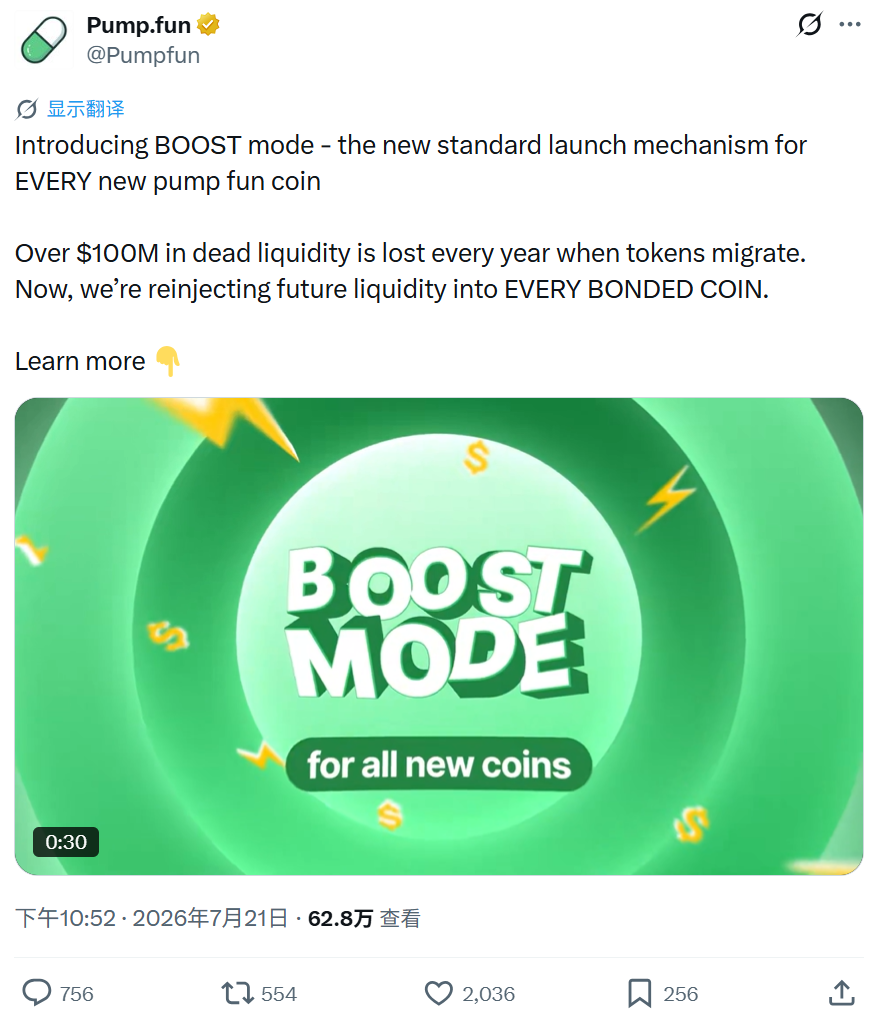
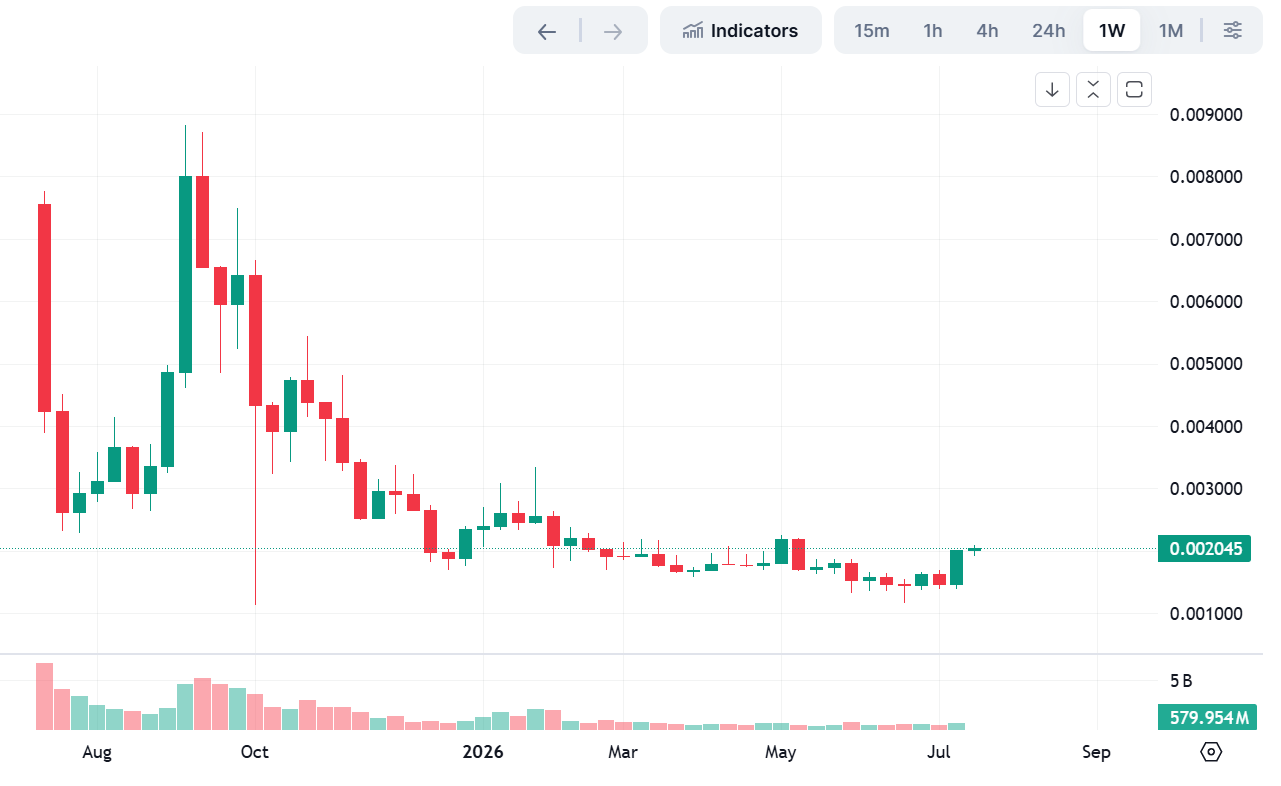
Pump.fun formally launched BOOST mode on July 21 and made it the default issuance mechanism for new tokens. After the announcement, PUMP continued to trade around $0.002.
20% of migration funds are redirected into a five-minute buy-and-burn window
According to Pump.fun’s official explanation, historical data shows that when a token graduates from the bonding curve and moves into a liquidity pool, roughly 20% of the liquidity ends up as “dead liquidity.” Even if every holder later sells, that portion remains permanently locked in LP and cannot be put to use elsewhere. The platform estimates that this mechanism strands more than $100 million in liquidity each year.
BOOST changes what happens to that slice of capital. Instead of letting it become locked liquidity, Pump.fun uses it to buy the token on the secondary market over the first five minutes after migration through a TWAP, or time-weighted average price, process. The tokens acquired in that process are then burned immediately.
As described in the article, Pump.fun withholds about 20% of the funds when a token graduates. Under the fixed migration rules cited there, that comes to 17.6 SOL for SOL trading pairs and about $2,516 for USDC pairs.
The funds are not a new subsidy from the platform. They come from the part of liquidity that would previously have been sacrificed during migration. Once the buy orders are completed, the purchased tokens are destroyed, creating short-term buying pressure while also permanently reducing circulating supply.
The bonding curve flow stays the same, and so does the graduation threshold
Pump.fun’s standard flow has been straightforward: users create a token with one click, trading takes place on the bonding curve, and once the token reaches a set market-cap threshold it migrates automatically to the PumpSwap liquidity pool. At migration, part of the liquidity is locked into LP under preset rules to support later trading depth.
The issue, as laid out in the piece, is that the locked share is large enough to leave capital stuck even after a token effectively dies. If the token price falls to zero and every holder exits, money still sits in LP. It cannot be withdrawn and cannot be reallocated into more active assets. Pump.fun’s estimate for that recurring loss is again more than $100 million a year.
BOOST does not change the trading experience on the bonding curve, and it does not alter the graduation threshold itself. Pump.fun also says the mode does not add or release any outside liquidity. The practical change is narrower: 20% of the settlement funds that would have gone into LP are pulled out and used for a five-minute TWAP purchase and burn.
The platform said BOOST applies automatically to Pump.fun tokens that migrate after 22:23 Beijing time on July 21. Tokens that had already migrated before that time are not included. Tokens launched through Mayhem, described in the article as the AI Agent lab mode, are also excluded.
The debate centers on what those first five minutes actually achieve
As of July 22, the article says Pump.fund had annualized revenue of about $342.54 million and total token buybacks worth about $411.27 million. Even so, its token price remained far below the $0.008 high mentioned in the piece. The article argues that large-scale buybacks alone are no longer enough to lift price expectations in a meaningful way.
From that framing, BOOST is less about adding another round of support for PUMP and more about addressing a product issue at the launchpad level. If meme coins show thicker order books and better short-term performance right after graduation, trader retention and repeat participation could improve. The piece says many players in PVP trading care less about whether a meme coin survives three days later and more about whether it can spike at the moment it graduates.
The article also argues that the platform’s real moat is not just the volume of token launches, but whether a certain share of those launched tokens can continue generating trading activity. If that holds, protocol revenue has a more durable base, and buybacks have a steadier source of funds rather than relying on existing income to support price.
Not everyone sees the change as a clear positive. Some traders worry that the extra buy pressure lowers the practical difficulty of launching a project, making more low-quality tokens appear successful and encouraging more aggressive issuance behavior. Others point to the short TWAP window itself. If buying stops after five minutes and large sell orders hit the market, the token could drop with even sharper slippage than before. In that reading, the mechanism trades a stronger opening burst for a higher risk of heavier selling later.