
Author: Fugui
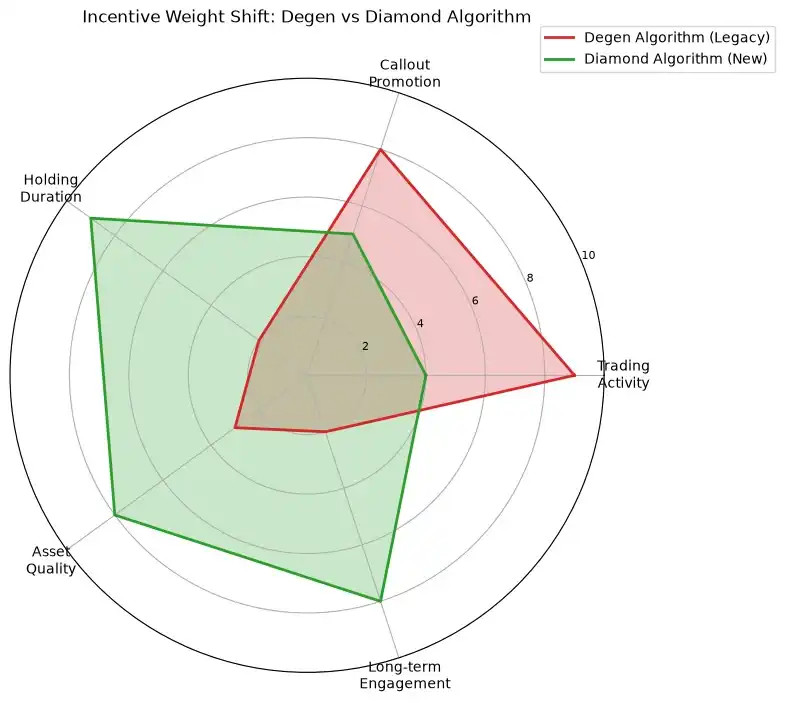
On Nov. 6, 2026, Alon, a co-founder of Pump.fun, announced on X that the platform had launched Diamond, a new reward algorithm. The previous system was renamed Degen, and both systems now run in parallel.
Diamond rewards users who do not rush to sell
Degen rewards people who generate callouts and bring trading activity to the platform. If a creator’s Callout post attracts more trading volume, the creator receives a larger USDC reward. The mechanism is built around transaction conversion.
Diamond uses a different set of incentives. It adds multipliers to callouts involving higher-market-cap tokens and gives greater weight to perps, EVM-based assets and assets outside Solana. The emphasis has shifted from immediate trading activity toward holding time and longer-term ownership.
That is a notable change for a platform built around rapid turnover, frequent token launches and transaction fees. Pump.fun is now encouraging users not to sell, even as its earlier growth model reaches its limits.
Assembling incentives that previously existed in separate places
Pump.fun did not invent the term Diamond Hands. During the 2021 GameStop episode, users of Reddit’s r/WallStreetBets used it as a rallying cry for retail traders who refused to sell during short pressure from institutions and violent price swings. Paper Hands became the opposite label for traders who sold as soon as the market moved against them. Diamond Hands later entered crypto culture and merged with the broader HODL tradition.
Turning that culture into a measurable reward system also has precedents. Virtuals Protocol launched a Diamond Hand Bonus in 2025. Users who held Genesis ecosystem tokens received extra points every 24 hours, with longer holding periods producing more points. The system was later changed so that users had to stake their assets to receive the rewards, turning passive holding into active locking.
BNB Chain’s $4 million Meme season in September 2026 centered on the HODLer Index. The index scored users according to holding size and holding duration. Selling during the campaign reduced a user’s score, and a minimum holding position of $100 was required to qualify for rewards.
Moonshot took a more direct approach. It set aside 80% of new-token issuance fees for distribution, with 70% going to the first 50 holders. That structure tied early supporters to a token’s longer-term performance. BONKRewards in the BONK ecosystem pays users a share of trading fees for locking their assets, with longer lockups receiving a larger share.
The pricing of social attention also predates Pump.fun’s approach. Kaito’s Yaps mechanism uses an AI algorithm to score crypto content. It looks beyond posting and like counts, weighing information added by the content, the influence of the people engaging with it and its impact inside a particular narrative. The resulting Yapper Points can accumulate and later connect to project allocations and airdrops. That is essentially an InfoFi structure in which information and attention become tradable assets.
Pump.fun’s main contribution is not the invention of Diamond Hands. It is the combination of previously separate incentives: social recommendations, trading outcomes, asset market capitalization, holding time and cross-chain asset rewards inside one Callout Rewards framework.
Earlier platforms rewarded token issuers, traders and content creators in separate systems. Pump.fun is trying to combine those roles. A user who produces widely distributed content, holds an asset with real capital and brings actual trading results could receive the largest rewards. The platform is moving beyond being only a token-launch tool.
From launch machine to trading social network
Pump.fun’s original model was simple. Anyone could spend a few dollars to launch a Meme token through a Bonding Curve. Buying pushed the token price up and selling pushed it down. Once a token accumulated enough liquidity, it graduated and moved to PumpSwap for AMM trading, while the platform collected a fee from every transaction.
The model depended on a steady supply of new tokens and new speculative opportunities. Once one token was exhausted, users could move to the next. The weakness was equally clear: token lifecycles were short, users arrived quickly and left quickly, and the platform struggled to retain either users or capital.
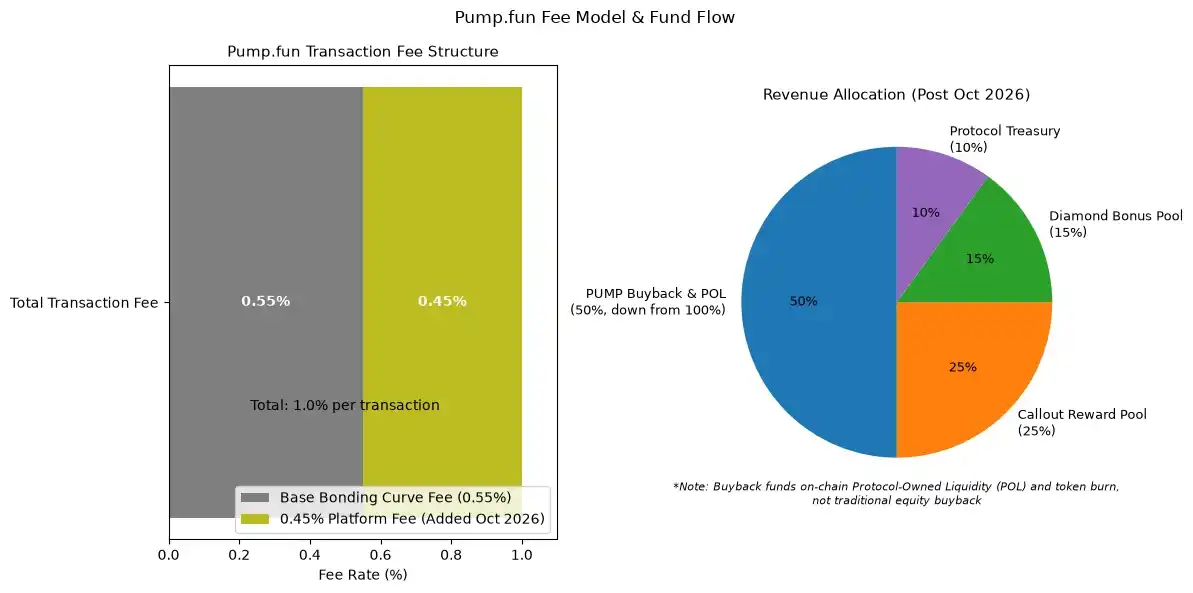
Pump.fun expanded its product line step by step. PumpSwap captured liquidity from graduated tokens. Callout Rewards paid creators who generated trading activity. The company then added the Terminal trading interface, a mobile app and Perps perpetual contracts. On Oct. 17, 2026, it introduced a 0.45% platform fee, which could be reduced to 0.40% through a referral code. Diamond now adds high-market-cap assets, cross-chain assets and holding behavior to the reward framework.
The two algorithms have different target users. Degen continues to serve existing users who prefer small-cap tokens and high-frequency trading. Diamond is aimed at perpetual traders, EVM users and participants willing to hold larger-market-cap assets for longer periods.
PumpSwap has become the platform’s biggest source of revenue. In October 2026, it generated about $107 million in fees, or 61% of total product fees. Pump.fun is no longer relying only on token launches. It is trying to cover the full path from discovering an asset to discussing it, trading it and holding it.
Callouts sit at the center of that social layer. Previously, a user who saw a KOL recommend a token on X had to move to an exchange to trade and had no direct way to know when the KOL sold. On Pump.fun, the creator’s holdings, trading history and the trading volume generated by the recommended token are visible on-chain, while the platform pays a cash reward.
This is a trading-native social network. X relies mainly on advertising, Farcaster on ecosystem applications, and Hyperliquid on trading fees. Pump.fun is trying to place content, assets, trading and rewards in one product.
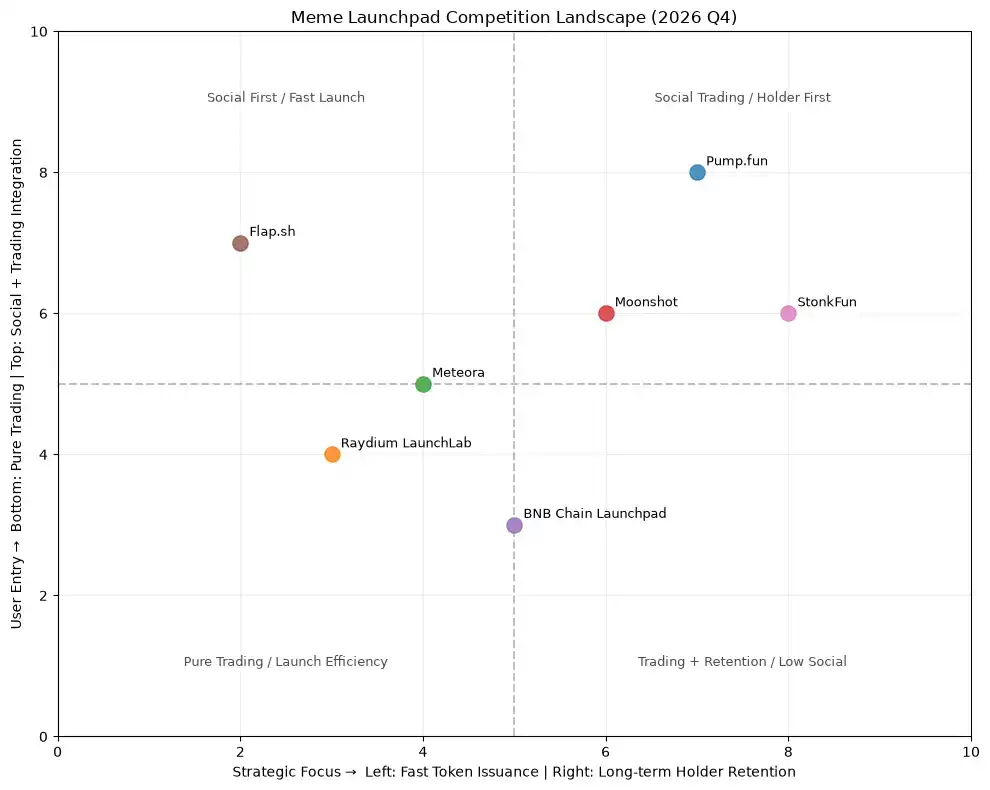
The competition is shifting from launch speed to capital retention
Pump.fun did not simply decide to become a social platform. The competitive logic of the sector has changed.
Raydium launched LaunchLab, using its AMM liquidity advantage on Solana to capture new-token launches and post-graduation trading. Meteora introduced Dynamic Bonding Curve, differentiating itself through issuance curves and liquidity management. StonkFun links stock-paired Memes with traditional equity narratives. Flap.sh offers similar one-click token launches on BNB Chain and other networks. Ponsfamily, which appeared in 2026, recorded daily revenue above Pump.fun’s on some days.
These competitors still largely target the older race: easier issuance, lower trading slippage and higher creator revenue shares. The larger shift is happening in user retention and the range of assets a platform can hold.
BNB Chain’s $4 million Meme season focused on how long users and capital stayed on-chain, not on how many tokens they launched. Moonshot distributed issuance fees to early holders, aligning those users with longer-term token performance. Virtuals changed holding rewards into staking rewards, requiring users to lock capital. BONK lets locked users share in ecosystem trading fees, making the competition about the broader ecosystem rather than a single token.
Earlier, the key metric was issuance efficiency. The platform that could let a user launch a token within one minute had an advantage. The focus is now holding duration, the time capital remains inside an ecosystem and whether a platform can give users a reason to stay.
As of November 2026, Pump.fun still held roughly 74% of fee share among Solana launchpads and about 49% across all chains. It remained the clear market leader. Its share of new-token trading volume, however, had fallen from more than 90% at its peak to as low as 52%, showing that competitors were taking share.
Record fees arrive as trading cools
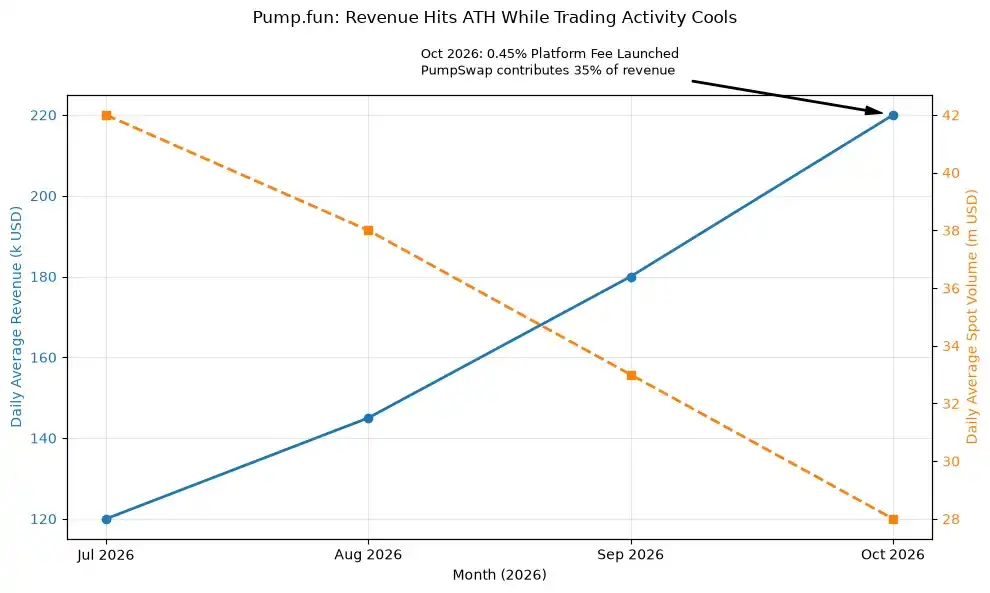
Pump.fun’s total product fees reached a record $175 million in October 2026. PumpSwap contributed $107 million, while Bonding Curve and the official website contributed $61.91 million.
The underlying figures tell a less uniform story. Over the latest 30-day period, launchpad fees were about $50.2 million, down 15% from the preceding 30 days. Protocol revenue was about $35.6 million, also down 15%.
Weekly data showed the decline more clearly. Weekly fees stood at about $15.9 million at the start of October and fell to $9.88 million in the first week of November, a decline of nearly 40% in a month. Daily revenue dropped from more than $1.5 million at its peak to $841,000 on Nov. 10.
Trading volume fell more sharply. Between the first week of October and early November, Pump.fun’s own weekly volume declined by about 46%, while the other seven launchpads combined fell 74%. Pump.fun held up better than its competitors, but the broader cooling in activity was clear.
Launchpad spot trading volume over the latest 30 days was about $3.88 billion, with daily volume fluctuating from tens of millions of dollars to $100 million. That was far below the scale of the speculative market in early 2025.
Two factors explain why fees could still reach a record. First, the 0.45% platform fee added on Oct. 17 came on top of the existing 1.25% Bonding Curve fee, increasing the amount earned per transaction. Second, PumpSwap supported revenue by handling trading in graduated tokens and contributed more than half of all fees.
In effect, Pump.fun is using higher fee extraction per transaction to offset lower volume. Higher revenue does not mean that more users arrived or that users traded more often. More money was collected from each transaction, while post-graduation trading helped replace revenue previously tied to new launches.
Fees cannot be raised forever, and PumpSwap’s volume still depends on overall market activity. Neither source can expand without limits.
Four pressures facing Pump.fun
Fatigue in the Meme market
The first pressure is fatigue in the Meme market itself. Meme trading depends on attention, and attention is easy to exhaust. After users suffer repeated losses and see that most new tokens eventually go to zero, they may be less willing to enter every new launch. Without a new wealth effect, an easy-to-use launch tool may not retain its former activity.
Competition for the trading entry point
The second pressure is the loss of the user entry point. Pump.fun built a Terminal, a mobile app and Perps partly because it does not want users to trade Pump.fun tokens through other terminals. If users move elsewhere, Pump.fun may collect the issuance fee but miss later trading fees and user data. The product users open every day determines where their capital and trading activity flow.
The creator subsidy dilemma
The third pressure concerns creator retention. Callout Rewards are funded by a pool carved out of platform-wide trading fees, together with the return of part of the newly issued PUMP tokens. It is a redistribution of platform traffic revenue.
Creators are not directly taking a cut from followers’ copy trades, and this is not an exchange-style profit-sharing arrangement. The money comes from the platform’s overall trading revenue and is paid as a subsidy.
That creates a dilemma. If subsidies shrink, strong KOLs may move to other platforms. If subsidies grow, they may attract volume farmers who post low-quality content, collect rewards and leave. Members of the community have already proposed removing Callout rewards, arguing that the subsidy may be supporting airdrop hunters rather than creators.
Blockchain analytics firm Bubblemaps calculated that a leading KOL could earn about $125,000 from a bundled recommendation. About $80,000 came from the platform reward pool and $45,000 came from establishing a position in advance and then selling. The new algorithm has not fully closed that route.
Support for the PUMP token
The fourth pressure involves PUMP. A buyback here is an on-chain protocol revenue-distribution mechanism, not the same as a public company repurchasing shares. The funds come from platform fees. The repurchased tokens are mainly used to add to Protocol-Owned Liquidity and for partial burns. There is no share-equity repurchase for stockholders.
In July 2026, the platform completed a large unlock of 82.5 billion PUMP tokens. The share of protocol revenue sent to the buyback pool then fell from 100% to 50%. Over the latest 30 days, the platform spent about $22.4 million on buybacks, equal to 45% of revenue.
Higher platform revenue does not mean holders receive an equal distribution. Unlock-related selling pressure remains, and the token’s fundamentals are under pressure. After Diamond launched, PUMP’s 24-hour futures volume rose 92%. That was futures speculation, not evidence of stronger spot demand.
The bigger contest sits outside Memes
The most significant threat to Pump.fun may not come from another Meme launchpad.
Robinhood Chain went live in July 2026. It is an Ethereum Layer 2 based on Arbitrum. Its first partners included Uniswap and Pleiades, and its stated areas include Stock Tokens, real-world assets, DeFi lending and on-chain derivatives.
Robinhood has 28 million retail customers across 38 countries and regions. Many have never used on-chain Memes, but they already trade stocks, ETFs and crypto on Robinhood. They can now trade stock tokens, Meme tokens and DeFi products inside the same wallet without switching between platforms.
Coinbase’s Base is pursuing a similar expansion. The exchange-incubated Layer 2 has more than $5 billion in TVL, while monthly active addresses have reached as high as 38 million. Base App combines a wallet, trading, social functions and DeFi. Since 2025, it has absorbed substantial Meme and SocialFi activity. Starting with Friend.tech, Base has continued trying to connect social activity with trading.
Robinhood Chain and Base do not need to copy Pump.fun’s one-click launch page to compete. They are competing for something more important: the user’s financial entry point.
Pump.fun is expanding outward from the crypto-native community, trying to bring in more asset types and traders. Robinhood and Base are expanding on-chain from traditional finance and exchange users, placing stocks, crypto and Memes in one trading environment. The directions differ, but the destination is similar: discovery, discussion, trading and holding inside one product.
Pump.fun’s added reward weight for perps, EVM assets and non-Solana assets is also an attempt to expand its asset boundaries. It does not want to remain only a venue for small Meme tokens.
Can rewards create real Diamond Hands?
The first problem is risk-free arbitrage. If a platform rewards spot holdings, users can turn holding into an arbitrage strategy.
A large trader can use several addresses to hold a token in the spot market, meet Diamond’s requirements for holding duration and market-cap exposure, and receive a high reward multiplier. At the same time, the trader can open an equivalent short position in perpetuals or a deep PumpSwap pool to hedge the token’s Delta risk. The trader then holds a position with little effective price exposure while collecting the platform subsidy.
Other possible routes include on-chain MEV frontrunning, wash trading between linked addresses and using flash loans to meet a holding snapshot temporarily. The algorithm can see balances on-chain, but it cannot directly see whether a position is hedged or identify every address connected through several layers. The subsidy may therefore flow disproportionately to professional market makers and arbitrage teams rather than ordinary holders.
The second problem is conflicts of interest. Creators do not directly take a share of followers’ copy-trading profits, but their platform rewards and profits from positions opened in advance may still depend on the performance of a recommendation. Users may ask whether a creator genuinely favors a token or has already filled a position and is waiting for new buyers to lift its value while also generating platform rewards.
Trust is the core asset of a social platform. When every post carries a direct financial incentive, trust becomes harder to establish. Creators on X can earn through advertising and subscriptions, which are not directly tied to their followers’ trading returns. A Pump.fun Callout creator, even without receiving a direct share of follower fees, has an incentive to bring users in, support the creator’s own holdings and increase rewards.
The third problem is that subsidies do not replace genuine demand. A user may hold a token temporarily to receive rewards, but once the rewards stop, a token without its own value or real community consensus can still be sold. Holding for several days does not automatically turn Paper Hands into Diamond Hands.
Professional participants using hedges to capture subsidies are also unlikely to develop lasting conviction in the token. Once the reward arrives, they can unwind the hedge and leave. Subsidies can create short-term holding data without creating long-term belief.
An algorithm can identify holding duration and wallet balances. It cannot identify the hedge behind a position or determine whether the holder truly believes in the asset.
What the next generation of platforms is fighting for
Meme-platform competition has moved through roughly three stages. The first was issuance volume and speed: the platform that let users launch the most tokens the fastest led the market. The second was trading volume, depth and slippage. The third is now emerging around holding time, social relationships and the entry point for asset discovery.
Pump.fun wants to move from a venue where users launch quickly, speculate quickly and leave quickly to an on-chain social-finance platform. Users would discover assets, discuss them, buy and hold them, and continue trading without leaving the product.
If that plan works, Pump.fun’s rivals will no longer be limited to other launchpads. They will include trading communities, trading terminals, social-trading applications and major firms such as Robinhood and Coinbase.
The central question remains unanswered: will users stay when USDC rewards stop, Callout creators receive no distribution and holding multipliers disappear? If users remain only because they can earn money and collect rewards, Pump.fun will have swapped launch subsidies for holding subsidies. The underlying model would still be buying traffic with money. If users stay because the platform offers assets worth discussing, creators they can trust and a smooth trading experience, it may become a true trading social network.
There is no answer yet. Diamond has changed the direction of Pump.fun’s incentives, but genuine long-term holders are not created by rewards alone.



