
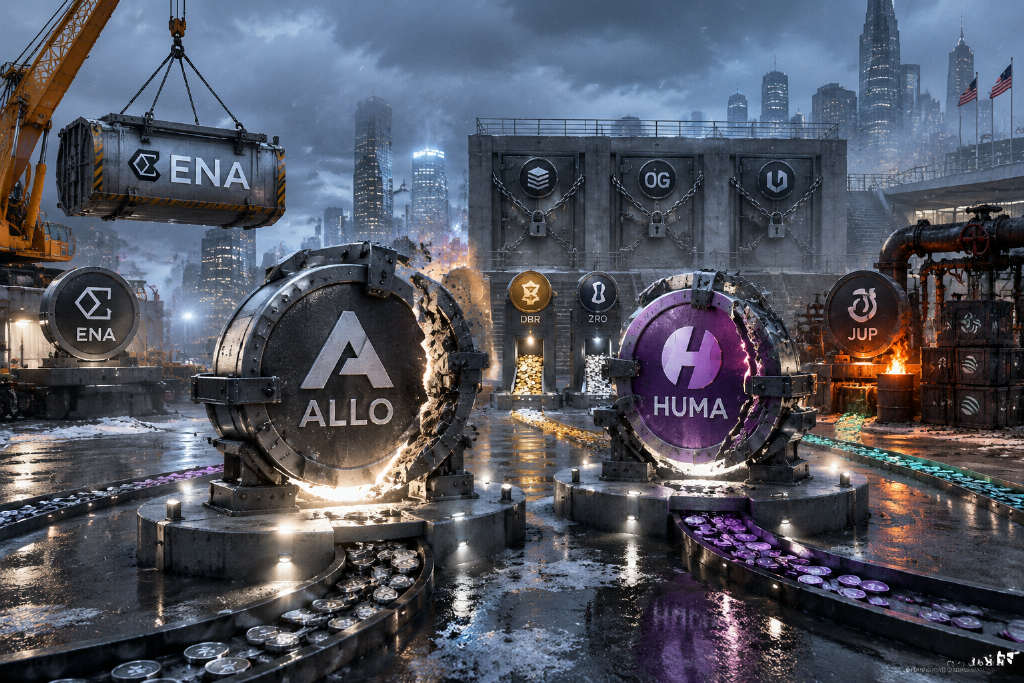
Q4 2026 is about to begin, and several high-profile token unlocks are moving into focus. Drawing on RootData data and project announcements, MarsBit said ALLO and HUMA are set for their first concentrated internal cliff unlocks in November, DBR and ZRO will keep following their quarterly and monthly release schedules, and ENA will move the remaining investor allocation forward into a one-time release on Oct. 5. At the same time, Story, now renamed DATA, and 0G have extended internal lockups, while JUP has pushed net supply lower through burns, paused emissions, and buybacks.
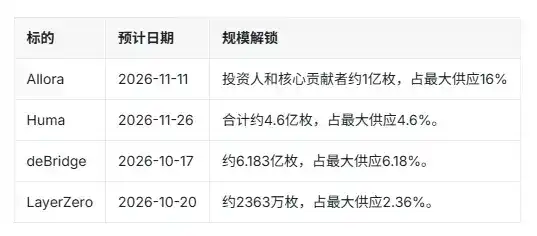
Major token unlocks scheduled for Q4
ALLO and HUMA fall into the cliff-unlock category, meaning the first concentrated release after a lockup period ends. DBR and ZRO continue to unlock on fixed schedules. The table referenced in the source uses a share of max supply, while the body text also cites the share of circulating supply at the time of verification. Because circulating supply changes over time, that second ratio may differ from the figure on the actual unlock date.
Allora (ALLO): first internal unlock of about 160.2 million tokens
Allora is described as a decentralized AI network. Investors and core contributors were allocated 31.05% and 17.5% of total supply, respectively. After a one-year lockup, each group will release 33% of its allocation, for a combined total of about 160.2 million ALLO. Based on the roughly 250 million circulating tokens shown on the calendar platform, that batch equals about 64% of current circulating supply. Including ecosystem and other tranches released in the same period, the calendar total is about 163.9 million tokens.
The newly transferable tokens are mainly held by investors and core contributors, and the size is large relative to current circulation. MarsBit noted that Allora already has a mainnet and financing base, but the material reviewed for this report does not provide continuous data on paid demand or revenue, making it hard to quantify how much business activity can absorb the added supply. Actual selling volume will also depend on how those holders choose to handle their allocations. The cited source is ALLO’s official rules.
Huma (HUMA): internal unlock delayed by six months
Huma focuses on PayFi, providing financing and liquidity for real-world payments. The first unlock for the team, advisors, and major investors was pushed back from May 26, 2026 to Nov. 26, 2026. Those allocations account for 39.9% of total supply. Based on an even release over the following 12 quarters, the first internal batch is estimated at about 332.5 million HUMA. Including other categories unlocking in the same period, the calendar total is about 459 million to 479 million tokens, or roughly 4.59% to 4.79% of the 10 billion max supply.
Because Huma’s business is tied to real payments, the six-month delay shifts the timing of internal circulation. Still, the report said current payment volume cannot be directly translated into token buying demand, and how much value HUMA captures from business growth depends on usage and value-distribution mechanisms. The adjustment only affects part of the internal allocation. Ecosystem and treasury categories continue to unlock under their own schedules. The cited source is HUMA’s token rules.
deBridge (DBR) and LayerZero (ZRO): quarterly and monthly releases continue
DBR’s upcoming quarterly unlock is about 618.3 million tokens, equal to roughly 10.44% of circulating supply based on the calendar platform’s figure at the time. Similar quarterly batches remain ahead. deBridge provides cross-chain trade and asset transfer matching, and funds do not need to stay parked in the protocol for long periods, so total value locked, or TVL, does not fully reflect business scale. The protocol already has fee revenue and buybacks, meaning ongoing unlocks and buyback demand will affect supply and demand at the same time. The cited source is DBR’s official rules.
ZRO’s monthly unlock is about 23.63 million tokens, or around 6.69% of circulating supply based on the platform figure at the time. LayerZero provides cross-chain messaging infrastructure. The project has disclosed buybacks and relocking for part of the investor allocation, as well as buyback arrangements tied to Stargate revenue. The first measure delays when some tokens can be sold, while the second adds token buy demand. The material reviewed here does not establish whether those buybacks are large enough to offset the monthly unlock. The cited source is ZRO’s official explanation.
In RootData’s front-end export for this review, there were 90 deduplicated token samples, 87 of which had a valid “next unlock value ratio.” Sixteen were at or above 10%, accounting for about 18.4%. The report said this field is close to the ratio of unlock value to circulating market capitalization and reflects supply size rather than an expected price decline. It also noted that the “next batch” shown in the snapshot may refer to a different date from the large internal unlocks discussed in the article.
Other projects on the unlock calendar
LAYER continues to release ecosystem allocations on a quarterly basis while team and investor allocations keep unlocking in parallel, leaving future supply spread across different tranches. VANA’s Vega upgrade involves product and technical changes, but supply and emission rates were not changed, so the existing release schedule remains in place.
Humanity (H) went through a security incident and token migration in June 2026. The token mapping before and after migration, along with changes in trading depth, makes price and circulating-supply comparisons more complicated. LISTA and STABLE are discussed later in the report because their supply-rule changes are part of the broader tokenomics section.
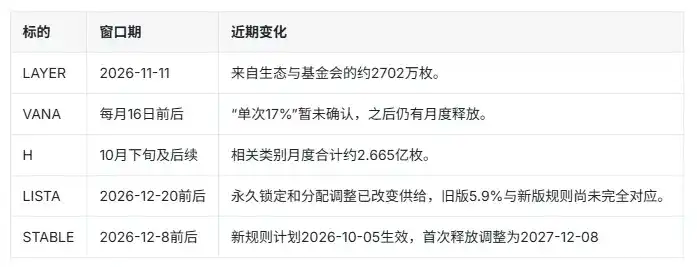
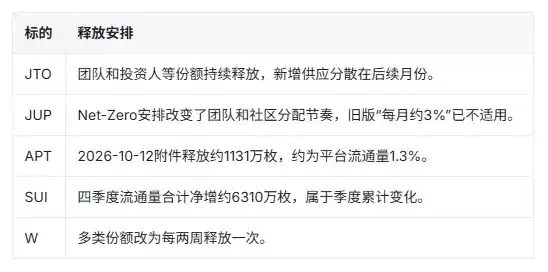
For projects with continuing releases, the source lists JTO rules, the JUP proposal, the APT calendar, SUI plans, SUI plan data, and W’s official announcement as references.
The report also notes that UNITE’s delayed team unlock starts on Sept. 30, 2026, while ENA’s accelerated release is scheduled for Oct. 5, 2026.
How tokenomics changed over the past two years
Over the last two years, several tokenomics revisions have altered original unlock schedules. UNITE and Story delayed internal releases, BABY spread concentrated unlocks into monthly tranches, and ENA brought part of the investor allocation forward. Burns, permanent locks, and buybacks changed total supply, circulating availability, or buy-side demand in different ways. The report groups these changes by type and separates measures that have already taken effect from those that are still pending.
Delays and longer lockups
UNITE passed a governance change in November 2025 that moved investor, team, and advisor unlocks back by eight months. The new start dates are July 30, 2026 for investors, Sept. 30, 2026 for the team, and Aug. 30, 2026 for advisors. Release duration and total allocation size remain unchanged, so supply is delayed rather than reduced.
Story announced in June 2026 that it had rebranded as DATA Network and would migrate the token to DATA on a 1:1 basis. Internal holdings were first delayed from Feb. 13, 2026 to Aug. 13, 2026, and the board later approved another 18-month delay to Feb. 13, 2028. Those two changes altered the timing of internal circulation, while total amount, allocation, and ownership stayed the same.
HUMA pushed its first internal unlock back by six months to Nov. 26, 2026, while ecosystem and treasury releases remain on separate schedules. SAHARA delayed investor allocations by three months to Sept. 26, 2026 and founder, core team, and advisor allocations by six months to Dec. 26, 2026. The adjustment applies only to those recipients.
0G changed allocations covering about 44% of supply held by the team and early investors in September 2026. The first release was moved from Oct. 22, 2026 to Oct. 22, 2027, but the later release period was shortened from 36 months to 24 months, with the full schedule still set to end in September 2029. If the total amount remains unchanged and releases are even, the monthly release pace after the delay would be 50% higher than under the original plan.
WLD made an earlier adjustment in July 2024, outside the report’s two-year observation window. For TFH team- and investor-related holdings, about 80% of that category had its lockup extended from three years to five years. The 80% figure refers to that holding category, not total token supply. A longer release period spreads the same batch over more time.
Tranching and linear release
BABY changed the locked allocations for early investors, the team, and advisors to a monthly 1/36 release starting on May 10, 2026 and ending in April 2029. The original concentrated batches were spread into monthly releases, but the total amount did not change. Ecosystem incentives and staking inflation remain separate sources of supply.
Wormhole introduced W 2.0 in September 2025, changing several allocation categories from annual concentrated releases to releases every two weeks and extending some lockup periods. That spreads out the amount released on any single date. Some tokens first move into foundation custody, but the final recipients’ ability to sell still depends on their own lockup terms, so custody timing and sellable timing are not identical.
Accelerated release
ENA changed the remaining monthly releases for the relevant original investors into a single-batch release starting on Oct. 5, 2026. Market estimates put the amount at about 1.4 billion tokens, though the final net figure still needs to be checked against buybacks and the release list. The report stresses that this does not mean all VC, team, and foundation allocations unlock at the same time. Supply that would otherwise have been spread over later months is being brought forward, while buybacks create demand for part of that amount. The actual net release size has not been confirmed.
For ENA held by StablecoinX, a contractual lockup exemption takes effect on Oct. 5, 2026. Even after that exemption, sales still require prior written consent from the foundation. Certain financing-related sales also require five business days’ notice, and the foundation retains a purchase option. Those contractual limits continue to shape when and how that portion can be sold.
STABLE rewrites lockup rules
STABLE’s new white paper proposes placing 82 billion tokens, or 82% of total supply, under a Universal Lock framework. The plan is scheduled to take effect on Oct. 5, 2026. The first release would move to Dec. 8, 2027, followed by seven overlapping release phases. That would push back near-term supply shown on the original calendar, though the change was still pending at the time of the research.
The new rules include a price-protection clause that can delay some releases under certain conditions, but it does not guarantee token price. That protection ends on Dec. 8, 2029, when any remaining tokens are released under the rules. This ties part of the release schedule to price conditions while preserving a final maturity date for supply. Voting rights and sale rights during the lockup period follow different rules. The cited source is Stable’s new white paper.
Permanent locks and burns
Jupiter burned 3 billion JUP in January 2025, cutting the supply cap from 10 billion to 7 billion, a 30% reduction. Those tokens have been removed from supply and no longer belong to future unlock schedules.
LISTA permanently locked 200 million tokens through LIP021 and adjusted multiple allocation categories. Permanently locked tokens no longer enter available supply, but the total supply shown in the contract may not decline at the same time, making the treatment different from a burn. The official page still contains both old and new descriptions, and the older allocation ratios do not yet fully line up with future release arrangements.
Paused emissions and buybacks
Under the Net-Zero arrangement approved by DAO vote in February 2026, JUP delayed a 700 million Jupuary distribution, paused on-chain emissions from the team reserve, and set up an offset arrangement for Mercurial-related allocations to counter actual selling. The existing mechanism that uses 50% of on-chain revenue for buybacks remains in place. The delayed 700 million tokens are still held in a community multisig wallet and can be reallocated by governance in the future. They were not burned. As a result, JUP now reflects three separate changes at once: a completed supply reduction, delayed distribution, and continuing buybacks.
ENA’s fee-buyback mechanism has already been approved by vote, with the first threshold tied to USDe reaching $7.5 billion in scale. The size of any buyback still depends on whether that threshold is triggered and how the plan is executed afterward. The material reviewed here does not confirm the actual amount purchased.
In Tokenomics 2.0 during spring 2026, LISTA removed the veLISTA lockup model and shifted value distribution toward buybacks. Previously staked allocations can now exit, making existing tokens easier to trade, but no new minting was added. Unlock-related exits and buyback demand will affect supply and demand at the same time, and the final effect depends on their relative size and the continuity of buyback funding.
Inflation and supply-cap changes
Aptos pushed supply reform in 2026, and its official dashboard lists a 2.1 billion token cap and a 2.6% annualized staking reward rate. At the time of verification cited in the report, monthly issuance was about 1.6 million tokens, roughly 164,000 tokens had been burned over the previous 30 days, and net issuance was still about 1.4 million. Based on that snapshot, APT remained in net inflation, with new supply from staking rewards coexisting with unlocks from earlier allocations.
Sample observations from the report
The report says it drew from 1,537 projects in RootData that had unlock schedules. Within that sample, ALLO and HUMA stand out for relatively concentrated first internal unlocks, while DBR and ZRO continue across multiple cycles. Tokenomics revisions also point in different directions. Story moved internal unlocks later, 0G delayed releases but compressed the later schedule, ENA pulled supply forward into a concentrated batch, and JUP combined burns, paused emissions, and buybacks. Even when projects are all modifying unlock calendars, the amount and pace of future supply can end up looking very different.