
Qingtianzu has completed a strategic funding round worth several hundred million yuan, with participation from Heda Investment, Houwei Capital and Zhonglian Jisong, among other industrial and entertainment-sector investors. The company disclosed the transaction on Nov. 13, according to Investment界AI.
This is the seventh financing round Qingtianzu has disclosed this year. Founded in December 2025 by humanoid robotics company Agibot and Feikuo Technology, Qingtianzu entered the robot rental market at an early stage. Following the latest deal, it said it is upgrading its business model from “robot rental” to “robot productivity services,” and from renting out equipment to delivering completed work.
Industrial investors bring operating scenarios
Houwei Capital is the market-oriented private equity investment manager under the Mango media group. Qingtianzu said the partnership will connect content with embodied intelligence. Robots would not be used only as props for performances. They could also serve as offline carriers for intellectual property content and as core points in immersive experiences.
The two sides plan to explore an entertainment format built around “IP content + robot performances + offline interaction.” The stated aim is to bring embodied intelligence into consumer-facing settings.
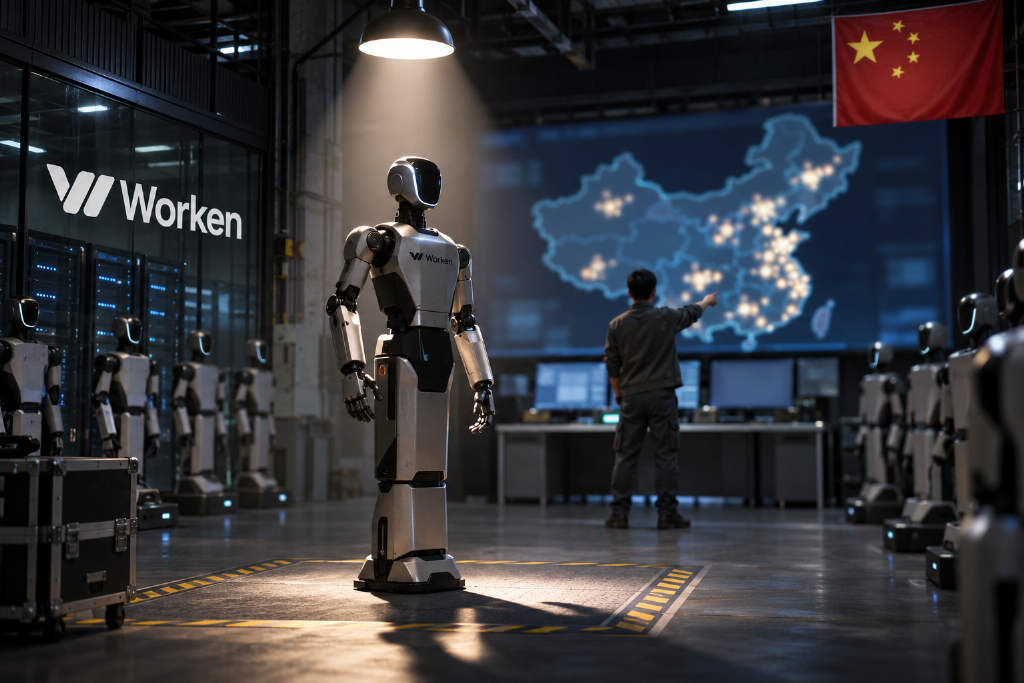
Heda Investment will support Qingtianzu’s regional industrial expansion and the concentration of technology, talent and service resources. The two parties will also work on deploying the Worken training system. The system is intended to validate robot capabilities in real industrial settings and support replication at scale.
Zhonglian Jisong Network Technology, which focuses on instant delivery, will open real logistics scenarios such as last-mile delivery and campus services after completing its investment. It will work with Qingtianzu on robot-fleet operating solutions and test multi-robot coordination and scheduling inside actual business processes. The partnership is designed to extend robot services from commercial performances to industrial use cases and to explore larger-scale fleet-based services.
Qingtianzu said all proceeds from the latest round will go toward the core capabilities of its robot productivity service business. The planned uses include application-service research and development, deployment of the Worken training system, development of an industry ecosystem and upgrades to the company’s nationwide fulfillment network.
Seven rounds in less than a year
Qingtianzu was established less than a year ago, but it has disclosed a rapid sequence of financings. In January 2026, it completed a seed round led by Hillhouse Ventures. Fosun Fortune, Muhua Kechuang, Dafeng Industrial and an embodied-intelligence company under Zhangjiang Group also participated.
According to the report, purely financial investors have had difficulty entering Qingtianzu’s shareholder register. Investors have generally been expected to bring industrial resources or a path to business expansion.
In March 2026, Qingtianzu completed both an angel round and an angel-plus round, bringing total funding from those rounds to more than 100 million yuan. Listed company Dayang Motor, Muhua Kechuang and Minzhuo Electromechanical were the lead investors. Lehua Entertainment, Fuzhuo Investment, Mingjia Capital, Ruizi Venture Capital, Tianji Investment, Jiaxing Nanto and Zhixing Investment were among the participating investors. Existing shareholder Dafeng Industrial subscribed for more than its pro rata amount.
Qingtianzu said more than 40 investment institutions expressed interest during that financing process. Mingjia Capital, operated by actor Huang Xiaoming, decided to invest in less than 24 hours after its initial meeting with the company.
The company soon announced a Pre-A round worth several hundred million yuan. Investors included Chia Tai Robotics, backed by Chia Tai Group, and Changxin, as well as listed companies such as Megmeet and Lens Technology. Existing shareholders continued to participate.
In May, Qingtianzu announced another financing sequence consisting of an A round and an A-plus round, with proceeds reaching several hundred million yuan.
Within a period of several months, the company, which does not manufacture robot bodies or develop a robot “brain,” became an embodied-intelligence unicorn, according to the report.
From renting machines to delivering work
Qingtianzu is trying to move past the market’s image of a company that simply rents out robots. Once robots enter real-world settings, customers often need more than a single machine. They need the ability to complete tasks, operate continuously and receive service support.
Demand is also moving beyond a group of robots working on one performance. It now includes division of labor and coordinated operations in science museums, commercial spaces and industrial settings. Qingtianzu is responding by extending its service from matching equipment supply and demand to organizing tasks, scheduling fleets and providing ongoing operations.
On the supply side, the company has connected nearly 20 robot-body brands, including Agibot, Gaoqing, Yingzhi XBOT, Shouxing, UWorld and Qingzong. It is also building capabilities in global asset-network scheduling, robot-fleet operating systems and operations management.
Through an integrated scheduling system, Qingtianzu aims to organize machines, skills and work assignments, turning equipment supply into a deliverable form of productivity.
Deng Feng, Qingtianzu’s newly appointed CEO, previously said that AI should not remain limited to screens and chat windows. It should also enter the physical world through embodied forms such as robots and address practical problems in production and services.
According to Deng, the value created by robots will not be limited to single-machine operations. It will move toward fleet deployment and collaborative work. The number of robots, the amount of time they can operate continuously and their actual work efficiency will all be used to measure the productivity and commercial value they create.
Worken and a nationwide service network
When robots work as a fleet, Qingtianzu uses Worken as the core measure for effective autonomous output. Through Worken, the company wants to build a service-measurement framework whose results can be recorded, compared and settled. The framework is intended to support robot capability pricing, service delivery and ongoing optimization across different use cases.
A productivity service network requires more than machines and technical systems. It also needs local organizations that can take on projects and keep operations running. Qingtianzu currently has 20 operating centers formally in service across China, including in Beijing, Shanghai, Guangzhou, Shenzhen and Hangzhou.
These centers handle market expansion, project delivery, continuing service and ecosystem coordination. During its first phase, Qingtianzu plans to establish service nodes in 54 cities.
The company’s shift from commercial-performance rentals to industrial demand is the main test of this business upgrade. The source article was published by the WeChat account “Investment界AI” and written by Yang Jiyun.



