
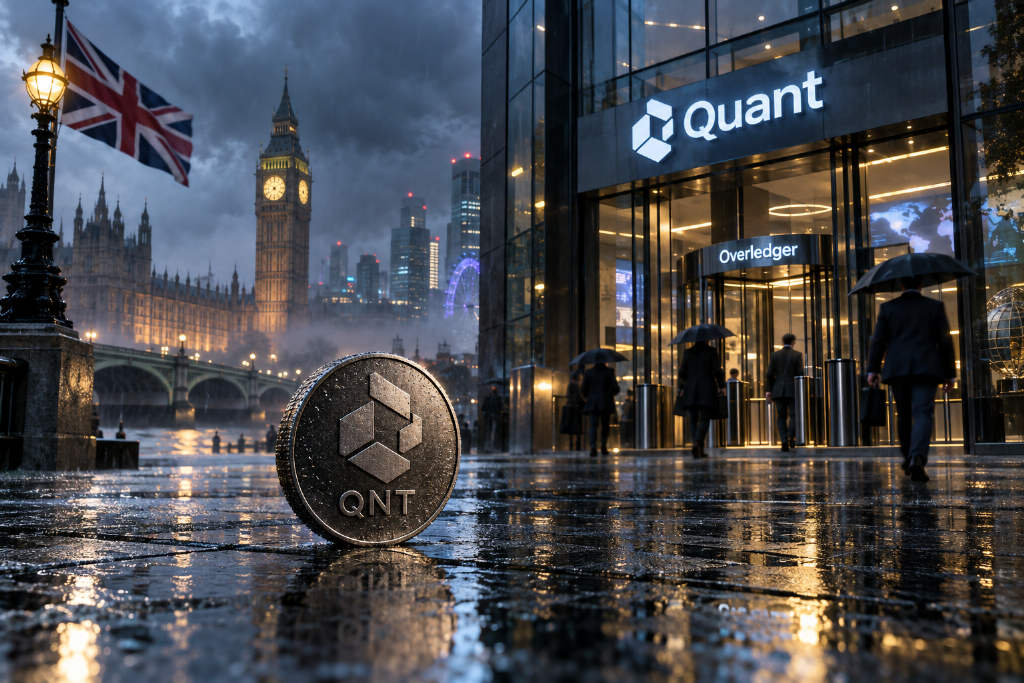
QNT turned into one of the market’s hottest names over the weekend after a violent rally dragged it back into the spotlight. As of writing, QNT was changing hands at 265 USDT, up 46.64% in 24 hours and 297.3% over the last seven days, after printing an intraday high of 373 USDT.
That spike has shoved fresh attention onto Quant, the company tied to the token, and onto one big market debate: how much of Quant’s institutional business traction really flows back to QNT?
What Quant does, and where QNT fits in
Quant is a UK fintech firm founded in 2018. It is not trying to be a public blockchain in the Ethereum or Solana mold. Different thing. The company sells blockchain interoperability, digital asset infrastructure, and programmable money tooling to financial institutions.
Its flagship product, Overledger, works as a middle layer between traditional financial systems and different blockchain networks. Quant’s pitch is straightforward: banks should be able to connect to tokenized deposits, digital assets, and multiple distributed ledgers without tearing out and rebuilding the systems they already run. The company says Overledger links digital currencies, assets, legacy payment rails, banking infrastructure, and blockchain networks in one layer.
That goes a long way toward explaining why Quant has shown up in a string of central bank, banking, and payments projects in recent years. Based on the source material, Quant acted as a technology supplier in the Bank for International Settlements and Bank of England’s Project Rosalind. In 2025, it also joined the European Central Bank’s digital euro innovation platform through the Pioneer program to test features such as conditional payments. Quant founder Gilbert Verdian has also worked on the ISO/TC 307 blockchain and distributed ledger standard and serves as convenor of the interoperability working group.
QNT is Quant’s native token. Company materials say Overledger subscriptions can be paid in QNT. Put simply, Quant sells financial infrastructure, and QNT is the token attached to that business system.
The Sept. 24 catalyst: The Clearing House partnership
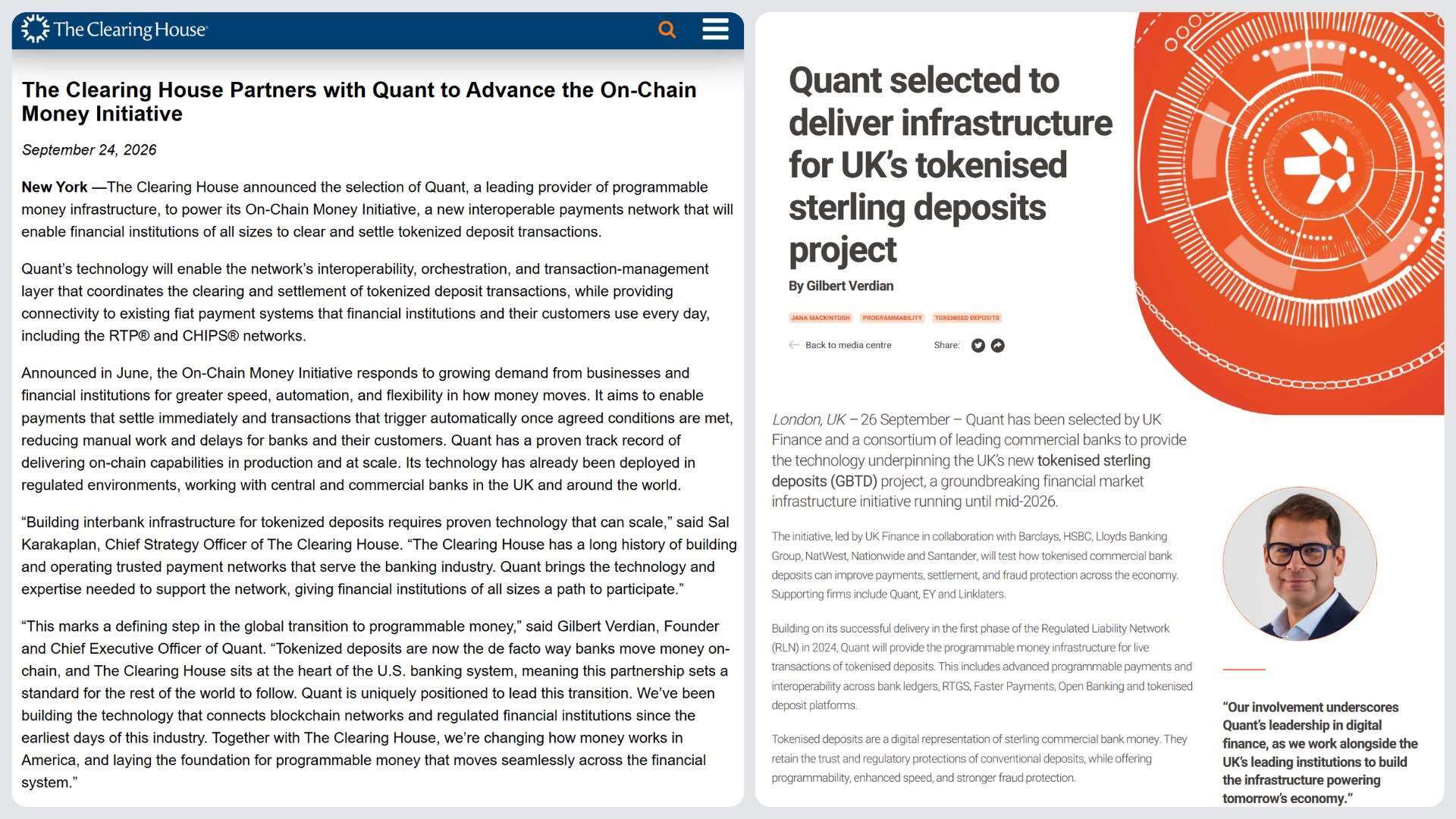
The latest QNT run really started on Sept. 24, when Quant said it had struck a partnership with US financial infrastructure operator The Clearing House, or TCH.
Under that deal, TCH picked Quant to provide technology support for its On-Chain Money Initiative. The goal is an interoperable payment network for financial institutions that can handle clearing and settlement for tokenized deposits. Quant is in charge of the interoperability, transaction orchestration, and transaction management layers, while also linking existing payment systems such as RTP and CHIPS. The network is expected to open to participating institutions in the first half of 2027.
The market cared partly because of where Quant sits in the stack. This was not presented as a one-bank pilot. It touched core US banking payment infrastructure. The source says TCH’s payment networks handle more than $2 trillion in payment clearing and settlement every day, and that the On-Chain Money Initiative, first announced in June, is meant to explore how tokenized deposits could be used in interbank payments, corporate treasury management, and digital asset settlement.
But one distinction matters. A lot. TCH processing more than $2 trillion per day does not mean future flows on that scale will settle through QNT. From the public information cited in the source, the confirmable part is that Quant has become a technology supplier for the initiative and is responsible for the infrastructure layer. It has not been disclosed whether participating banks will have to hold or use QNT.
TCH is only one part of the recent institutional story
TCH is not the lone example of Quant pushing further into traditional financial infrastructure this year.
In January, Quant entered a strategic partnership with Japanese systems integrator Dentsu Soken. The two companies said they planned to help Japanese financial institutions adopt tokenized deposits, institutional stablecoins, and programmable settlement infrastructure.
In March, Quant partnered with financial software company Murex to integrate its programmable money infrastructure into Murex’s MX.3 platform. The point was to let banks handle tokenized deposits and digital bonds inside their existing trading, risk, and post-trade systems.
Before that, Quant also got involved in the UK’s Great British Tokenised Deposits, or GBTD, project. The source says UK Finance announced this month that Barclays, HSBC UK, Lloyds, Monzo, Nationwide, NatWest, and Santander had completed the first tokenized pound deposit transactions involving real customers, with Quant acting as the project’s infrastructure technology provider.
In the market, traders have been stitching those separate updates into one bigger story. Quant has TCH in the US, GBTD in the UK, Dentsu Soken in Japan, and Murex in capital markets software. And that has strengthened the view that the company is turning into an infrastructure supplier for financial institutions testing tokenization and programmable money.
A viral post from Jan Nieuwenhuijs accelerated the move
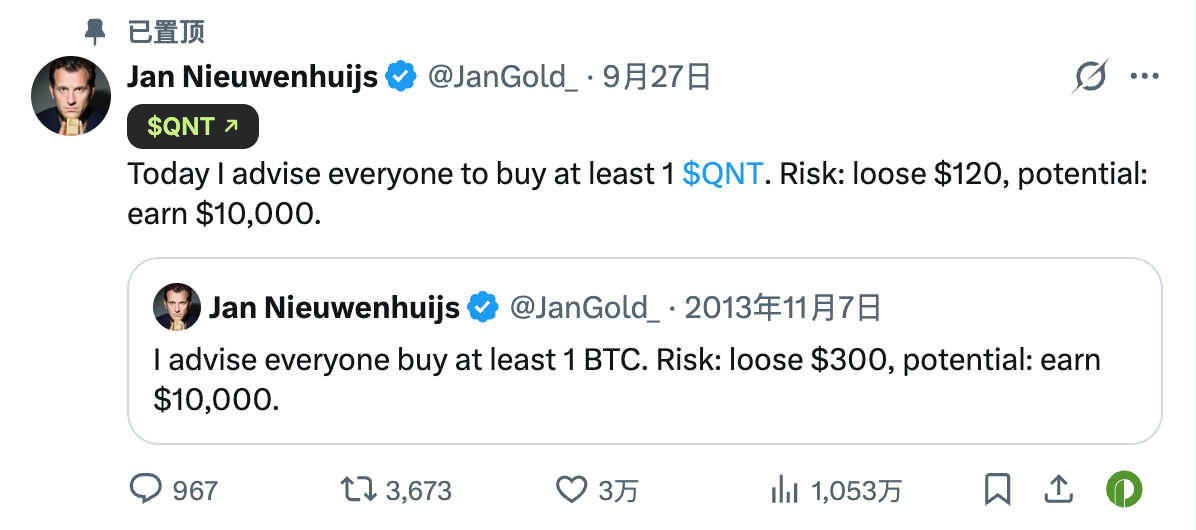
The professional infrastructure angle broke out to a much larger audience after a Sept. 27 post from overseas KOL Jan Nieuwenhuijs.
Jan quoted one of his own 2013 posts about BTC that said, “I suggest everyone buy at least 1 BTC. The risk is losing $300, while the potential profit is $10,000.” He then reused the exact same framing for QNT: “I suggest everyone buy at least 1 QNT. The risk is losing $120, while the potential profit is $10,000.”
Because QNT had already begun climbing, the post spread fast across the community. The source says it had racked up more than 10 million views by the time of publication, helping push the token into another leg higher.
At that stage, what started as a niche financial infrastructure update got squeezed into a much simpler market story people could pass around fast: if investors missed BTC back then, they should not miss QNT now. With broader crypto risk appetite improving too, the mix of institutional partnerships, limited supply, and an early-BTC-style narrative helped shift the move from a news rally into a plain FOMO trade.
Business growth is not the same as token value capture
From a fundamentals angle, this rally did not come out of nowhere. The TCH on-chain money initiative, along with the projects in the UK and Japan, suggests Quant’s technology is getting real-world validation from traditional financial institutions. And if tokenized deposits and digital asset settlement move closer to actual deployment, the part of the market Quant operates in has room to expand.
But for QNT, Quant’s business growth and token value capture are still two different things. The public information cited in the source confirms that QNT can be used to pay Overledger subscription fees. What it does not show is how much revenue these banking and financial infrastructure projects may generate for Quant, or how much of that would turn into direct demand for QNT.
After a weekly gain close to 300%, the market is no longer pricing only the partnerships that have already been announced. It is also pricing future expectations around value capture. So, in that sense, QNT looks more like a repricing driven by both fundamental catalysts and sentiment.
The faster a chart goes vertical, the easier it is for expectations to outrun reality. For a token that has already moved this hard, the next issue may matter less than how many new partners Quant can announce and more than whether those partnerships translate into measurable commercial revenue and, later, into real token demand.
Signs of near-term cooling have started to appear
There are early hints, too, that short-term sentiment may be easing off. Well-known trader Doctor Profit (@DrProfitCrypto) wrote on X this morning that he had taken profit on his entire QNT position. He said he could not rule out more upside, but he believed the long side had become overcrowded and that some large holders had already started distributing, which led him to exit.
With QNT already up roughly 300% in a week, short-term volatility is still a direct risk for market participants.