
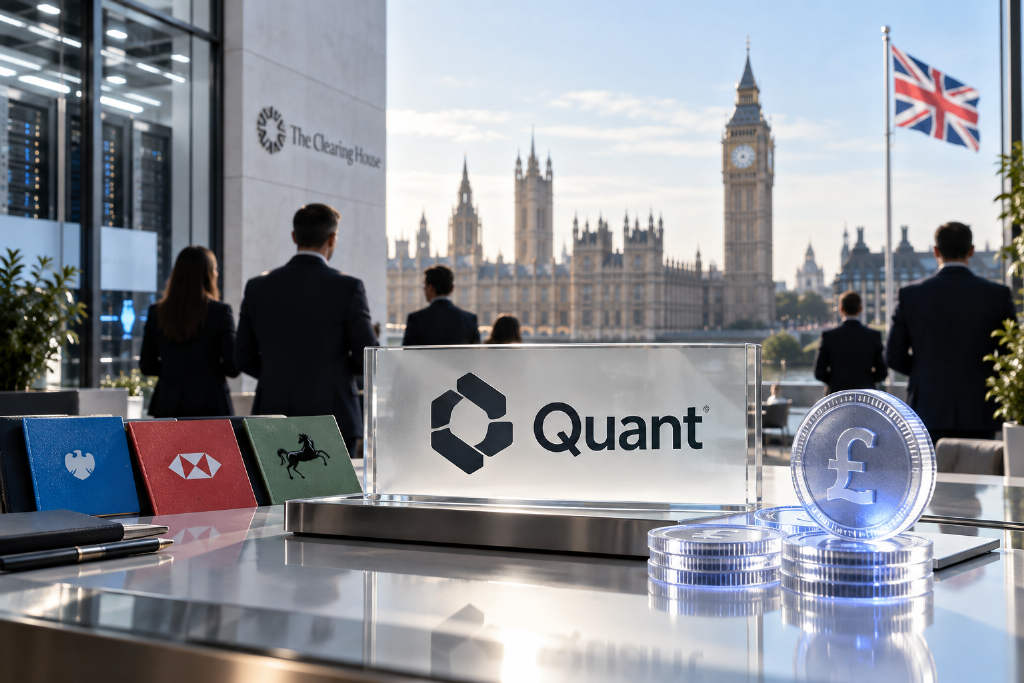
QNT jumped roughly 180% in the past week, climbing from about $60 to above $167. And 24-hour trading volume pushed past $600 million.
The near-term spark was a fresh banking infrastructure mandate tied to Quant. On Sept. 24, The Clearing House (TCH) said it had picked Quant as the technology provider for its On-Chain Money Initiative. Then, on Sept. 26, seven major UK banks — including Barclays, HSBC and Lloyds — used the Quant platform to carry out what the report called the world’s first real customer payment transactions involving tokenized pound deposits.
TCH clears and settles more than $2 trillion every day. It also operates core pieces of the U.S. banking payments system, including RTP, the real-time payments network, and CHIPS, the large-value interbank settlement network. The initiative includes 25 major U.S. banks and is expected to go live in the first half of 2027. Quant founder Gilbert Verdian described the partnership as "a decisive step in the global shift toward programmable money."
Quant’s role is not a blockchain, but a layer that connects systems
The case for QNT’s violent move starts with Quant’s place in the stack.
Quant does not operate its own blockchain. Its main product, Overledger, is an interoperability layer built so different blockchains and legacy systems can talk to each other and transact. In the tokenized deposit setup, Quant works as an orchestration layer, coordinating clearing and settlement across different bank systems while staying compatible with existing payment rails like RTP and CHIPS.
That matters for business reasons. Banks do not need to move onto one chain. Each institution can keep its own tech stack, and Quant sits between them to translate and coordinate. For a network that involves 25 banks, the article argues, forcing every participant onto a single blockchain was never realistic. Simple as that. It presents this as a main reason TCH chose Quant.
The UK rollout has also gone past the proof-of-concept stage. The Sept. 26 transaction involved a real mortgage refinancing case, with funds released automatically after the property ownership transfer was confirmed. The report treats that as a move away from testnet-style demos and into real customer activity with real money moving.
Tokenized deposits are not the same as stablecoins
The article makes a clean distinction between tokenized deposits and stablecoins.
USDC and USDT are stablecoins issued by non-bank entities and backed by reserve assets such as Treasuries and cash. Holders have a redemption claim on the issuer, but the tokens themselves are not bank deposits and are not covered by deposit insurance.
Tokenized deposits are different. They are bank liabilities issued by regulated commercial banks. They sit on bank balance sheets and come with deposit insurance protection. Here, tokenization means putting bank liabilities onto blockchain infrastructure for representation and transfer without changing their legal status. They are still bank deposits.
For banks, tokenized deposits are more appealing than stablecoins because they do not create deposit disintermediation. The funds stay inside the banking system; only the settlement mechanism changes. The article uses that point to explain why TCH, an institution owned by banks, chose to back tokenized deposits instead of a stablecoin model.
How the article maps the broader trade
Canton Network (CC): the closest comparable
Canton Network, built by Digital Asset, is described as a privacy-focused institutional blockchain. Its participant list includes DTCC, Goldman Sachs, BNY Mellon, Tradeweb, Deutsche Börse, HSBC, Broadridge, BNP Paribas and Visa.
The article says JPMorgan’s JPMD tokenized deposit product is already running on Canton, with a launch date of January 2026. DTCC plans to use Canton for tokenized U.S. Treasuries, and Deutsche Börse’s digital securities settlement platform is also built on the network.
The main difference from Quant comes down to architecture. Quant offers interoperability across different systems. Canton is a single institutional transaction network. One is framed as a translator. The other is a platform.
CC’s fully diluted valuation is estimated at about $5.5 billion, with a ranking around No. 24. Its fee model uses token burning: transaction fees are priced in dollars, paid in CC, and then burned. So network usage is tied directly to reducing token supply. But there is a catch. Total supply is uncapped, and issuance continues through rewards for validators and application developers. Whether deflation can outrun issuance is described as the same arithmetic problem faced by ZAMA.
Canto (CANTO): a small-cap NeoFinance trade
Canto is an EVM-compatible Layer 1 in the Cosmos ecosystem, and it brands itself as NeoFinance, a public infrastructure layer for decentralized finance. Its design is built around what the report calls free public primitives: a zero-fee DEX, a lending market based on a Compound v2 fork, and the NOTE stablecoin.
Through Fortunafi and Hashnote, Canto has brought tokenized real-world assets on-chain and introduced U.S. Treasury yield into the ecosystem. But its role is different from Quant and Canton. Rather than acting as interbank settlement infrastructure, Canto is presented as an RWA access layer for DeFi-native users.
The article says CANTO’s market capitalization is only in the tens of millions of dollars, with limited liquidity and very high volatility. It places the token at the high-beta, small-cap end of the RWA theme, not in the same risk bucket as QNT or CC.
Chainlink (LINK): an indirect infrastructure beneficiary
Chainlink provides Data Streams, Proof of Reserve, NAVLink and CCIP for Canton. Chainlink Labs has also become a super validator for the Canton Global Synchronizer. And in Swift’s pilot for tokenized asset settlement, Chainlink is identified as a core technology provider too.
LINK is not a pure tokenized-deposit trade. Still, every step banks take toward on-chain infrastructure increases demand for oracles and cross-chain messaging. In the article’s framing, LINK is the pick-and-shovel exposure in this segment.
XRP and XLM: older payment-settlement narratives
Ripple’s XRP and Stellar’s XLM have long been linked to cross-border payment and settlement narratives. The report argues that their positioning differs in a subtle way from tokenized deposit infrastructure. XRP and XLM lean more toward becoming payment networks that replace SWIFT, while Quant and Canton lean toward adding a blockchain settlement layer to banking systems that already exist. One route is replacement. The other is an upgrade.
The article ends by saying that, with the SEC having just granted an innovation exemption for tokenized stocks and TCH choosing Quant, the favored direction inside the banking system is getting clearer: use blockchain technology to upgrade banks, rather than use crypto networks to replace them. In that framing, the direction looks better for Quant and Canton, while putting implicit pressure on the established XRP and XLM narratives.