
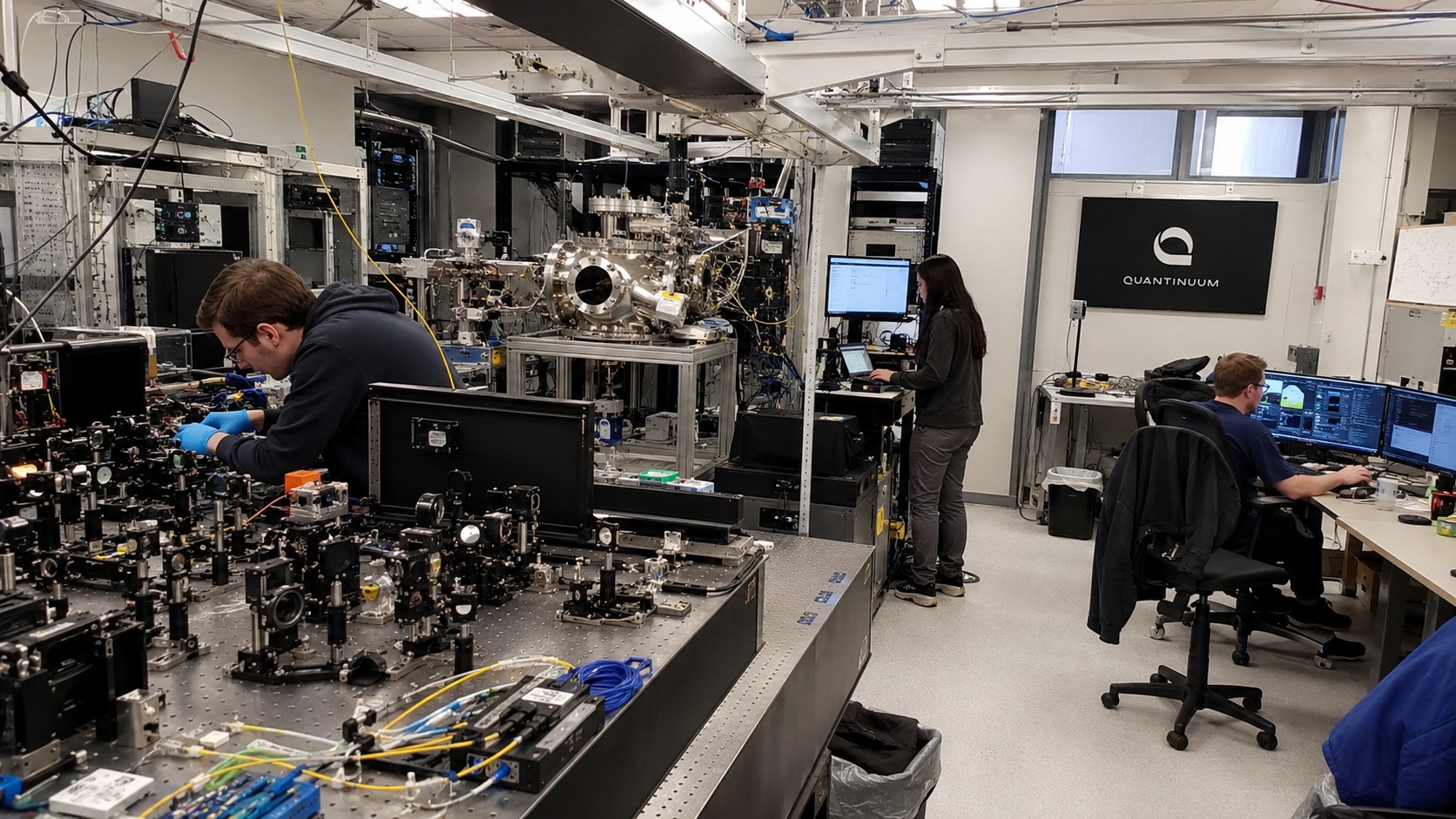
Quantinuum's Nasdaq IPO is drawing massive demand, with sources telling Bloomberg on May 29 that oversubscription reached double-digit multiples. The company is now considering increasing both the number of shares offered and the price range by roughly 10%. The original plan of 21 million shares at $45-$50 each, implying a $12.7B fully diluted valuation, may be upgraded to $49.50-$55 per share, pushing the valuation above $14B. Trading under the ticker QNT is expected to start June 4.
From $5B to $14B in 18 Months
Formed from the merger of Honeywell's quantum computing division and Cambridge Quantum, Quantinuum has raised capital at an accelerating pace. In January 2024, it secured $300 million at a $5B valuation. In September 2025, it raised another $600 million at $10B, with Quanta Computer and NVIDIA's NVentures joining. Now the IPO oversubscription has pushed the price up 10%, tripling the valuation from $5B to $14B in just 18 months.
Elite Underwriting Team and Government Backing
Joint bookrunners include JPMorgan, Morgan Stanley, and Goldman Sachs, with a large syndicate of Bank of America, UBS, Jefferies, Evercore ISI, and others. Honeywell will hold 49.1% of shares post-IPO, maintaining control. Additionally, the Trump administration's $2B quantum investment plan allocates roughly $100 million to Quantinuum in exchange for a minority equity stake, effectively providing a government endorsement before the public listing.
Traditional IPO vs. SPAC Predecessors
Every other publicly listed quantum computing company—IonQ, D-Wave, Rigetti—went public via SPAC. Quantinuum is the first to choose a traditional IPO, submitting to full SEC scrutiny. The trade-off: stronger price discovery. The heavy oversubscription signals institutional confidence in the sector's revaluation.
Deep Losses, Leading Technology
Quantinuum's financials are bleak: FY2025 revenue of just $30.9 million, net loss of $192 million, and cumulative losses of roughly $1.5 billion. About 60% of its revenue comes from a single customer, Japan's RIKEN. But its trapped-ion technology is globally leading. The Helios system, set for commercial deployment in 2026, features 98 fully connected physical qubits and 48 logical qubits, with a two-qubit gate fidelity of 99.921%. Early customers include Amgen, BMW, JPMorgan, and SoftBank. The next-generation Apollo (targeting 2029) aims for a million-gate fault-tolerant universal quantum computer.
IonQ Benchmark: Revenue Gap, Valuation Catch-up
IonQ, already listed, has a market cap of ~$19.4B and FY2025 revenue of $100.5 million—the first quantum company to break the $100M mark. Quantinuum's revenue is one-third of IonQ's, yet its IPO valuation ($12.7B, potentially $14B) reaches about 70% of IonQ's market cap. The market is clearly prioritizing technological roadmap and commercial timeline over near-term profitability.