

Railgun recorded its busiest month to date in September, with stablecoin volume moving into and out of its privacy pool reaching $117 million, according to a report by Alea Research compiled by TechFlow. The study frames the demand in practical terms: on public blockchains, every stablecoin payment exposes sender, receiver and amount on-chain, creating problems for payroll, treasury operations and traders trying to avoid revealing positions.
Stablecoins have now become the core asset class inside Railgun’s pool. The report says stablecoin transaction volume through the privacy pool rose 93.6% over one year, climbing from $60.7 million in September 2025 to the current peak. By September, stablecoins made up 77.2% of all assets flowing through the pool, up from 33.7% a year earlier. During the month, stablecoin activity at the edge of the pool was more than three times ETH volume, at $117 million versus $34.8 million.
Railgun stores shielded tokens in a smart contract pool and lets users control assets through zero-knowledge proofs. Those proofs allow on-chain validation without revealing ownership, balances or token type. USDC, USDT, DAI and fxUSD can move between Railgun addresses while both counterparties and transfer amounts remain hidden. The report adds that f(x) Protocol began supporting direct minting of synthetic stablecoin fxUSD into shielded balances in September.
Peer-to-peer transfers between two Railgun addresses carry no protocol fee. Wallets can also choose to run Private Proofs of Innocence, an optional on-chain screening mechanism that checks new deposits against sanctions or scam-tracking blacklists without exposing user identity.

EIP-7702 changed the execution model in a matter of days
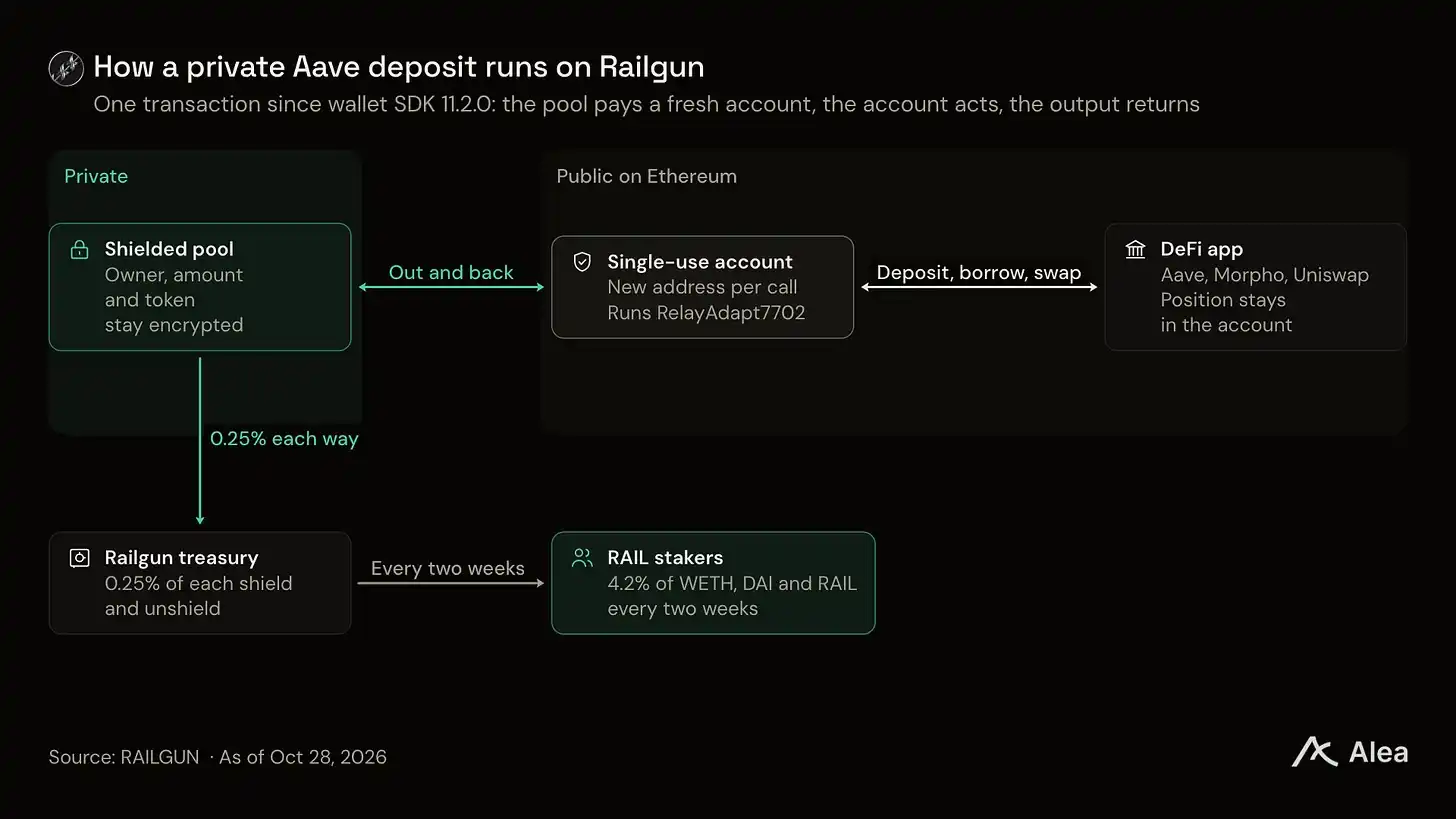
Before October, all Railgun DeFi contract interactions ran through a single shared relay contract called Adapt Relay. In that setup, the pool transferred tokens to the relay, the relay called an external dApp, and the result was shielded again and returned in the same transaction.
That model worked for immediate swaps. It broke down for actions tied to a specific deposit address, such as Aave lending collateral, because a public shared contract could not assign a position back to the underlying user who supplied the funds.
Railgun’s Wallet Toolkit 11.2.0, released on September 30, replaced that relay-based structure with Ethereum’s EIP-7702. The upgrade allows externally owned accounts to execute smart contract code directly. Under the new design, each DeFi call is initiated by a fresh one-time account derived by the wallet from the user’s private key. Wallets point those accounts to the same delegated contract, RelayAdapt7702. Because all users share the same delegated proxy, on-chain traces do not reveal which wallet application was used.
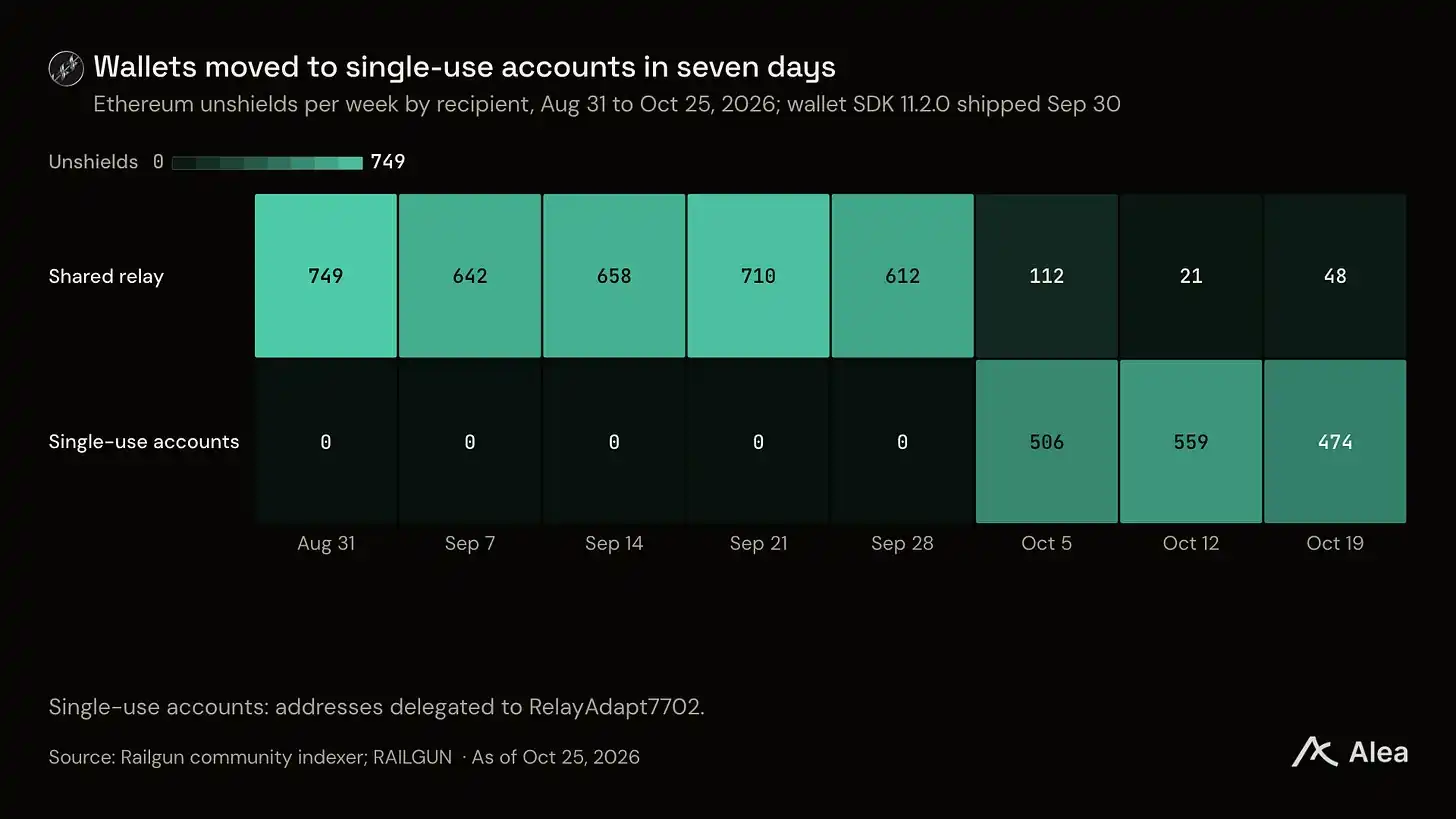
The migration happened quickly. After the September 30 release, weekly unshield calls on Ethereum going to the old shared contract fell from 612 to 21, while calls to one-time accounts jumped from zero to 559. Looking at the transition in more detail, unshield calls flowing to the legacy shared relay dropped from 612 in the week of September 28 to 112, then fell again to 21.
Total network interaction stayed near 600 calls a week through the shift, with weekly counts of 612, 618, 580 and 522. From October 5 to October 25, 89.5% of unshield calls were directed to one-time independent accounts. Those 1,539 operations were spread across 1,368 different addresses, suggesting that almost every interaction used its own fresh account.
That change opened the door for private users to hold on-chain lending positions and vault shares. Positions created from a one-time independent account remain in that account, and the account has no traceable on-chain link to the owner’s public wallet address.
The report credits third-party wallets with helping the rollout take hold. Terminal Wallet’s code became the reference point for the new interaction flow. On September 23, Railgun’s official manual version 3.0.2 added routing for private deposits into any Morpho lending vault. Mobile wallet Anon integrated Railgun in September, and stakers have already approved a deployment on Base.
September set a transaction record across four chains
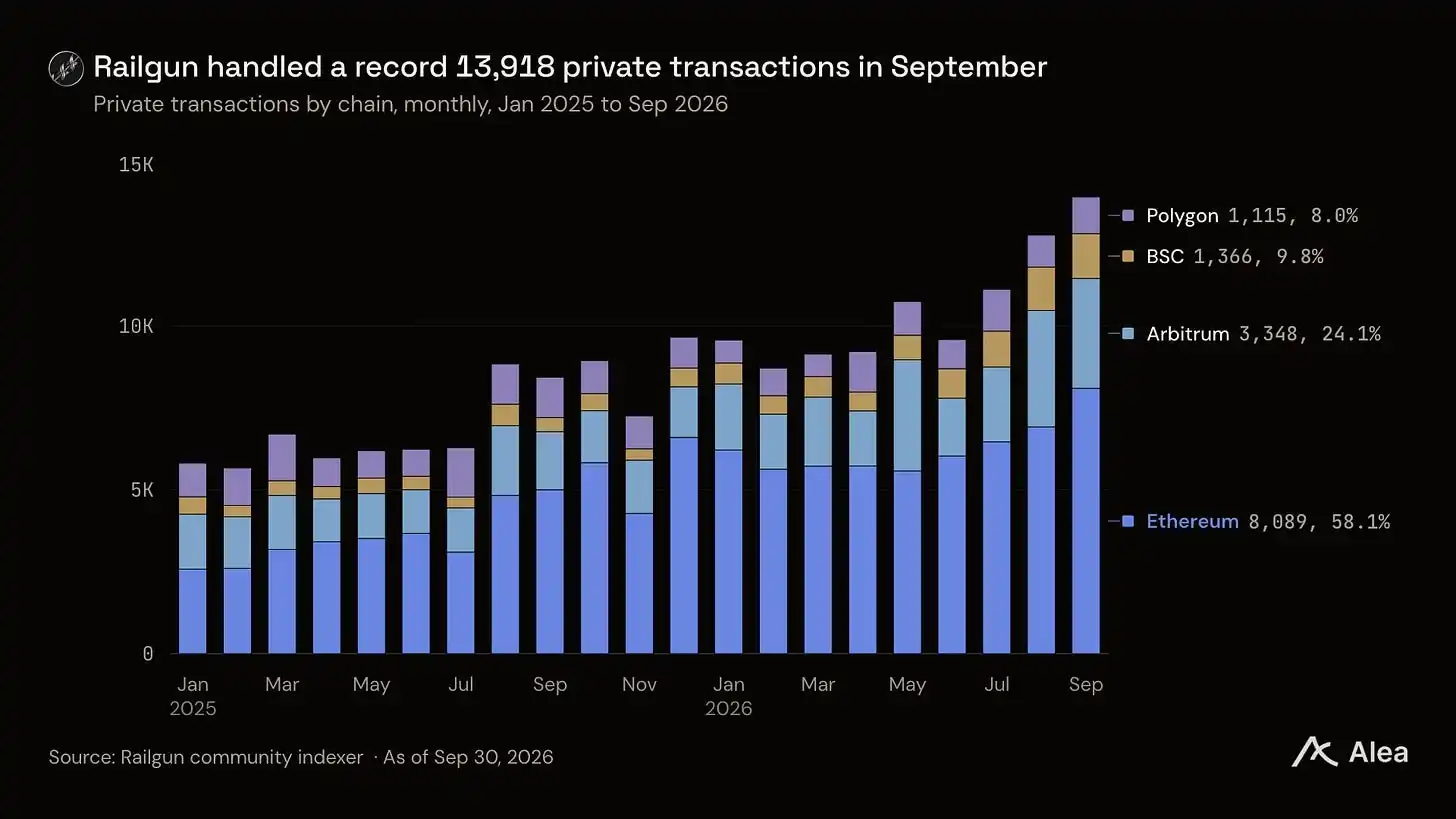
Railgun processed 13,918 privacy transactions in September, the highest monthly total in its history. Ethereum mainnet accounted for 8,089 of them, while Arbitrum handled 3,348. From January through September 2026, cumulative privacy transactions across the network reached 94,685, up 57.6% from the same period in 2025.
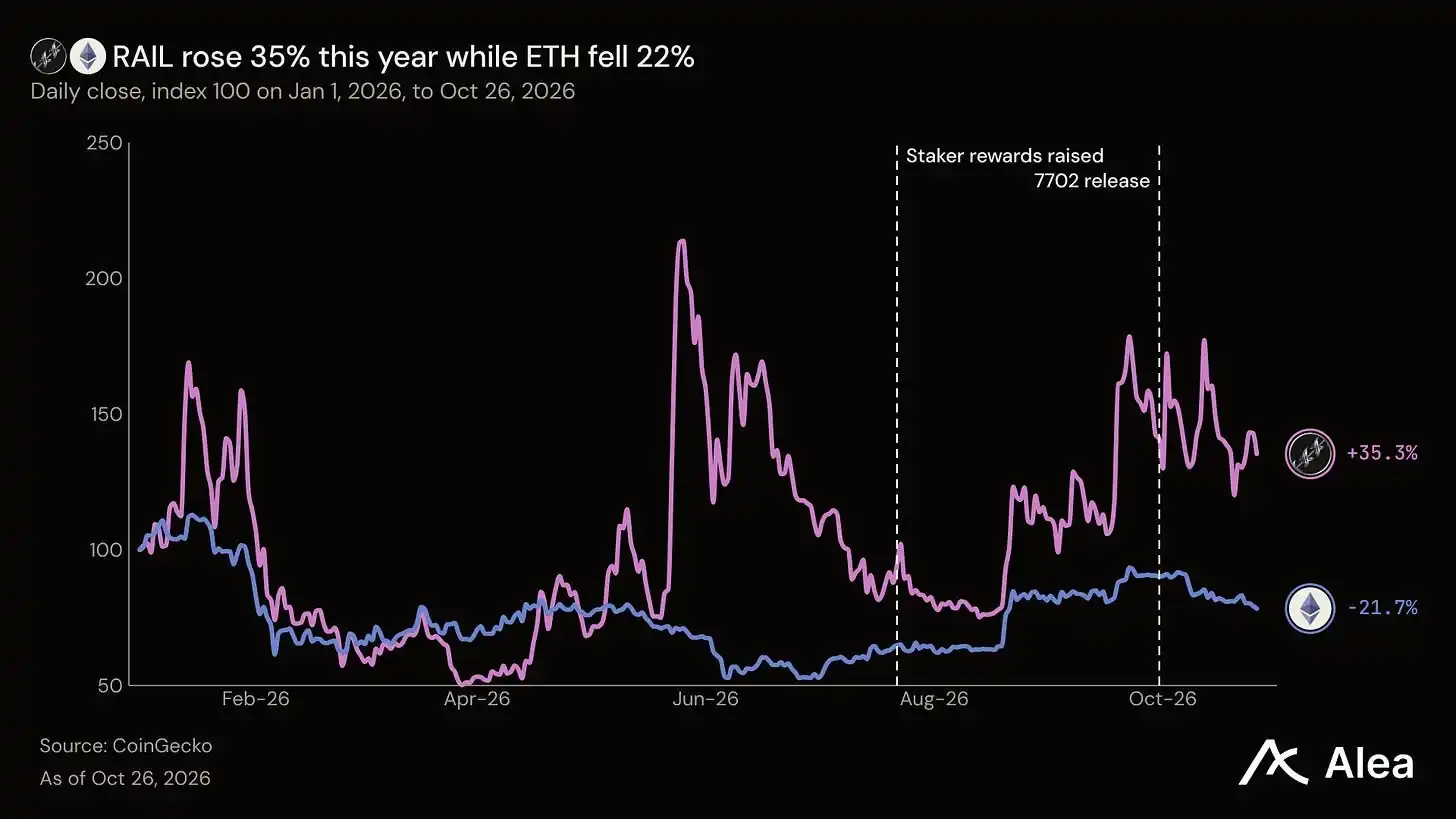
On token performance, the report says governance token RAIL rose 35.3% this year while ETH fell 21.7% over the same period. It also notes that September privacy transaction volume across Ethereum, Arbitrum, BSC and Polygon reached 13,918, up 65.2% year over year.
Staking payouts increased after the July governance vote
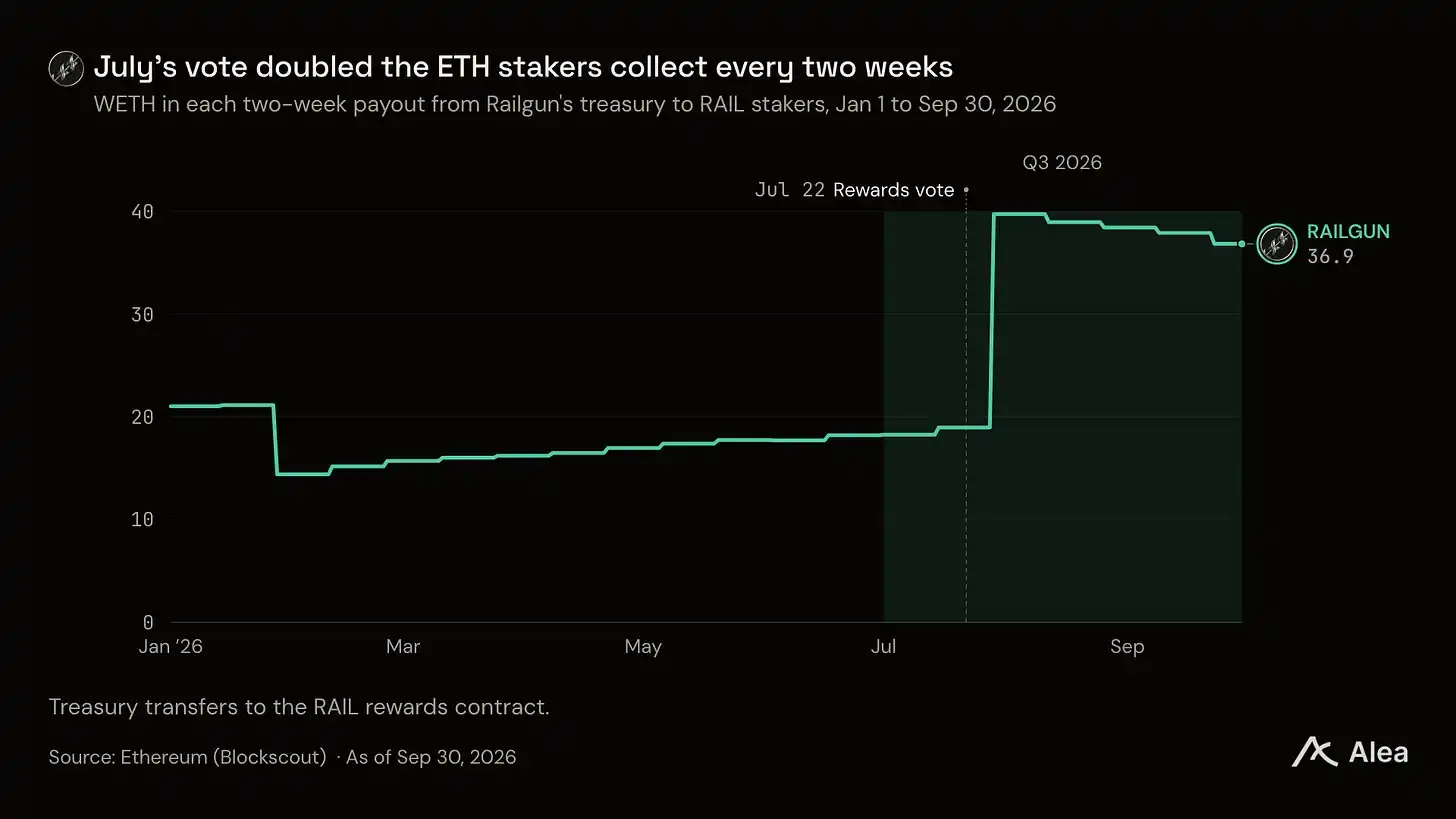
Every two weeks, Railgun’s on-chain treasury sends part of its WETH, DAI and RAIL reserves to the staking rewards distribution contract. Before July, each payout period was roughly 14 ETH to 21 ETH. After stakers voted on July 22 to raise the distribution ratio from 2.0% to 4.2%, each biweekly payout increased to about 35 ETH to 40 ETH.
By October 21, cumulative payouts for the year had reached 524.4 ETH, with 262.9 ETH generated after the proposal passed. Earlier in the report, Alea Research also notes that stakers have received 524 ETH so far this year, with half of that total coming after July.
Railgun charges a fixed 0.25% fee on every shielding and unshielding operation, and that revenue goes directly to the treasury. Relay broadcasters that submit transactions on behalf of users collect an additional gas premium, but that income belongs to the broadcasters rather than the protocol treasury.
Under the current rules, 4.2% of the treasury’s WETH, DAI and RAIL becomes claimable every two weeks based on each user’s share of staked and locked RAIL. The report says the full payout path is executed by smart contracts, with no multisig or core team signer able to intervene. Any change must go through on-chain governance. RAIL itself has no buyback or burn mechanism.
In the October 21 payout cycle, the treasury distributed 35.0 WETH, 15,730 DAI and 88,849 RAIL. USDC and USDT reserves held in the treasury were not included in that distribution round.
Scenario analysis points to a blended annualized payout yield of about 7.6%
Alea Research also modeled protocol fees and staking returns. Across the network, stakers have locked 42.53 million RAIL, equal to 70.9% of the current minted circulating supply of 60 million tokens. Using a RAIL price of about $2.41 on October 27, the report puts circulating market capitalization at $144.5 million. On the token contract’s 100 million cap, fully diluted valuation would be $241 million.
Protocol fees captured in September reached $385,507, the highest monthly figure in 2026. If monthly fees simply hold at the September level for a full year, the report estimates that annual protocol fees would equal 4.5% of the value of all staked RAIL at a $2.41 token price. If monthly fees grow 3% on average, September 2027 fees would reach $549,641 and the annualized return would rise to 6.4%. At 6% monthly growth, fees would climb to $775,716 and annualized payout yield would increase to 9.1%.
Beyond protocol fees, the treasury is also distributing RAIL that it already holds. Based on treasury balances as of October 27, the report estimates the current blended annualized payout yield for stakers at about 7.6% of locked value.
Stablecoins are now the center of Railgun’s business
The report’s broader conclusion is straightforward. Stablecoins now account for roughly three-quarters of Railgun’s network transaction value, making them the protocol’s main business line. At the same time, EIP-7702 has extended privacy from token swaps into more complex DeFi activity such as lending and vault deposits, and the wallet ecosystem completed that shift within seven days.
Alea Research adds that browser wallet Ambire is set to integrate Railgun through the Ethereum Foundation’s Kohaku development kit. With Ambire preparing to go live and the RailOxide cross-chain private trading protocol announced on October 24, another wave of wallet integrations is moving toward this privacy infrastructure.



