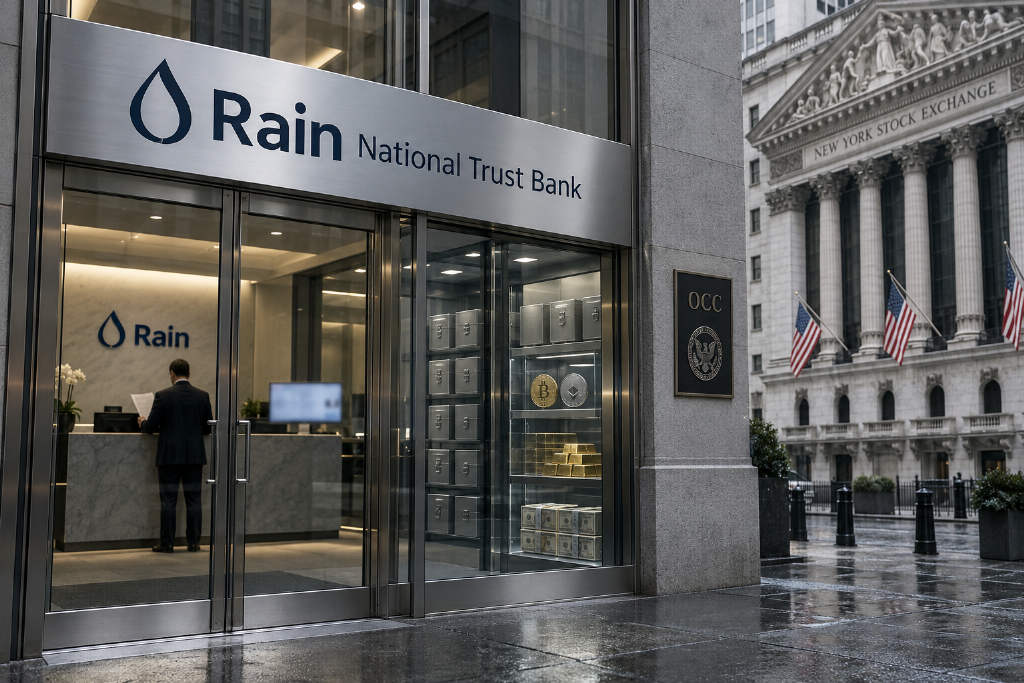
Stablecoin payments platform Rain has applied to the U.S. Office of the Comptroller of the Currency, or OCC, to establish Rain National Trust Bank (RNTB). If approved, the entity would operate as an independent national trust bank headquartered in New York and regulated by the OCC. Its planned services are aimed at institutional clients and would include custody for digital assets and U.S. dollars, management of stablecoin reserves, and issuance and redemption services for U.S. dollar stablecoins. The proposed bank would not accept deposits and would not offer consumer accounts. Rain said client custody assets would be kept separate from the bank’s own assets. The company itself would continue operating as a stablecoin payments platform, while RNTB would function as an independently capitalized subsidiary under OCC oversight. The update was carried by Techub News, citing Wu Says Blockchain.
Stablecoin payments platform Rain has filed an application with the U.S. Office of the Comptroller of the Currency (OCC) to set up Rain National Trust Bank, or RNTB.
If it gets the green light, RNTB would run as an independent national trust bank based in New York and overseen by the OCC. It would serve institutional clients with digital asset and U.S. dollar custody, stablecoin reserve management, plus issuance and redemption services for U.S. dollar stablecoins.
The proposed entity would not take deposits or provide consumer accounts. Simple as that. Client custody assets would be kept separate from the bank’s own assets.
Rain would keep operating as a stablecoin payments platform, while RNTB would sit under OCC regulation as an independently capitalized subsidiary.
This article was originally published by Bit.Fan. For more cryptocurrency news and market insights, visit www.bit.fan. Disclaimer:
The market information, project data, and third-party content displayed on this platform are for industry information sharing only and do not constitute any form of investment advice or return commitment.
Cryptocurrency trading carries high risks. Users should fully assess their risk tolerance and make independent decisions. All profits, losses, and legal responsibilities are borne by the users themselves.