

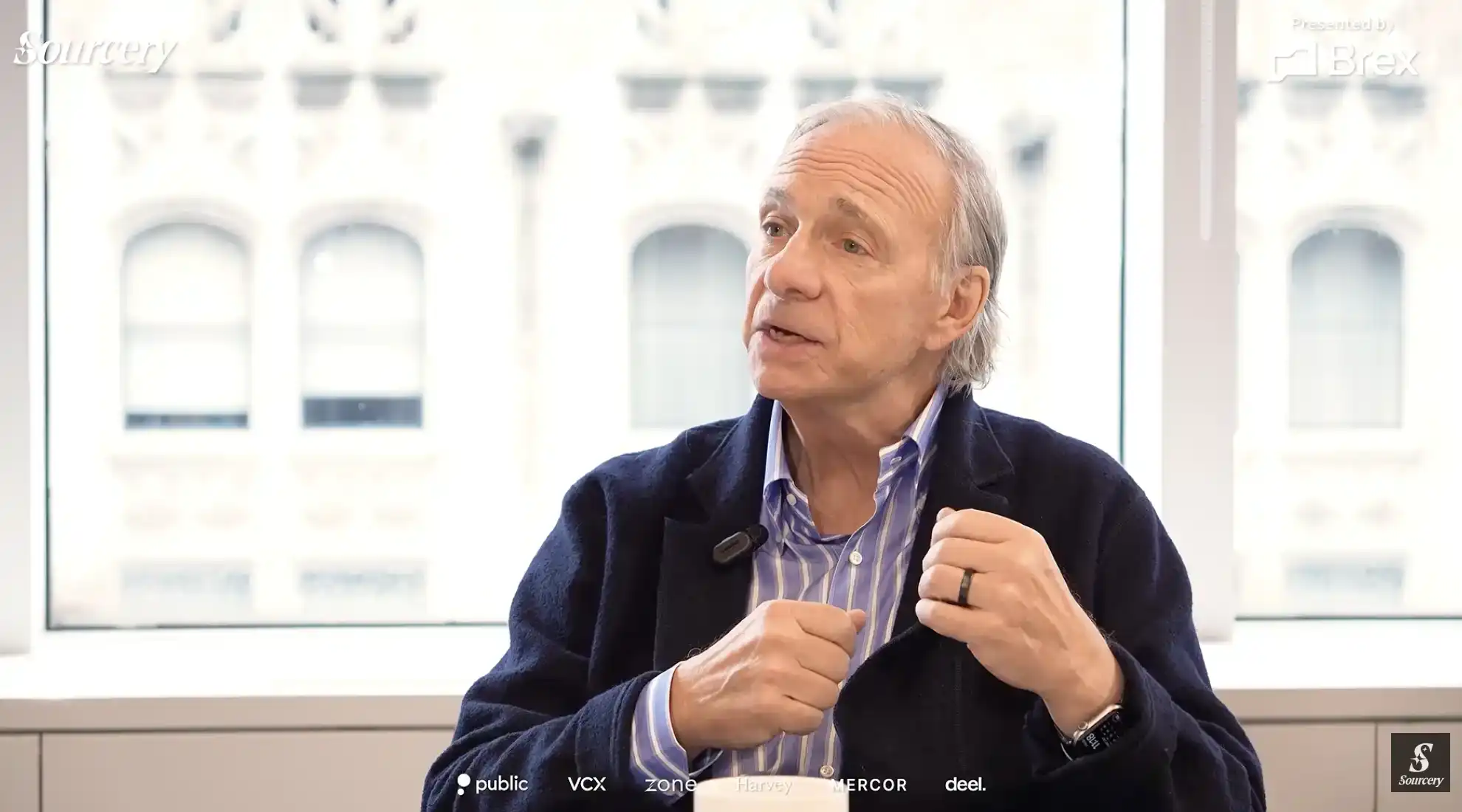
Ray Dalio, founder of Bridgewater Associates, discussed the AI investment boom and the conditions that could turn rising paper wealth into a wave of forced selling during a Nov. 23 episode of the Sourcery podcast hosted by Molly O’Shea.
The discussion moved beyond the question of whether AI companies can eventually create commercial value. The harder market question is how much investors have already paid for that expected value, and whether enough buyers will remain when shareholders try to convert paper gains into cash.
How a $50 million round can support a $1 billion valuation
Dalio used a simple financing example. A company raises $50 million at a $1 billion valuation. The company receives $50 million in cash, while the new transaction creates a reference price for the company’s broader equity. The founder’s paper wealth is then recalculated using the new valuation and the founder’s ownership stake.
That wealth remains unrealized until shares are sold. A single transaction can set a price for a small portion of the equity, but it does not guarantee that every shareholder can sell at the same level. If many holders try to cash out at once, buyers must provide much more capital to preserve the previous price.
Financing can establish a price. Large-scale monetization tests whether the market has enough demand to support it. Investors who bought with borrowed money face another constraint: repayment dates and financing costs can force a sale before the underlying business produces the cash flow expected in the long run.
Debt limits the time investors can wait
Dalio compared the current AI enthusiasm with the electrification, automobile and radio boom of the 1920s. Electric lights, refrigerators, radio, cars and airplanes were entering American life, making the effects of technological change visible. The developments attracted investors, including people who borrowed money to buy related assets.
His point was not that new technology lacks value. It is that the time required for a company to generate cash may not match the time available to its investors. AI companies may depend on demand and profits that take years to develop, while interest and principal payments have fixed deadlines.
If a loan cannot be refinanced when it matures, or if financing costs become too expensive, an investor may need to sell even while remaining positive on the company’s long-term prospects. The time needed for corporate earnings to materialize and the time an investor can continue financing a position are separate variables.
Valuation analysis often discounts expected future cash flows back to the present and compares that value with the current price. Dalio said the approach becomes difficult with new technologies because cash flows decades into the future are hard to forecast reliably. A company may ultimately earn substantial money while its stock still suffers a major decline before those earnings arrive.
Concentrated capital can turn selling into a shared pressure
During a rising market, new money flowing into the same theme can absorb sales from earlier holders. It can also lift prices with relatively limited trading. Dalio is concerned that greater dependence on AI could leave more portfolios exposed to similar financing conditions and risk preferences.
Once some investors start raising cash, falling prices can make buyers more cautious. Later sellers may then have to accept a larger discount. The decline can prompt additional holders to reduce their positions, turning the concentration that supported the advance into a source of selling pressure.
Dalio’s risk chain runs from higher asset prices to more borrowing and buying, followed by a possible shift from financing demand to selling pressure. Assessing a bubble therefore requires two questions: how much money companies may eventually earn, and whether investors can keep financing their holdings before that money arrives.
Debt repayment, higher interest rates and wealth taxes that must be paid in cash can all force asset sales. The more investors are concentrated in one theme, the easier it becomes for liquidation by one group to reinforce liquidation by another. The operating outlook of the companies does not have to deteriorate at the same time for the buying support behind a valuation to disappear.
Long-term technological progress does not protect short-term prices
Dalio’s comparison with the 1920s also highlights the difference between using a technology and holding its assets. Consumers may continue using new products even as the related securities fall because financing conditions have changed.
The more convincing a technological story becomes, the more capital it can attract to the same direction. Investors who cannot tolerate a prolonged drawdown may then become sellers when conditions tighten. Borrowing that helped push prices higher can become a source of supply.
On this view, AI can generate long-term returns while investors still lose money along the way. A technology revolution can last for years, but markets must find buyers with both the willingness and the ability to pay at each point in time. A bubble can break when holders’ need for cash exceeds the market’s ability to absorb assets at previous prices.
U.S. debt brings the question back to who pays
Dalio also placed the U.S. debt problem within a broader framework involving money, debt and politics. In 1971, while working at the New York Stock Exchange, he expected the stock market to fall after President Richard Nixon announced the suspension of the dollar’s convertibility into gold. The market rose instead.
The experience led him to study the 1930s and showed him that changes in the value of money can produce asset-market outcomes that differ from intuition. He said his research into the Great Depression later helped him anticipate the 2008 financial crisis.
In Dalio’s framework, money and debt, domestic politics, geopolitics, natural shocks and technological progress shape long-term cycles. U.S. fiscal policy brings several of those forces together. Once debt pressure reaches the budget, the choices generally involve higher taxes or spending cuts. Either option imposes costs on identifiable groups.
Dalio said the ability to reach a bipartisan compromise will affect whether such measures can be implemented. Elections do not remove the underlying question of how the costs will be shared.
Wealth inequality can make that compromise harder. Dalio said technological progress raises productivity, but whether the gains become a broader improvement in living standards depends on whether more people have access to education, can build skills and can participate in production. If the gains remain concentrated among a small group while other families struggle to cover basic education costs, disputes over taxes, public spending and distribution become more intense.
Dalio is building an AI system around his investment principles
Dalio also described how he wants to use AI in investment decisions. When he founded Bridgewater, he recorded his investment standards, turned them into programs and tested how the rules performed under different historical conditions.
He said identifying bubbles can follow the same process: define the signals that would indicate rising risk, then examine what happened when similar signals appeared in different environments. He is now building an AI system that incorporates his investment principles and could pass accumulated decision-making experience to other people.
Under his approach, models can help researchers compare a wider range of historical situations. Humans still need to ask the questions, explain causal relationships and decide which standards should be adopted.
Bridgewater’s internal Dot system reflects a similar idea. It records judgments and feedback from team members during meetings, then uses the accumulated material to identify what each person does well and where each person is prone to error.
Across the discussion of market bubbles and AI-assisted investing, Dalio kept returning to how outcomes are produced. For the current AI trade, that leaves two practical questions: who must sell first when financing costs rise, and how many buyers will still accept the old price when those orders reach the market?



