
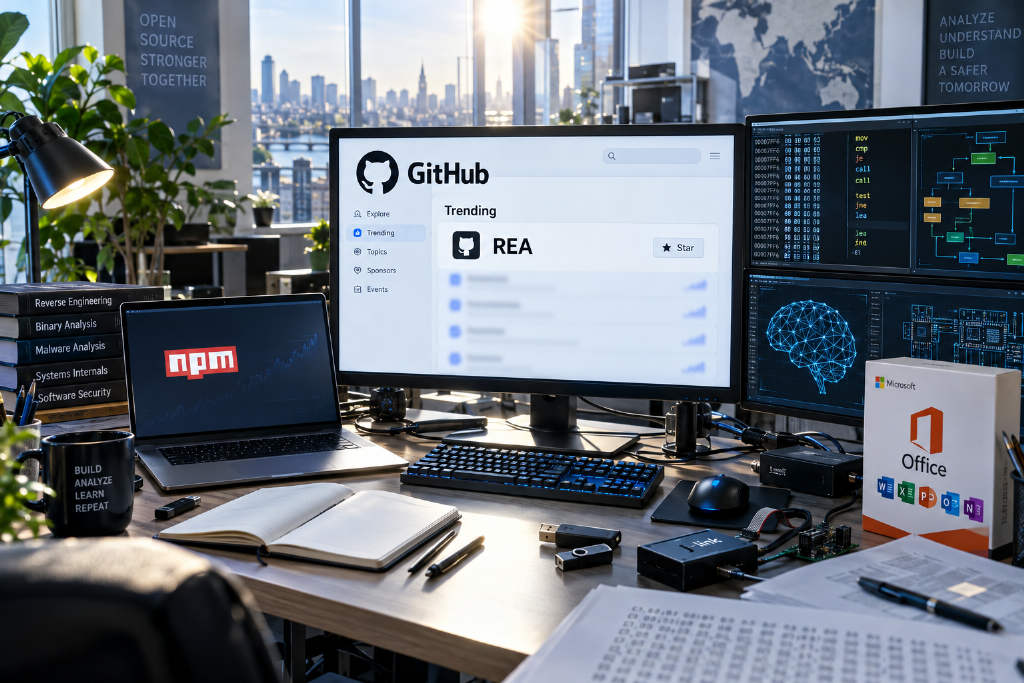
REA, short for Reverse Engineer Anything, has exploded on GitHub over the past two days. The source article says the project pulled in nearly 70,000 stars in that span and was approaching 80,000 by day three, the same day it reached No. 1 on GitHub Trending.

The article compares REA with two other fast-rising projects. One is OpenClaw, which it says added 60,000 stars by the third day of its breakout earlier this year. The other is Jev. Because Jev is closed source, the comparison there is based on npm downloads rather than GitHub stars: Jev logged 35,000 downloads in its first three days, while REA had reached about 44,000, according to the source.

What REA is built to do
The article describes REA as a bridge between large language models and reverse-engineering tools. It says the project is built around MCP, or Model Context Protocol, and acts as a middle layer that lets AI agents call tools such as Ghidra and Hopper, decompile binaries, read assembly, trace interfaces, and then produce a readable reconstruction.
In the source’s framing, a user does not need to understand formats such as ELF or EVM bytecode. Instead, the user can issue a direct instruction to inspect how a specific feature inside a commercial app works, and the AI agent, through REA, handles the decompilation and analysis workflow before returning an explanation and reconstructed code.

The article uses Notion’s clipboard bridge as an example of the kind of feature that could be examined this way. It also says that app runtime behavior, native binaries, Android APKs, and even hardware firmware could become targets for analysis and reconstruction under this model.

The article’s argument on closed-source software
The source argues that commercial software companies have long relied on closed source code as a defensive moat. Ordinary users could not easily interpret binaries, while reverse engineering remained the domain of specialists familiar with tools such as IDA and Ghidra. In that telling, REA changes the equation by making those workflows accessible through AI.
The article goes further and says the project author is already working on reversing large commercial software such as Office. If tools of this kind eventually manage to fully reverse engineer closed systems on the scale of macOS or iOS, the source argues that the long-standing moat around closed-source software would face a direct challenge and that software trade secrets could become far easier for large models to expose.

Three predictions laid out in the piece
The second half of the article lays out three predictions.

- First, it says code-level “micro-innovation” could lose much of its value. The argument is that copying once depended on inferring logic from a product’s interface and behavior, while AI paired with reverse-engineering tools could now inspect and reconstruct lower-level implementations more directly. In that scenario, SaaS companies that rely on a small number of proprietary algorithms or implementation tricks could find those advantages easier to replicate.
- Second, it says software intellectual property disputes could become harder to resolve. The article argues that if it becomes much easier to show similarity in non-core code, while AI-generated reproductions preserve logic but rewrite syntax, existing copyright frameworks may struggle to keep up.
- Third, it says software engineering could shift toward more aggressive obfuscation. If companies still want to protect their assets, the article argues, they may have to make code harder to read and harder to analyze.
The source uses a Python implementation of quicksort to illustrate how readable code can become highly opaque after obfuscation. In its view, developers may end up optimizing not only for elegance, readability, and efficiency, but also for resistance to machine analysis.
How the article closes
The article ends by arguing that after REA, software businesses may depend more on compute, data, and network effects than on code itself. In that framing, code is no longer treated as an untouchable core asset, but as something that can be reverse engineered, dissected, and reconstructed.

The reference cited in the piece is the project’s GitHub page at https://github.com/morluto/rea. The article was republished from the WeChat public account Xinzhiyuan, with authorship credited to ASI Qishilu and editing credited to Ma Ke.



