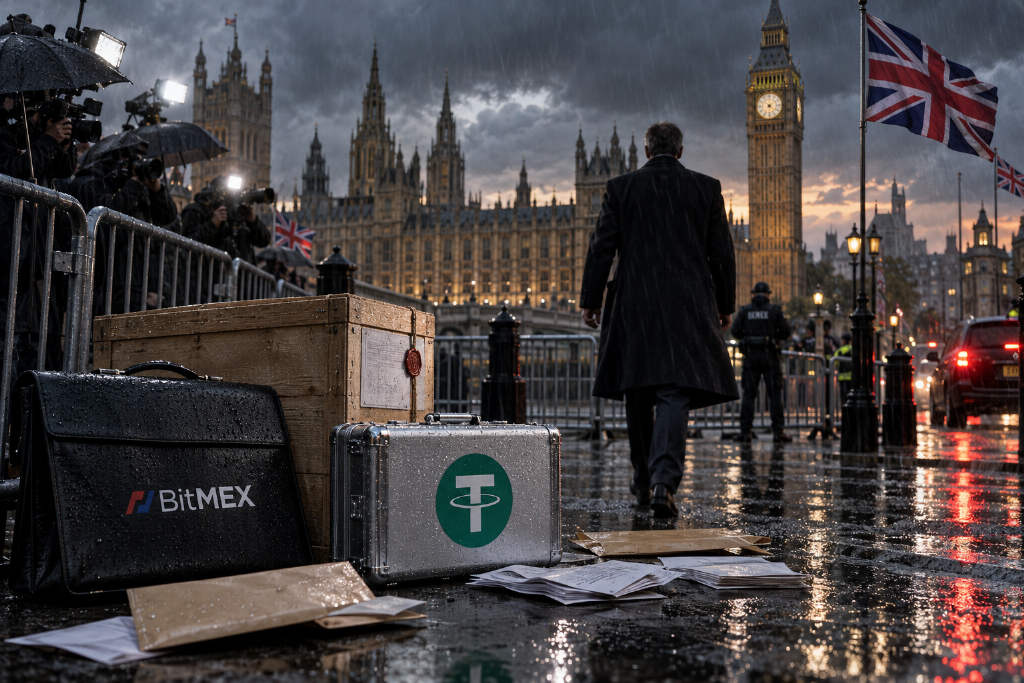
Two low-profile crypto billionaires gave about $100 million to Reform UK over two days, handing Nigel Farage’s party a financial boost that has jolted Britain’s debate over political money, overseas wealth, and crypto influence.

The account, written by David Segal for The New York Times and translated by Foresight News, centers on Farage, the 62-year-old politician who rose to national prominence through Brexit. The report describes him as a flamboyant and polarizing populist who has also shown a strong appetite for money. In 2023, he earned $1.86 million for appearing on the reality show “I’m a Celebrity … Get Me Out of Here!” and finished third. He has also served as a highly paid brand ambassador for London gold dealer Direct Bullion.
An earlier $6.3 million gift had already put Farage under scrutiny
The latest donations were not the beginning of Farage’s troubles. In April 2024, while campaigning for the party in a personal capacity, he received $6.3 million. Farage later said the money came from pro-Brexit British crypto investor Christopher Harborne, who has long lived in Thailand and is known there as Chakrit Sakunkrit. Farage said the transfer was an “unconditional gift.”
In an April interview with The Daily Telegraph, Harborne said the donation sought “nothing in return.” Questions followed anyway. The Sunday Times estimated Harborne’s net worth at about $24 billion, with much of it tied to an early investment in Tether, the issuer of USDT.
In June that year, Harborne met the governor of the Bank of England and urged the central bank to shelve the digital pound project known as Britcoin. Because a live Britcoin would compete directly with Tether, the meeting fed speculation over whether the donation carried a commercial interest.
The Parliamentary Commissioner for Standards is now investigating Farage for failing to declare Harborne’s £5 million gift. Farage has denied wrongdoing. The report says the issue soon turned into only one part of a larger string of controversies.
Channel 4 footage led to a police inquiry
In early September, Channel 4 released secretly recorded video showing Farage and several senior Reform UK figures apparently discussing ways to get around Britain’s ban on overseas campaign donations.
In one segment, Farage is seen drinking wine and eating oysters while praising a poll that was said to have been financed by an American billionaire. Days later, the Metropolitan Police in London opened an investigation to examine whether election law had been broken.
A Reform insider told the BBC the party looked “a bit like a pirate ship.” The money story did not end there. It became much larger.
Ben Delo and Christopher Harborne each gave $48.7 million
On Sept. 11, news emerged that Ben Delo, the self-described “math geek” and BitMEX co-founder, had donated the equivalent of $48.7 million to Reform UK. The report says it was the largest single political donation in British history. In an article for The Daily Telegraph, Delo said he wanted to help Reform become “a credible party of government.”
Harborne moved the next day. He gave another $48.7 million to the party and wrote in The Daily Telegraph: “My competitive instinct compelled me to match this donation, and so I did.”
That back-to-back funding surge nearly rewrote the financial map of British politics. The report notes that almost all of the money came from fortunes accumulated abroad and from just two people.
Britain’s system is smaller, and critics say it is becoming more American
The shock in Britain reflects the scale of the country’s campaign finance system. Unlike the U.S., Britain does not have super PACs. Political parties receive limited public funding for parliamentary work and policy research, but campaign spending is not covered.
Sam Power, a University of Bristol lecturer who studies political finance and corruption, said all candidate spending by all parties across constituencies in the last British general election totaled only $125 million. That is roughly what a single 2024 Senate race in Montana cost in the United States.
“We’re seeing the U.K.’s model of political fundraising become more Americanized, and the American model, in our eyes, is a cautionary tale,” Power said. “This is not just a Reform issue, but a system-wide issue. It is forcing people to ask whether this is really the direction we want British democracy to go.”
Crypto money is shaping politics beyond Britain
The report places the U.K. donations in a wider trend. In the United States, crypto companies and the billionaires behind them have become a major political force, backing candidates in both parties who support friendlier regulation for the industry.
Donald Trump once attacked cryptocurrencies as highly volatile and baseless. The article says his stance later reversed. In the first year of his second term, his family’s crypto businesses brought in more than $1.4 billion, much of it from his TRUMP meme coin.
A representative for Farage declined to be interviewed. Delo and Harborne also declined. Farage has long cast himself as a kind of Trump on the Thames, battling traditional finance, the political establishment, and mainstream media.
Farage’s alliance with crypto carries its own contradictions
At first glance, the report argues, Farage does not look like an obvious champion of crypto. He is intensely focused on borders, while digital assets do not respect them. He has also shown favor toward Tether, based in El Salvador, instead of a homegrown digital pound with “Brit” in its name.
Yet crypto fits the persona he has cultivated: the outsider, the anti-establishment fighter, the man willing to challenge entrenched power.

Michael Crick, author of “One Party After Another: The Disruptive Life of Nigel Farage,” said Farage did not go to university and worked in metals trading in the City of London without much success before spending more than 20 years as a member of the European Parliament. “He absolutely craves all the things that come with wealth,” Crick said, “and yet there’s this sense of frustration in him — he has devoted his life to politics.”
One controversy after another
The report says a pattern has taken shape in recent months: whenever politics and money collide around Farage, a public relations crisis follows.
After the standards commissioner opened an investigation into the undeclared £5 million gift, Farage quickly resigned his seat for Clacton-on-Sea and announced he would run again for the same constituency. In a video statement, he said: “The people of Clacton can choose to back me, or they can choose the establishment.”
Mainstream parties reacted with little urgency and did not field candidates. Farage’s only real opponent was Count Binface, a comedian who wears a bin on his head and claims to be from outer space. Farage won easily, but the summer episode hurt Reform’s poll numbers.
Then came another Channel 4 report based on undercover footage organized by the investigative firm Verbatim. An actor posing as an American donor discussed polling with Farage. Channel 4 said the survey had been commissioned by Reform but paid for by a U.S. company. If the poll counted as overseas support for a political party, it could violate British donation law.
Farage described the poll this way: “It’s fantastic, it’s very good value for money.” He later said he had not been paying attention to that part of the conversation. Two senior aides resigned after the broadcast. Reform denied wrongdoing and said an internal investigation found that an aide, not the party, had commissioned the poll.
The article adds that Reform’s support slipped after the by-election drama and the Channel 4 report. After former Greater Manchester mayor Andy Burnham became prime minister, Labour’s support rose. Against that backdrop, the arrival of nearly $100 million shifted the storyline from “Reform is damaged” to “Reform is flush with cash.”
A party for ordinary people, financed by billionaires abroad
The money also sharpened a political contradiction. Farage says Reform speaks for ordinary people. The two men financing the party are billionaires whose careers were spent largely overseas.
Delo said he specifically returned to Britain so he could donate to Reform without restriction. Ben Habib, the party’s former deputy leader and now a Farage critic, said courting overseas billionaires was no different from courting outside migrants.
“Other than on crypto-related matters, the policies Farage is putting forward will have very little impact on these two men,” Habib said. “But they are influencing the direction of British politics and how the country is governed, and I think that is very unhealthy.”
Christopher Harborne’s fortune and his Tether stake
Little is publicly known about Harborne. The article says much of what is known came from a 2024 defamation lawsuit he filed over a Wall Street Journal report that suggested he had been involved in efforts by crypto companies to mislead banks.
Harborne once worked as a McKinsey consultant, moved to Thailand in the 1990s, and later built an aviation fuel business. The decisive turn in his wealth came after the 2016 Bitfinex hack. He had been trading on the exchange at the time. Users affected by the breach received dollar-denominated BFX tokens. Most holders sold. Harborne saw an opening and bought heavily.
He later converted the tokens into equity and, through a series of transactions, acquired about 12% of Tether. The report says Tether is now valued at $183 billion, putting Harborne’s stake at roughly that percentage. In court filings tied to the defamation case, Harborne said he had never held a management role at Tether.
Carol Alexander, a finance professor at the University of Sussex, said: “He was just at the center of a giant enterprise at exactly the right moment. It was highly risky, and it could easily have gone the other way.”
Harborne barely uses social media and has not given a long-form interview or appeared on podcasts. One of the few publicly available recordings of his voice comes from a talk at his Thai retreat, Kamalaya. “At Kamalaya, we try to help each visitor make one small change every time they come,” he said calmly while seated at a table. “Just one small thing is enough.”
The Guardian cited video in which Harborne said that in his 40s he worked 18 hours a day and sustained himself on chocolate milk and biscuits. Around the same period, a two-seater plane he was flying crashed into the garden of a couple in Hampshire, England. The homeowners were not injured.
His politics are not easy to classify. In his opinion writing, he has had little to say about borders or immigration. He said his main concerns were artificial intelligence, nuclear war, and climate change. As for the £5 million gift, he said it dated back to 2019, when a protester threw a banana milkshake at Farage during a campaign event in Newcastle. That attack, he said, made him decide “to guarantee Nigel’s safety, not just now, but for the rest of my life.”
After the gift became public, Farage was asked on a radio program how he would use the money. He snapped back: “What if I want to buy a Ferrari with it?”
Ben Delo, BitMEX, and a 2025 pardon from Trump
Delo’s story is also unusual. The report says he grew up in Oxford and was asked to leave three schools in his early years, including once for vandalizing a teachers’ bathroom. At 11, he was diagnosed with Asperger’s syndrome. He has said that made it hard for him to read social cues, though others saw him simply as a prankster.

In 2005, he graduated from Oxford and attended a formal dinner wearing a wetsuit under his white tie because the rules required formal dress but did not go into further detail. British media have often described him as the country’s youngest self-made billionaire, though the report says his exact net worth is difficult to pin down.
After working at JPMorgan in Hong Kong, Delo co-founded crypto derivatives exchange BitMEX in 2014. Six years later, U.S. prosecutors accused BitMEX of willfully failing to build adequate anti-money-laundering and customer identification systems. In February 2022, Delo pleaded guilty to one count of violating the Bank Secrecy Act and agreed to pay a $10 million fine. Four months later, he received a sentence of 30 months of probation.
In March 2025, President Trump granted him a full pardon. “Today, a legal wrong has been righted,” Delo said in a statement. “I am delighted to have my name cleared and to put the burden of this wrongful conviction behind me so I can continue with my life and charitable work.”
After the pardon, Delo stepped up philanthropy. According to the report, he has donated more than $100 million to causes including autism research and his Oxford alma mater. One of his most closely watched projects is The Sanctuary, a neo-Gothic building near Westminster Abbey that sits somewhere between a co-working venue and a private members’ club. There is no sign on the door, and members are told not to photograph the interior.
Harry Shukman of the British investigative group Hope Not Hate described the inside this way: “Chesterfield leather sofas, ancient tapestries depicting medieval scenes, champagne, Fabergé eggs, and a stuffed penguin. There is also a map of St. Helena, where Napoleon was exiled.”
The Sanctuary regularly hosts events featuring right-wing scholars, podcasters, and politicians who oppose “woke culture.” Guests have included Rupert Lowe, founder of Restore Britain, a party positioned to the right of Reform UK.
In a telephone interview, Lowe said of Delo: “I think he is worried about the direction of the U.K. and is trying to do what he thinks is best to change it. I think he is an excellent man.”
In his own opinion article, Delo said he had “left the crypto industry” and was not donating to make more money. What mattered to him, he wrote, was defeating political correctness, which he once described as “a totalitarian ideology that is suffocating our society.” Reform, in his view, is the only party capable of fighting it.
He compared Reform to a startup facing centuries-old incumbents. “One reason the old parties survive so long is that they raise the cost of challenging them,” he wrote. “I want to see a fair fight, with a level playing field.”
A proposed Labour cap could force money back
The immediate question is whether Reform UK can keep the donations.
The party plans to hire as many as 400 campaign managers in target constituencies nationwide. Farage has also said he wants to build “the strongest research and policy team in the history of British politics.” Those plans depend on the money staying in place.
In March, Labour introduced legislation that would cap annual political donations at £100,000 for British citizens living overseas or newly returned to the U.K. The measure would apply retroactively from March 25. If enacted, it could trigger large clawbacks.
If Delo and Harborne were resident overseas before that cutoff date, Reform may have to return almost all of the £72 million in donations. Their place of residence has now become a major political question in Britain.
Richard Tice, Reform’s deputy leader, told the BBC: “We are satisfied that, under both the current law and the proposed law, they are fully compliant.”
The bill is expected to move through the House of Lords in the coming months, but the article says the final destination of the crypto money will most likely be decided in court.
Farage may yet face another election test
Whatever the legal result, the report says Farage is likely to reinforce his place as Britain’s leading populist figure and as the U.K. standard-bearer for the nationalist movements that have swept across Europe.
He may still need to fight again for his Clacton-on-Sea seat. According to the report, the parliamentary commissioner’s findings are expected soon, and an adverse conclusion could trigger a recall petition. That would force Farage to contest the same seat for a third time.
Even if he wins again, a harder task would remain: persuading voters across Britain that he and Reform are ready to govern.
Alastair Campbell, the podcaster and former press secretary to Prime Minister Tony Blair, said: “There’s no doubt these scandals have damaged him.” He added that Farage hopes to become like Trump, in the sense that people grow accustomed to the controversies and conclude: “Yes, that’s Nigel, but frankly all politicians are dirty.”