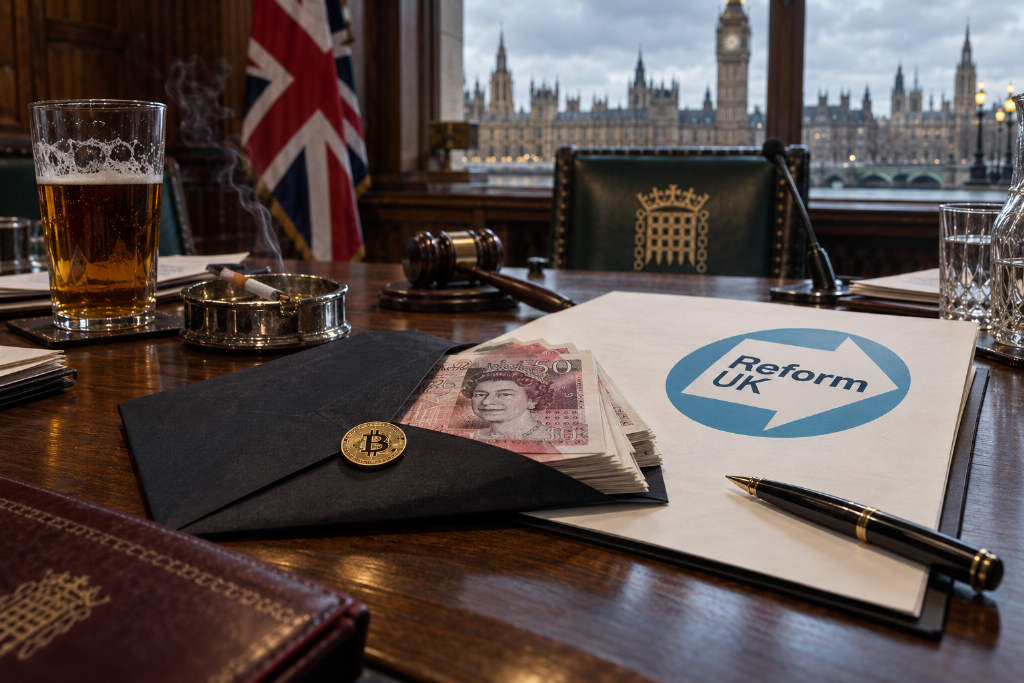
Reform UK leader Nigel Farage is facing intensifying scrutiny after he and his party received huge financial backing from two crypto billionaires, a wave of money that has set off a broader argument over foreign-linked wealth, political access and the growing role of digital-asset fortunes in British politics.
The article describes Farage as a pub-going, cigarette-smoking populist with a man-of-the-people image, yet one surrounded by very wealthy allies. Two of them, both billionaires with crypto ties, have repeatedly sent major sums to him and to Reform UK. The scale of that support has turned the affair into one of the most talked-about political scandals in Britain this year.
An undeclared £5 million gift and the Harborne questions
Farage, now 62, rose to national prominence through Brexit. He is portrayed as outspoken, divisive and openly attracted to wealth. In 2023, he appeared on the reality show I'm a Celebrity... Get Me Out of Here!, was paid $1.86 million and finished in third place. He also serves as a highly paid brand ambassador for London gold dealer Direct Bullion.
Those earnings, the article says, were dwarfed by a large payment in April 2024. At the time, Farage was campaigning for the party as a private individual and received $6.3 million. He later said the money came from pro-Brexit British crypto investor Christopher Harborne, who has long lived in Thailand and is known there as Chakrit Sakunkrit. Farage described it as an 「unconditional gift」. In an April interview with The Daily Telegraph, Harborne said he wanted 「nothing in return」.
The donation quickly raised questions. The Sunday Times estimated Harborne’s net worth at about $24 billion, much of it tied to a well-timed investment in Tether, the issuer of the USDT stablecoin. The article also says that in June of the same year, Harborne met the governor of the Bank of England and urged the central bank to shelve the digital pound project known as Britcoin. Because a launched Britcoin would compete directly with Tether, suspicions followed over whether the large donation carried an element of self-interest.
Farage is now under investigation by the office of the parliamentary standards commissioner for failing to declare Harborne’s £5 million gift. He denies wrongdoing.
Secret recordings and a police review
The controversy did not stop with the undeclared gift. In early September, Channel 4 released secretly recorded footage that appeared to show Farage and several senior Reform UK figures discussing ways to get around Britain’s ban on overseas campaign donations.
In one clip, Farage is shown eating oysters and drinking wine while praising a poll that was reportedly financed by an American billionaire. Days later, the Metropolitan Police opened an investigation to examine whether election law had been broken.
One Reform insider told the BBC that the party looked 「a bit like a pirate ship」. If that was the problem, one loyal supporter came up with a blunt answer: send more money.
Ben Delo and Harborne rewrite the funding map in 48 hours
On Sept. 11, it emerged that another crypto billionaire, BitMEX co-founder Ben Delo, had donated the equivalent of $48.7 million to Reform UK, described as the largest single political donation in British history. In an article for The Daily Telegraph, Delo said he wanted to help Reform UK grow into a credible party capable of governing.
The next day, Harborne matched him with another $48.7 million gift to the party. Harborne, also writing in The Daily Telegraph, said: 「My competitive instincts pushed me to follow that donation, and I did.」
Nearly $100 million landed with Reform UK in just two days. The article says that alone transformed the funding balance in British politics. It adds that almost all of the money came from opaque wealth accumulated overseas, provided by so few people that they could fit into a phone booth.
Is British political finance becoming more American?
Britain does not have the kind of super PAC system seen in the US. Parties receive only limited public money, mainly for parliamentary work and policy research, not for campaign spending. Compared with the US, the total volume of money in British politics has long been much smaller.
Sam Power, a lecturer at the University of Bristol who studies political finance and corruption, said that in the last UK general election, all campaign spending by all candidates across all constituencies totaled just $125 million. That figure, the article notes, is roughly in line with the cost of a single 2024 Senate race in Montana.
「We are seeing Britain’s model of political fundraising becoming more American, and from our perspective the American system is a cautionary example,」 Power said. 「This is not only a Reform UK problem. It is a system-wide issue. It is making people ask whether this is really the direction we want British democracy to move in.」
Crypto money is shaping more than British politics
The piece argues that Britain is not alone. In the US, crypto companies and the billionaires behind them have already become a potent force, backing candidates in both parties who support friendlier regulation for the industry.
It also points to Donald Trump’s shift on crypto. Trump once criticized cryptocurrencies as highly volatile and lacking foundation. Later, his stance changed sharply. In the first year of his second term, the article says, his family’s crypto businesses brought in more than $1.4 billion, with a large share tied to his TRUMP meme coin.
Farage’s representatives declined to be interviewed for the article, and so did Delo and Harborne. Farage has long cast himself as a British version of Trump, a fighter taking on traditional finance, an old political class and the mainstream press.
At first glance, that posture does not obviously fit crypto. Farage is intensely focused on borders, while digital assets ignore them. There is another contradiction too: he favors Tether, based in El Salvador, over a domestic digital pound carrying 「Brit」 in its very name. But crypto’s anti-establishment streak and outsider appeal fit the role he has built for himself.
Farage, ambition and money
The article traces that political persona back to a middle-class childhood in rural Kent. His father was an alcoholic stockbroker who left the family when Farage was 5.
Michael Crick, author of One Party After Another: The Disruptive Life of Nigel Farage, said Farage did not attend university and worked in the City of London as a metals trader without much success. He then spent more than 20 years as a member of the European Parliament, a well-paid role but still less lucrative than finance.
「He does crave all the things that come with wealth,」 Crick said. 「At the same time there is frustration there. He has devoted his life to politics.」
By-elections, stings and party turmoil
The article says a pattern has emerged in recent months: whenever Farage’s politics and money become entangled, a public relations crisis follows. After the parliamentary commissioner opened the inquiry into the undeclared £5 million gift, Farage quickly resigned his seat for Clacton-on-Sea and then announced he would stand for the same constituency again.
In a video statement, he said: 「The people of Clacton can choose to support me, or they can choose to support the establishment.」
The establishment barely reacted. Major parties did not field candidates, leaving Farage’s only real challenger as Count Binface, a comedian who wears a bin on his head and claims to be from space.
Farage won comfortably, but the summer farce hurt Reform UK in the polls. Then Channel 4 aired undercover footage organized by investigative firm Verbatim. In the video, an actor posing as an American donor discussed political polling with Farage. Channel 4 said the survey had been commissioned by Reform UK but financed by a US company. If that polling counted as overseas support for the party, it could violate British political donation law.
Farage’s reaction to the poll was: 「It’s great value.」 He later said he had not really been listening during that part of the conversation. Two senior aides resigned after the program aired. Reform UK denied any breach and said an internal inquiry found that the polling had been commissioned by aides personally, not by the party.
The article adds that after the by-election saga and the Channel 4 report, support for Reform UK began to slide. Once former Greater Manchester mayor Andy Burnham became prime minister, Labour’s support rose. Against that backdrop, the arrival of almost $100 million shifted the story from 「Reform UK is damaged」 to 「Reform UK is rich」.
A party of “ordinary people” backed by overseas billionaires
The money carries political risk of its own. Farage says Reform UK speaks for ordinary people, but the two men financing the party have little in common with ordinary voters.
Both spent much of their careers overseas. Delo said he deliberately returned to Britain so he could donate to Reform UK without restriction. Ben Habib, the party’s former deputy leader and now a Farage critic, said courting overseas billionaires was no different from courting outside arrivals in any other form.
「Farage’s policies, apart from the crypto-related elements, will hardly affect either of these men,」 Habib said. 「Yet they are influencing the direction of British politics and the way the country is governed. I think that is very unhealthy.」
Christopher Harborne and a fortune built out of a crisis
Harborne and Delo both have enough wealth to shake British politics, but neither is highly visible in public life.
Much of what is publicly known about Harborne comes from a 2024 defamation lawsuit he filed. He sued over a Wall Street Journal report that he said falsely implied he was involved in efforts by crypto firms to mislead banks. Harborne previously worked as a McKinsey consultant, moved to Thailand in the 1990s and built an aviation fuel business.
The most important step in his fortune came out of disaster. In 2016, major crypto exchange Bitfinex was hacked while Harborne was trading there. The platform issued dollar-denominated BFX tokens to compensate users. Most holders sold them. Harborne saw opportunity and bought heavily. He later converted those tokens into equity and, through a series of later transactions, secured about a 12% stake in Tether.
Tether is now valued at $183 billion, and Harborne holds roughly 12% of it, according to the article. In court papers tied to the defamation case, he said he has never held any management role at Tether.
Carol Alexander, a finance professor at the University of Sussex, said: 「He was simply at the center of a huge enterprise at exactly the right time.」 She added: 「It was hugely risky, and it could have ended very differently.」
Harborne barely uses social media and has never sat for a long-form interview or podcast. One of the few public audio clips of him comes from a talk at Kamalaya, his retreat in Thailand. 「At Kamalaya, we try to help every visitor make a small change each time they come,」 he said. 「Just changing one small thing is enough.」
The article says that calm appeared later in life. The Guardian cited video of Harborne saying that in his 40s he routinely worked 18 hours a day, living on chocolate milk and biscuits. Around the same period, a two-seater plane he was flying crashed into the garden of a couple in Hampshire. The homeowners were not hurt.
His politics are hard to place neatly. In opinion pieces, he says little about borders or immigration and instead points to artificial intelligence, nuclear war and climate change as the issues he cares about most. As for the £5 million gift, he said it stemmed from a 2019 campaign stop in Newcastle when a protester threw a banana milkshake at Farage.
That attack made him decide, he said, 「to protect Nigel not just now, but for the rest of my life.」
After the donation became public, Farage was asked on a radio show what he planned to do with the money. He responded with irritation: 「What if I want to buy a Ferrari with it?」
Ben Delo: BitMEX, a guilty plea, a pardon and political spending
Delo’s personal story is no less unusual. The article says he grew up in Oxford and was expelled or pushed out by three schools while still in primary education. One incident involved damage to a teachers’ bathroom. At 11, he was diagnosed with Asperger’s syndrome. He has said that made it hard for him to read social cues, though others thought he simply enjoyed causing mischief. When he graduated from Oxford in 2005, he wore a wetsuit under formal evening dress because the rules required formal clothing but did not specify more than that.
British media often describe him as the country’s youngest self-made billionaire. His precise wealth is hard to pin down, and his path to it included a very public setback.
After working at JPMorgan in Hong Kong, Delo co-founded crypto derivatives exchange BitMEX in 2014. Six years later, US prosecutors accused BitMEX of deliberately failing to build proper anti-money-laundering and customer identification systems. In February 2022, Delo pleaded guilty to one count of violating the Bank Secrecy Act and agreed to pay a $10 million fine. Four months later, he was sentenced to 30 months of probation.
In March 2025, President Trump granted him a full pardon. 「Today, a legal wrong has been corrected,」 Delo said in a statement. 「I am pleased to clear my name, lift the burden of an unjust conviction and continue with my life and philanthropy.」
After the pardon, Delo stepped up large-scale charitable giving. The article says he has committed more than $100 million to causes including autism research and his former university at Oxford. His most closely watched project is The Sanctuary, a space near Westminster Abbey in a neo-Gothic building that sits somewhere between a co-working venue and a private members’ club. There is no sign on the door, and members are told not to photograph the interior.
Harry Shukman of the British research group Hope Not Hate visited the venue and described what he saw: 「Chesterfield leather sofas, ancient tapestries showing medieval scenes, champagne, Fabergé eggs and a stuffed penguin. There is also a map of St Helena, where Napoleon was exiled.」
The Sanctuary hosts events featuring right-wing academics, podcasters and politicians who oppose what they call woke culture. Guests have included Rupert Lowe, founder of Restore Britain, a party described as more extreme than Reform UK.
Speaking by phone, Lowe said of Delo: 「I think he is worried about the direction Britain is going in and is trying, in the way he thinks best, to change that. I think he is an extremely good man.」
In his own commentary, Delo said he has 「left the crypto industry」 and is not donating to make more money. What he wants, he wrote, is to break political correctness, which he described as 「a totalitarian ideology that is strangling our society」. In his view, Reform UK is the only party able to confront that enemy.
He compared Reform UK to a startup facing opponents that have been around for centuries. 「One reason the old parties endure for so long is that they raise the cost of challenging them,」 he wrote. 「I want to see a fair fight and a level playing field.」
A proposed cap could decide the fate of £72 million
Reform UK now plans to hire as many as 400 campaign managers in target seats across the country. Farage has also said he wants to build 「the strongest research and policy team in British political history」.
That depends on whether the party gets to keep the money.
In March this year, Labour introduced a bill that would cap political donations from British citizens living overseas, or recently returned from overseas, at £100,000 a year. The measure would apply retroactively from March 25. If it becomes law, it could force large sums to be repaid.
If Delo and Harborne were overseas residents before that cutoff date, Reform UK could be required to return almost all of the £72 million it received from them. Their place of residence has therefore become a matter of intense interest in Britain.
Richard Tice, Reform UK’s deputy leader, told the BBC: 「We are satisfied that they are fully compliant both with current rules and with the proposed legislation.」
The bill is expected to complete its passage through the House of Lords in the coming months. The final fate of the crypto-funded donations may ultimately be settled in court.
Farage’s position may strengthen, but the danger has not gone away
Whatever the legal outcome, the article argues that Farage is likely to consolidate his role as Britain’s leading populist, the clearest domestic face of the nationalist wave moving across Europe.
Yet he may still need to fight for his Clacton-on-Sea seat again. According to the article, the parliamentary commissioner’s report is expected soon. If the findings go against him, a recall petition would begin and Farage would have to contest the same seat for a third time.
Even if he wins again, he faces a harder challenge: persuading voters across Britain that he and Reform UK are ready to govern.
Alastair Campbell, the podcaster and former press secretary to Prime Minister Tony Blair, put it this way: 「There is no question these scandals have damaged him. But he wants to be like Trump, where people have broadly priced this stuff in. They will think, ‘Yes, Nigel is that kind of character, but to be honest all politicians are dirty anyway.’」