

A team of researchers says it built a smaller, cheaper version of a large AI model and got an unusual result: the reduced model turned out stronger than the compressed version it would normally be expected to trail.
That claim runs against the standard tradeoff in model compression. In a paper published Friday, the researchers wrote: 「For practitioners, the practical message is that in a distillation-based healing pipeline the quantization step is not a cost to be minimized but an additional opportunity for teacher supervision, yielding a model that is simultaneously cheaper to serve, lighter in memory, and at least as accurate as its full-precision counterpart.」
From GPT-OSS 120B to a 4-bit 60B model
The report describes model parameters as the numeric settings that store what a system has learned. More parameters generally mean a more capable model, but they also increase memory use and power consumption. OpenAI’s GPT-OSS 120B has 120 billion parameters, and each one adds to the hardware burden.
To make models cheaper to run, developers typically cut parameter counts and lower precision. The idea is similar to compressing an image file: the file gets smaller, but enough compression blurs the result. In AI, pushing that process too far usually damages performance, and that tradeoff has long been taken as a given.
According to the researchers, this case broke that pattern. They reduced GPT-OSS from 120 billion parameters to 60 billion and quantized each parameter into a 4-bit format. Under normal assumptions, that level of compression would significantly weaken the model. Instead, they said they found a way to improve it.
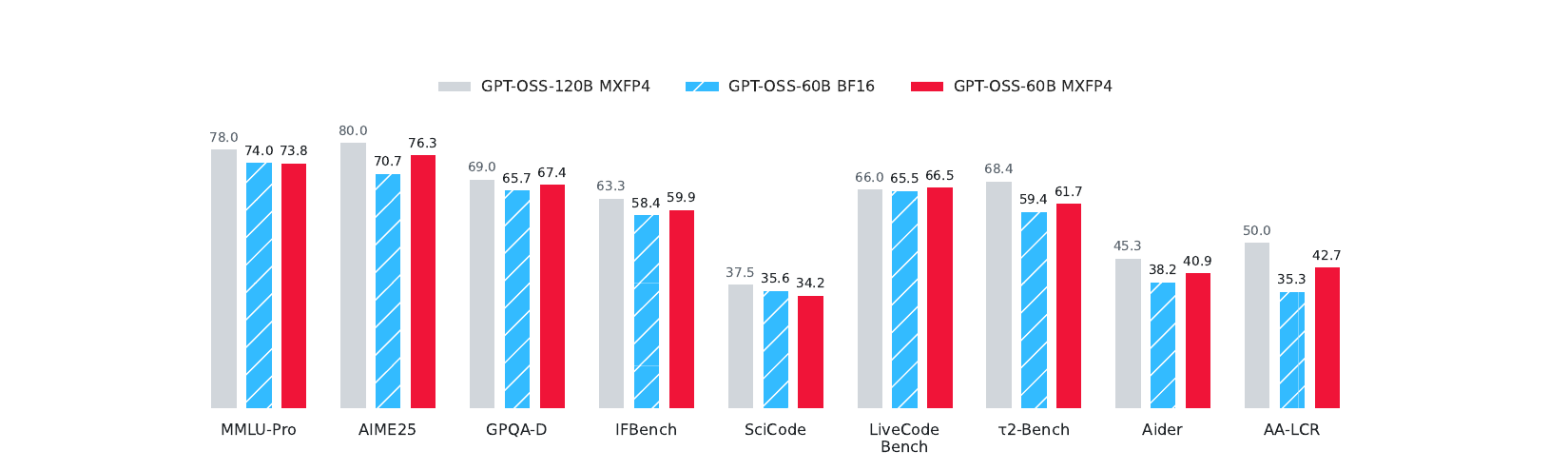
In almost all of the benchmarks used for comparison, the smaller model outperformed a model built at full precision, the report said.
The change was in the supervision target
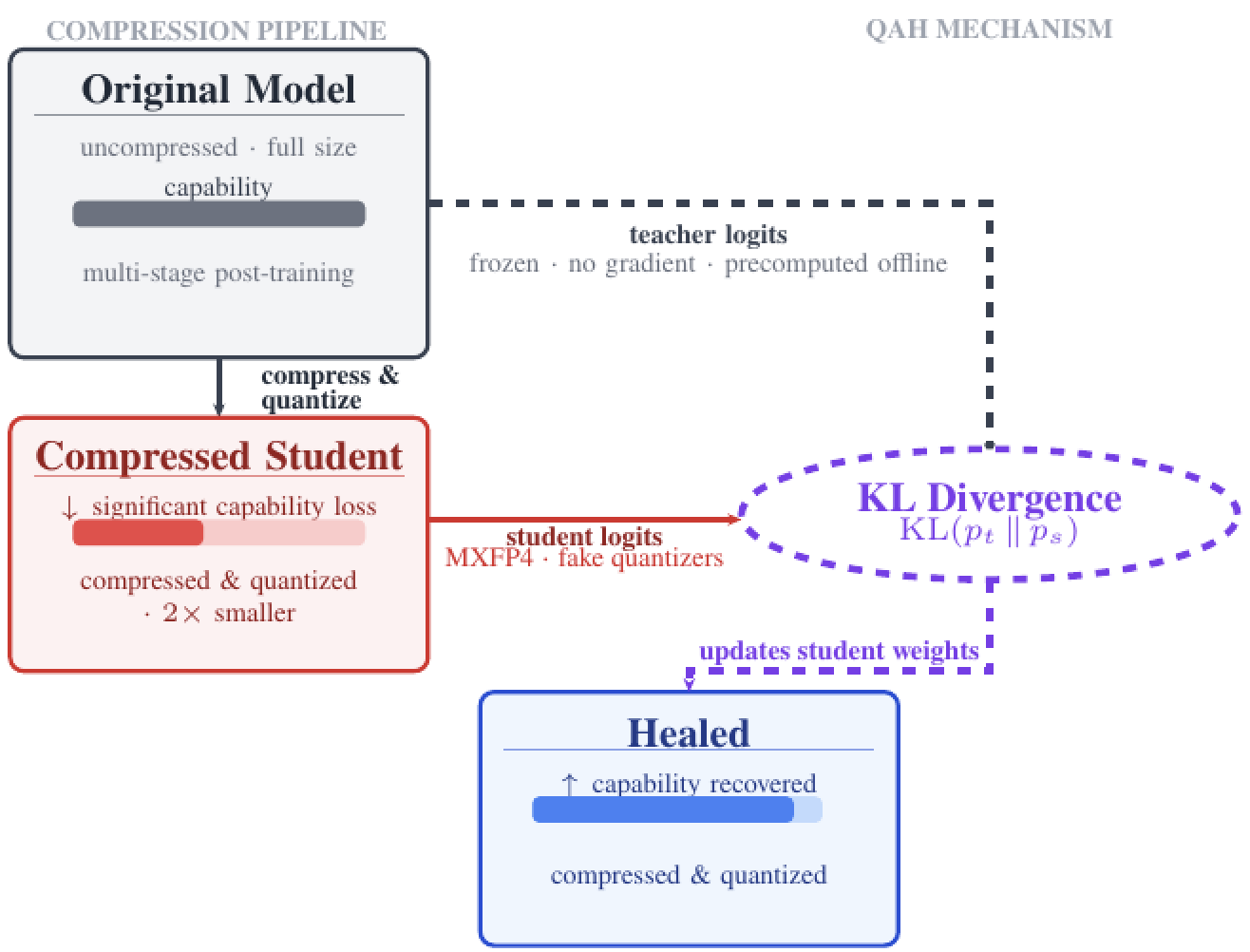
The researchers argued that the weakness in standard shrinking pipelines comes from what the smaller model is asked to imitate. In a typical setup, a compressed model is corrected against a halfway version — in this case, a 60-billion-parameter model kept at higher precision. But that intermediate model is already a degraded copy of the original.
If the small model learns from that blurred middle step, it inherits the middle step’s errors and has little chance of rising above it.
The team calls its method Quantization-Aware Healing. Rather than training the compressed model against the intermediate version, the process sends the smaller model back to the original uncompressed large model and uses that output as the teaching signal. The student is guided by the source model, not by an already compressed sibling.
On 7 of 9 tests, the 4-bit 60-billion-parameter model outperformed the higher-precision 60B counterpart that would usually be considered the stronger version. The original 120B model still won most rounds, so scale still mattered. Even so, the compressed system reached a level the article says few expected it to hit.
Lower memory use and broader access
Why this matters is simple: AI workloads are expensive in hardware terms. The healed model needs roughly a quarter of the memory of the original and half the parameters, according to the report. That kind of reduction can move a model from a data-center-only setup toward something that can run on a capable desktop, and potentially, over time, on a phone.
For smaller labs and local developers, a model that delivers better output while using half the energy could be meaningful.
Open weights, but not a fully open recipe
The team has released the healed Hypernova-60B model as open weights on Hugging Face, allowing others to download and run it.
Still, the process is not fully open. The tool used to produce the 60B student model is proprietary, so the complete recipe has not been released.
The scope of testing is also limited for now. The researchers only evaluated GPT-OSS and did not test the method on Llama, Qwen, or Mistral model families.
The article also pointed to a broader run of surprising results from open models: a free model called Ox Alpha recently beat a Claude system despite having no publicly known builder, there has been growing attention around Alibaba’s Qwen 3.8 Flash Next, and a wave of finetunes has been improving smaller models by using reasoning traces from larger LLMs such as Fable or Claude Opus.