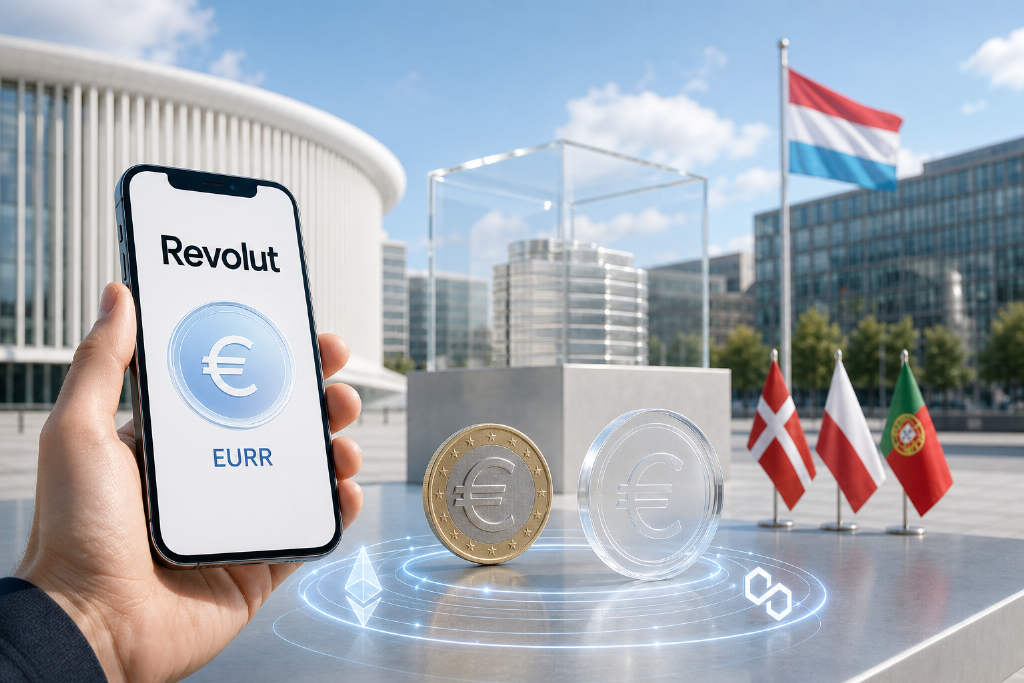
Revolut has begun a phased launch of EURR, its first euro stablecoin, starting with selected eligible customers in Denmark, Poland and Portugal. The company said it plans to extend the product to other European Economic Area markets during 2026. EURR will be integrated into the Revolut retail app as a link between euros, crypto assets, external wallets and supported blockchain networks.
But the entity issuing the token, managing reserves and handling redemptions is not Revolut.
EURR carries the Revolut brand, but Bridge is the legal issuer
Although EURR is presented as Revolut’s first stablecoin, its legal issuer is neither Revolut Bank nor a Revolut group crypto entity. The issuer is Bridge Building S.A., a company registered in Luxembourg.
According to the white paper, Bridge Building S.A. is the legal issuer of EURR and the on-chain entity responsible for minting and burning the token. It also manages the euro reserves corresponding to circulating supply and processes fiat redemption requests from holders. Minting and burning are executed through smart contracts deployed by Bridge Building.
Bridge Building holds an electronic money institution license and a crypto-asset service provider license issued by Luxembourg’s financial regulator, the Commission de Surveillance du Secteur Financier, or CSSF. Bridge’s parent company was acquired by Stripe in February 2025, which means the issuance infrastructure behind EURR effectively comes from Stripe’s stablecoin platform.
Public offering and distribution are handled by Revolut Digital Assets Europe Ltd. The company provides related crypto-asset services through the Revolut app and Revolut X. It holds a MiCA crypto-asset service provider license issued by the Cyprus Securities and Exchange Commission under license number CASP001/25. The authorization covers custody, operation of a trading platform, exchange between fiat and crypto assets, exchange between crypto assets, placement of tokens and transfer services.
In practical terms, the structure breaks down into three parts: Revolut supplies the brand, the app and user access; Bridge handles issuance, reserves and redemptions; Revolut’s European crypto entity handles sales and related services.
How 1 EURR is meant to track €1
Under MiCA, EURR is classified as an e-money token. Its target is to keep 1 EURR equivalent in value to 1 euro. The white paper says the date when public offering or admission to trading began was Aug. 20, while Revolut publicly announced the phased rollout on Aug. 26.
EURR has no fixed issuance cap. Supply is expected to rise or fall with demand in the European Economic Area, but Bridge must hold €1 or equivalent euro-denominated reserve assets for every EURR in circulation.
Those assets are required to be kept in segregated accounts, separate from Bridge’s own funds. Bridge said reserves will be checked each month by an independent accounting firm to confirm that the reserve amount is equal to or greater than EURR circulation in the European Economic Area. The current white paper does not disclose the name of that accounting firm.
Early in the rollout, Bridge’s reserve page at one point showed only 374 EURR in circulation, backed by €374 in reserves, all held as bank cash.
Redemption is available at par, but not without compliance checks
Under normal conditions, EURR holders can request redemption from Bridge at face value at any time, and Bridge does not charge a redemption fee. Applicants must first become recognized customers of Bridge, submit identity documents and pass KYC, anti-money laundering, sanctions list and bank account checks. They must also provide a valid EEA IBAN held in their own name. The white paper says eligible redemption proceeds will be transferred to the bank account within two business days.
That means the right to redeem at par is a legal right subject to compliance procedures. It does not mean any anonymous wallet can instantly swap EURR back into euros. Bridge may also freeze addresses linked to suspected illegal activity or freeze related EURR in response to orders from competent authorities.
EURR does not pay interest to holders and is not designed for appreciation or investment return. Bridge may place reserves in interest-bearing accounts or other eligible yield instruments, but the white paper explicitly states that EURR holders have no right to interest or other returns generated by those reserves. In that section, the white paper does not say where that income ultimately goes.
In extreme market stress, the recovery mechanisms described in the white paper may temporarily introduce redemption liquidity fees, daily redemption limits or even a suspension of redemptions. Those measures are framed as emergency tools.
Networks live at launch and networks listed in the white paper
At launch, Bridge’s reserve page and media verification showed live deployment on Ethereum and Polygon. The white paper’s list of supported networks also included Optimism, Arbitrum, Base, Solana, Injective, Avalanche, TON and Sui.
Where EURR fits in Revolut’s crypto stack
EURR is not Revolut’s starting point in crypto. It adds a branded infrastructure layer to a product lineup the company has been building for years.
For mainstream users, the closest touchpoint is the Revolut retail app. Users can buy, sell and hold crypto assets with fiat funds in their accounts, and in supported regions they can also transfer assets to external wallets.
For users with heavier trading needs, Revolut launched the standalone crypto platform Revolut X in 2024. The platform first went live in the U.K. and offers market orders, limit orders, TradingView charts and professional market tools. In 2025, Revolut added a mobile version of Revolut X and began offering services in Europe through Revolut Digital Assets Europe, the group’s MiCA-licensed entity.
Another product connecting users to external blockchains is Revolut Ramp. It allows users to buy crypto assets using Revolut account balances or external bank cards and send those assets directly to self-controlled third-party wallets. Revolut said Ramp has been integrated with MetaMask, Ledger, Solflare and other wallets or partner platforms.
Licensing is a central part of the setup. Revolut’s European crypto business operates through a Cyprus entity with a MiCA license. In the U.K., its crypto business entity has completed Financial Conduct Authority anti-money laundering registration. In July 2026, Revolut also received in-principle approval from Dubai’s Virtual Assets Regulatory Authority and said it plans to offer brokerage, trading and investment management services for virtual assets in the United Arab Emirates after obtaining final authorization.
Taken together, Revolut’s crypto setup now includes four connected entry points: retail users buy, sell and hold assets through the consumer app; more active traders use Revolut X; external wallet users move between fiat and crypto through Ramp; and EURR is the layer that brings euro value onto blockchain rails.
How EURR differs from simply supporting USDC and USDT
The difference from merely supporting USDC and USDT is that Revolut is now plugging its own brand, user distribution and foreign exchange system into the issuance and circulation path of a stablecoin. Even so, reserve management and redemption remain Bridge’s responsibility, so Revolut should not be described as EURR’s legal issuer.
For users whose base currency is the euro, EURR offers a more direct on-chain route. It removes the need to first convert euros into dollar stablecoins and can avoid adding EUR/USD exchange exposure in that step.
For now, both issuance scale and market access remain limited. The article points to several factors to watch: how quickly market access expands, how many networks are formally deployed, whether external wallets and trading platforms integrate the token, and how secondary market liquidity develops. More than the initial circulation figure, the larger question is whether Revolut can use its distribution reach of more than 80 million global retail customers to turn stablecoins from a product that requires users to seek out a crypto platform into an everyday money tool embedded inside an existing financial app.