
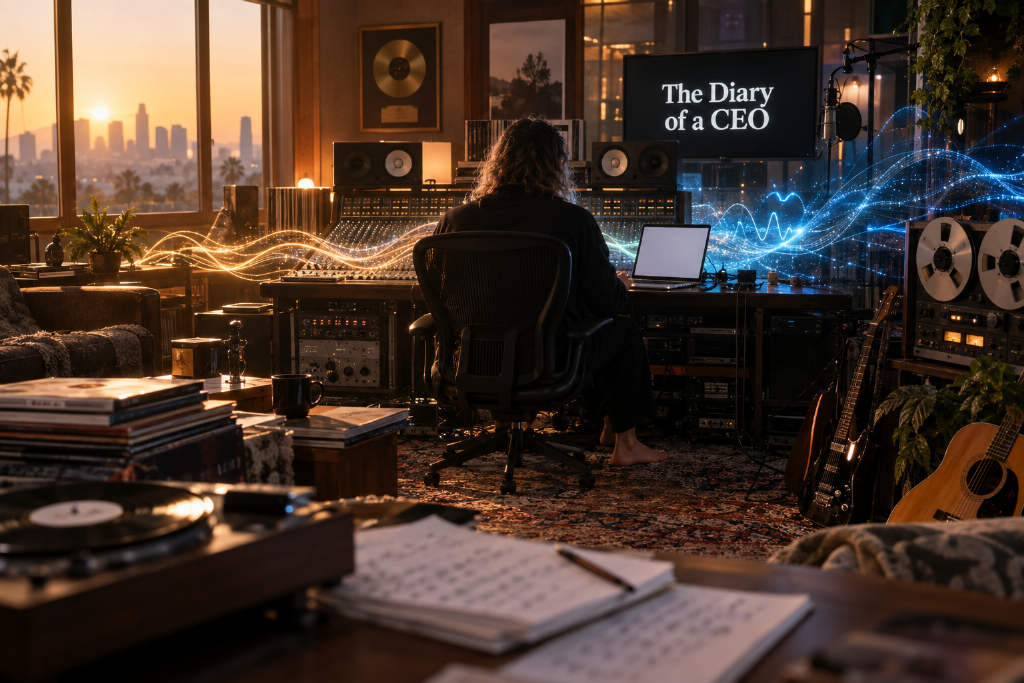
Legendary music producer Rick Rubin said creativity is not built on data, short-term returns, or market demand, but on whether an artist stays loyal to a personal point of view, even when the result feels "indefensible." He made the remarks in an interview with Steven Bartlett, host of The Diary of a CEO, where he also discussed AI, Jay-Z, Kanye West, Eminem, and Adele.
Rubin sees AI as a tool for execution, not a settled replacement for artists
Rubin said he is open to generative AI and believes it could become a powerful creative tool. In his view, people who cannot paint or play an instrument may still be able to express ideas through prompts. He was less certain, though, that AI on its own can become a true artist.
"Art exists in the conception, not in who puts the paint on the canvas," Rubin said. He argued that the prompt is where the creative act sits. What matters most is not only who executes the work, but who formed the original idea and how that idea was shaped.
To explain the point, Rubin referenced directors Alfred Hitchcock and Wes Anderson. Both, he said, can fully imagine a film through storyboards before shooting begins. The actors, cinematographers, and production crew are carrying out something that already exists in the director’s mind. In that sense, Rubin said, AI models can become a new execution layer, while prompts function like instructions given to a studio, a photographer, or a musician.
He also described a possible future workflow in which AI generates thousands of songs, a creator hears a few interesting seconds, and then reworks those fragments into something new, much like hip-hop producers once went crate digging for vinyl samples.
That shift, Rubin said, could give more people creative ability for the first time. "Maybe more people will be able to create because of AI, and I think that’s a beautiful thing," he said.
The missing piece for AI, in Rubin’s view, is point of view
Even with that openness, Rubin said human artists still hold an asset that AI struggles to copy: point of view.
What a great artist really offers is not just music, writing, or images, he said, but a way of seeing the world. AI can learn from existing work and generate large volumes of content, yet it does not have a fixed life experience or a stable worldview. "What we really want from artists is their point of view," Rubin said.
That is why he remains skeptical that AI can fully replace artists. Tools may lower the barrier to execution, but the feeling, judgment, and perspective behind a work still come from the creator.
How Jay-Z made "99 Problems"
Rubin also revisited the making of Jay-Z’s "99 Problems." After Rubin played the beat, Jay-Z asked for one thing only: keep it looping.
Jay-Z then sat in the back of the studio for about 20 to 30 minutes, occasionally mumbling or humming to himself. At some point, Rubin recalled, he said he was ready, walked into the booth, and delivered the full verse in one pass. He did not write any lyrics down during the process.
Rubin said other rappers he worked with usually spent a great deal of time writing, but he never saw Jay-Z physically write his lyrics. What stood out even more was what came next: Jay-Z might record the verse three times with the exact same words, while changing the rhythm, emphasis, and cadence each time.
Rubin compared it to a saxophone solo. The melody is basically the same, he said, but each performance shifts slightly. For Rubin, that is one of the clearest differences between Jay-Z and other rappers.
His work with Jay-Z has also extended into HBO’s eight-part documentary series JAŸ-Z IN 8. The series premiered on Sept. 18 and centers on long-form conversations between the two in Paris, revisiting Jay-Z through his songs, lyrics, childhood, and creative process rather than only through his status as a billionaire and entrepreneur. Two episodes are released every Friday, with the final two scheduled for Oct. 9.
Kanye West and the role of fearlessness in art
When the conversation turned to Kanye West, Rubin’s answer was simple: "fearless." Rubin worked on the final-stage production of Kanye’s 2013 album Yeezus and said Kanye was almost completely without fear in artistic decisions. Rubin said that was a major reason the two could work together.
Many people treat risk and success as opposites, Rubin said, but he sees them as linked. Only by taking risks can something genuinely different from what the market already knows appear.
Yeezus was his example. By that point, Kanye had already built a successful hip-hop formula, yet the album leaned heavily into industrial, electronic, and minimalist sounds and deliberately disrupted the structure of a conventional hip-hop record. Bartlett said that when he first heard Yeezus, his reaction was essentially, "What the hell is this?" Over time, though, he came to see it as a work of genius.
Rubin said truly revolutionary work often lands that way. People may dislike it at first because the market has not yet developed a frame for understanding it.
"99 Problems" was once dismissed as a non-single
Rubin used "99 Problems" to make another point: market judgment can be badly wrong. After the song was finished, he played it for Def Jam. According to Rubin, the label president told him it was good, but it would never become a single.
The reason was straightforward. It did not sound like anything else on the radio at the time. Rubin saw that as the song’s strongest quality. If a track sounds just like everything else already on the radio, he said, it is simply more of the same. "99 Problems" ended up having a major impact precisely because it was so different once it did break through to radio.
Why Eminem stays sharp
Rubin said great creators share more than point of view. They also tend to have an almost obsessive workload. He pointed to Eminem as an example.
Eminem, Rubin said, is almost always writing lyrics, not because he is necessarily making a new album, but because "he wants to be the best version of himself that he can be." Rubin said he had seen stacks of Eminem’s notebooks and asked whether all of that writing would make it into songs. Eminem’s answer: "No, no, no. 99% of it no one will ever see."
The point is training. Rubin compared him to a professional athlete who is always in off-season training. Even without an album release on the calendar, he keeps working on the core skill.
Adele and consistency in the studio
Another artist who left a strong impression on Rubin was Adele. He worked on Adele’s 21 and said some singers need many takes so the best parts can be edited together. Adele, by contrast, could sing the same song 30 times in a row, and "all 30 would be good."
Each take might differ slightly, but the quality held up every time. Rubin said one of the biggest differences between Adele and many pop singers is that she is a songwriter herself. In a pop system where songs are often built by production teams and then handed to singers, Adele’s work comes more directly from her, which gives listeners a stronger sense of personality.
The best work can look "indefensible"
Rubin said he has been thinking a lot about one word lately: indefensible. Usually the word is negative, suggesting something that cannot be reasonably defended. In art, he said, it may be necessary.
If every creative decision can be explained through market research, data, or commercial logic, that usually means the work has not gone far enough. "Reason is only a small part of how we make decisions," Rubin said. The work that matters most often comes from intuition.
That is also why he said he almost never thinks about short-term numbers when making music. Rubin said he has been producing for 40 years and "we never think about short-term incentives. Not once." The goal, he said, has always been to make the version he likes best first, not to predict what the market will like.
Creativity is not rare, Rubin said. It gets trained out of people.
Rubin also pushed back on the idea that only a small number of people are born creative. "Creativity gets knocked out of us over the course of our lives," he said. Schools teach students to sit still, follow rules, and repeat correct answers. Rubin said that system trains obedience, not free thought.
In his view, everyone has creativity. The difference is that many people gradually stop trusting their own judgment. The core discipline for an artist is not learning to predict an audience, but rebuilding an internal compass.
Rubin used pizza as an analogy. If two slices are in front of you and you are asked which one tastes better, you usually do not begin by asking which slice the market prefers or which one your friends would choose. You simply know which one tastes better to you. That, he said, is the kind of judgment mature creators need to build.
His creative philosophy, as he framed it, comes down to staying loyal to your own feelings, working hard, continuing the practice, and keeping money and market pressure from contaminating the process.