
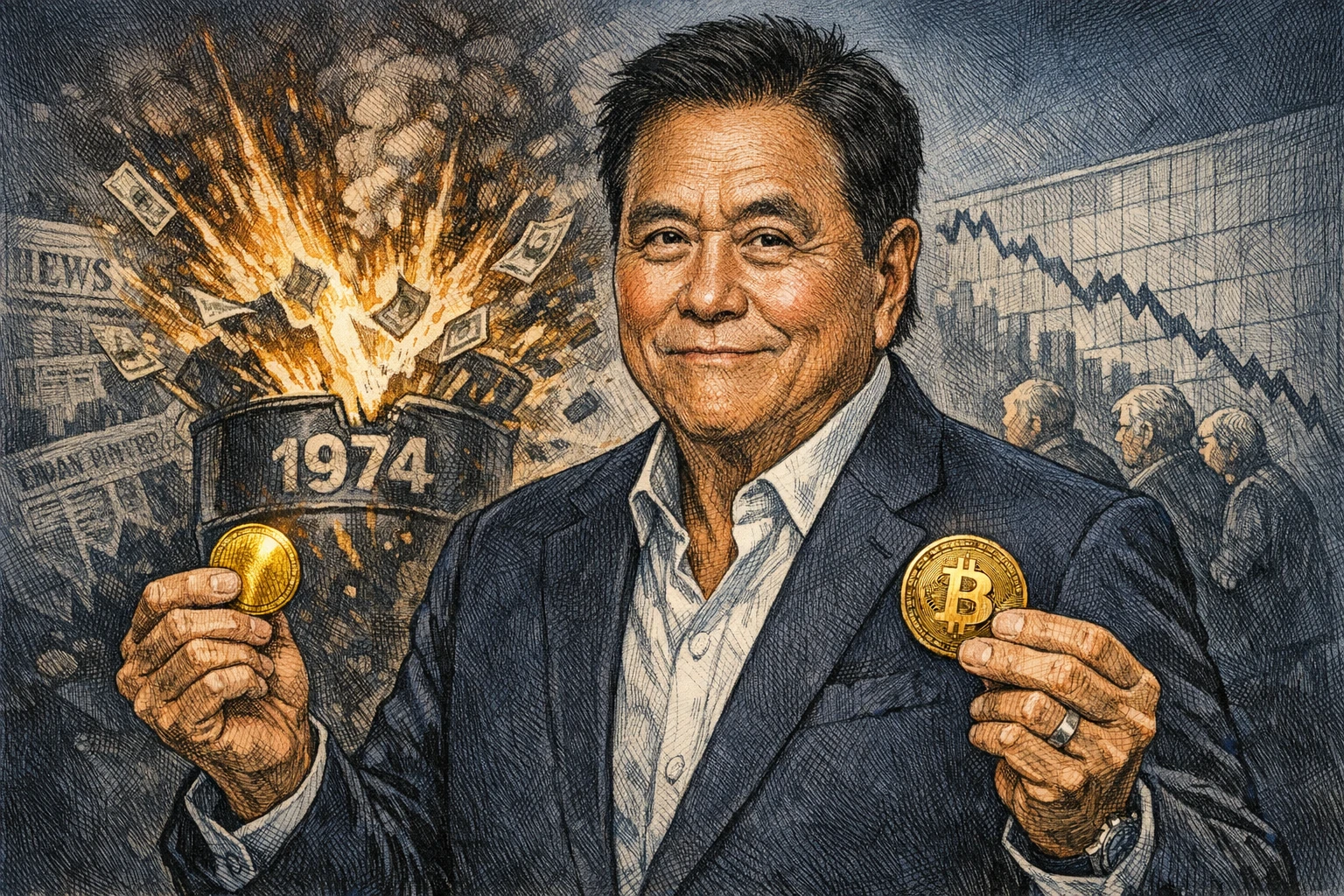
Robert Kiyosaki, author of Rich Dad Poor Dad, has renewed his warning that the roots of today’s inflation and debt pressures can be traced back to 1974. In his view, two policy changes from that year — the rise of the petrodollar framework and a restructuring of the U.S. retirement system — set the stage for the financial strains now coming into focus. He said on X that “the future created in 1974 has arrived,” and repeated his long-standing claim that Bitcoin, gold, and silver are “real money.”
Bearish Bitcoin sentiment rises as Kiyosaki says he bought more
His latest remarks landed at a time when market sentiment had already turned defensive. According to on-chain analytics platform Santiment, bearish commentary on Bitcoin climbed to its highest level since late February, while the ratio of bullish to bearish comments across major social platforms fell to 0.81. Optimism was thin. Kiyosaki, by contrast, said he had used millions in cash last week to add to positions in oil wells, gold, silver, and Bitcoin.
That purchase followed an earlier warning from him last month about a major financial bubble break. He argued that a crisis could trigger a sharp repricing in scarce assets once the fallout hits. His projections were aggressive: Bitcoin could reach $750,000 within a year after a crash, while Ether could rise to $95,000. He also listed 2026 targets of $250,000 for Bitcoin, $27,000 for gold, $100 for silver, and $60,000 for Ether.
His argument centers on the petrodollar and ERISA
Kiyosaki’s framework points back to the end of Bretton Woods and the collapse of the gold standard. He argues that once the United States anchored dollar credibility to oil rather than gold, the monetary system became tied more closely to energy politics and geopolitical pressure. In his telling, today’s inflation strain and energy tensions did not emerge in isolation. They were built into that earlier reset.
He pairs that view with criticism of the Employee Retirement Income Security Act, or ERISA, passed in the same year. Kiyosaki says the law reshaped retirement security in the U.S. and accelerated the move away from guaranteed lifetime pensions toward defined-contribution structures such as 401(k) accounts. That shift, he argues, moved retirement risk away from employers and onto individuals. The change looked technical at the time. Its social cost may be much larger.
Kiyosaki says retirees could face a loss of income security
His warning is aimed squarely at baby boomers. Kiyosaki says millions may discover that once they stop working, they effectively have no dependable income stream. If confidence in fiat money weakens and market-linked retirement accounts fail to withstand the next systemic shock, the numbers shown on paper may not hold up in practice. That is one reason he has long rejected what he sees as paper wealth.
The source material also notes that his forecasting record is mixed. He has warned for years about a collapse in the U.S. dollar, and that timeline has repeatedly shifted, drawing criticism. Santiment, on the other hand, says surging bearish sentiment can sometimes act as a contrarian indicator, since markets often move against the crowd’s expectations. For Kiyosaki, the conclusion has not changed: gold, silver, and Bitcoin remain the assets he wants to own.