
Robinhood’s dispute with AMC has turned into a wider argument over tokenized equities, but Bullish’s Tram Doman says the core problem is not simply who gets to issue stock-linked tokens. It is whether those tokens can trade inside a market structure that actually supports price discovery, hedging, arbitrage, and settlement.
AMC Chief Executive Officer Adam Aron described Robinhood’s tokenized AMC shares as a 「fake-ish market」 and said legal action was on the table. Robinhood Chief Executive Officer Vlad Tenev pushed back, saying public companies do not get to approve every product built on top of their stock.
After that exchange, the debate shifted toward a narrower legal line: which format counts as legitimate, wrapped tokens that represent a claim on underlying shares, or issuer-sponsored tokens recorded on the shareholder register. Doman’s argument is that the more difficult question comes after the legal distinction. A token can exist and still fail to trade inside anything resembling a complete market.
What happened in Robinhood’s AMC token
Using data from the Uniswap pool on Robinhood Chain, the piece says that across the seven trading sessions from Aug. 31 to Sept. 9, the median deviation between Robinhood’s AMC token close and AMC’s close on the New York Stock Exchange was 0.87%. The widest gap was 2.71%.
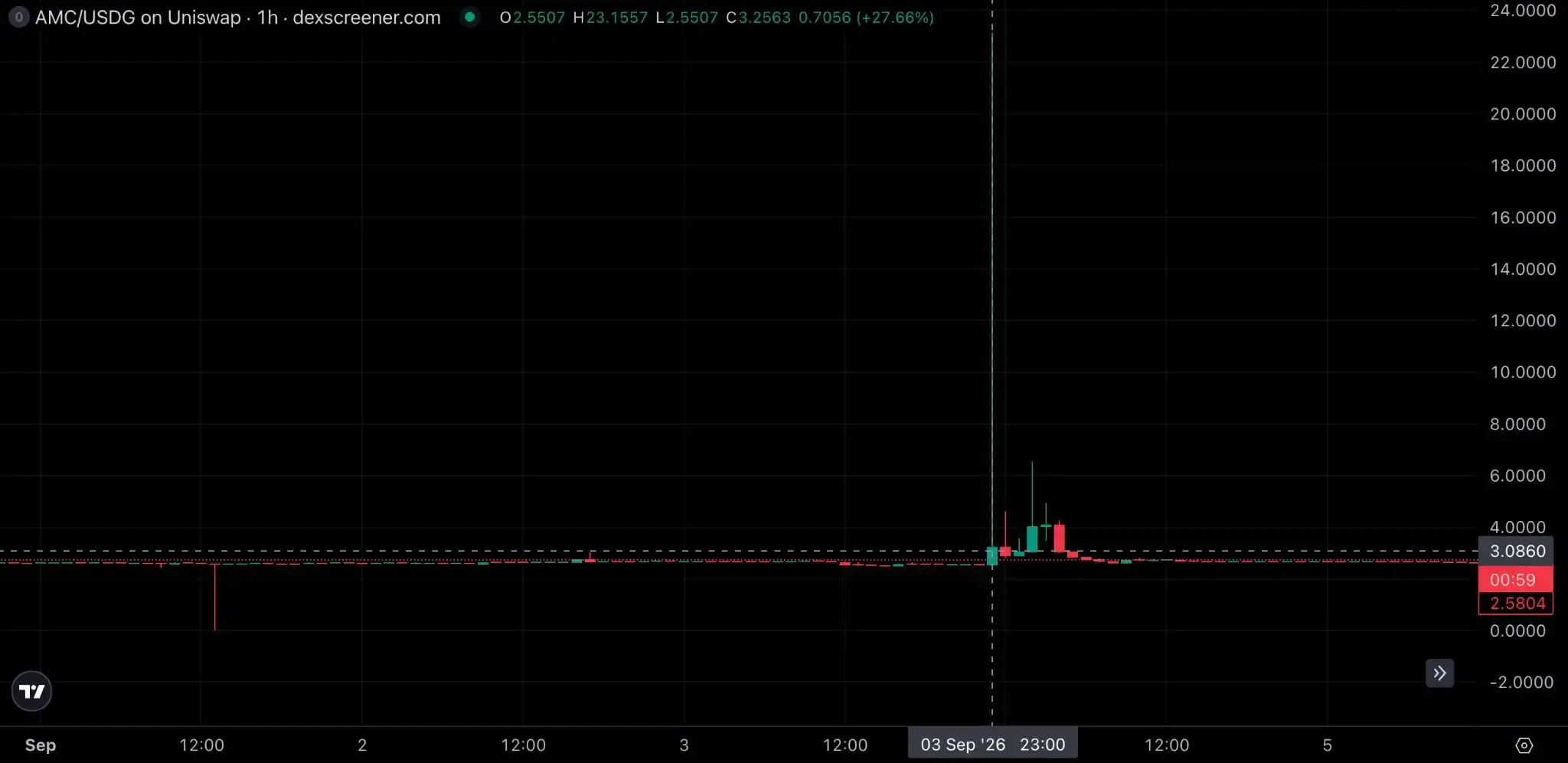
Outside underlying market hours, the picture changed. Near midnight on Thursday, Sept. 3, Robinhood’s AMC token rose from $2.55 to $23.16, roughly nine times AMC’s NYSE close of $2.54 seven hours earlier. It then fell back to $3.26 within the same hour. Trading volume in the pool during that hour was about $10.5 million.
Doman says wrapped products of this kind are usually structured as claims on an offshore issuer, with the issuer holding the underlying stock as collateral. In theory, if the stock position and the token liability match 1:1, prices should remain aligned. In practice, the two instruments trade separately, so dislocations can appear. In established markets, arbitrage desks, high-frequency firms, and market makers would normally step in and compress those gaps, much like they do with depositary receipts relative to ordinary shares or exchange-traded funds relative to net asset value.
That mechanism did not show up here. The Jersey-based issuer had appointed only one authorized participant with the ability to create and redeem tokens. The spike happened during hours when creation and redemption were allowed, but that participant did not mint or burn tokens at the time. Onchain data cited in the article shows 47 mint events on Friday, Sept. 4, all between noon and 7 p.m. Eastern Time, squarely inside cash-market hours and roughly half a day after the token had already broken away from parity and then moved back.
Why the move was not classical arbitrage
In a normal market, a dealer can sell into a premium by borrowing stock or leaning on inventory, then buy back later. Without token borrowing infrastructure, Doman says, the only way to obtain new tokens is to pre-fund the issuer. That means buying the stock first. If the NYSE is already closed, the broker would have needed to acquire that hedge before the close.
That turns the trade into a capital-consuming exposure rather than a near-mechanical arbitrage. The premium a trader can monetize is capped by how much the onchain pool can absorb. The position becomes a proprietary directional bet, not a clean basis trade.
The same constraint applies to the issuer. Minting tokens before buying the matching shares would leave the issuer short stock until the market reopens, a hard risk to justify for an instrument marketed as fully collateralized.
As a result, the selling that pushed the token back down was not driven by arbitrageurs flattening a gap between the token and the stock. It came from token holders taking profit. Money stayed within the token market itself, with no turnover in real AMC shares. Doman’s conclusion is blunt: nobody was arbitraging; everyone was using their own balance sheet to bet on direction.
How unrelated speculation can distort a stock token
The article says the token’s price action had little to do with AMC common stock itself. Hours after Aron posted about the matter, someone launched a memecoin priced in tokenized AMC. As demand for that memecoin rose, the pool sold AMC tokens to buy the memecoin, dragging the stock token’s price with it.
That leaves an instrument that is supposed to track an exhibition-chain company’s shares being priced by speculative demand unrelated to those shares. Anyone downstream using that price reference ends up consuming numbers written by activity that has nothing to do with the underlying security.
To limit spillover from onchain dislocations into the cash equity market, the U.S. Securities and Exchange Commission has capped exempt onchain trading volume at 0.25% of average daily volume for large-cap stocks and 2.5% for other listed companies. The article also notes that offshore wrapped tokens sold to non-U.S. holders, including Robinhood’s, sit outside the SEC’s jurisdiction and continue to operate under that separate structure.
Wrapped tokens expand distribution but keep structural frictions
Doman does not dismiss wrapped tokens outright. He says they serve a real purpose, especially in emerging markets where access to U.S. equities is limited or expensive. Robinhood’s stock-token offering covers more than 190 companies across 120 countries. xStocks and Ondo are pursuing similar distribution through different channels.
Outside the United States, that model does not require issuer consent, a place on the shareholder register, or separate approval market by market. That is where wrapped tokens get their reach. It is also where holders pick up counterparty risk.
The tradeoff is clear in the piece: broader distribution in exchange for potential price dislocation, weaker investor rights, and less transparency from the issuer. The limit is not only Robinhood’s operating schedule or the setup of a single issuer. Price discovery does not stop just because the NYSE or Nasdaq closes. Many brokers still accept orders in extended hours and hedge exposure through overnight venues and derivatives.
But once the main exchanges close, the ability to source underlying shares at scale falls sharply. Holders are left with claims on stock that can be converted in practice only during the NYSE’s 32.5 regular trading hours out of a 168-hour week. In off-hours trading, any premium over the prior close is a risk the buyer carries and then pays for when prices converge after the opening bell.
What issuer-sponsored tokens solve, and what they do not
Issuer-sponsored tokens, or ISTs, take a different route. They tokenize the registered shares themselves, with the issuer and transfer agent participating directly in the trading framework. Along with the same 24/7 availability and programmability that wrapped tokens advertise, an IST is the security itself, with voting rights and corporate actions attached.
That changes the risk a market maker is being asked to warehouse. Quoting a wrapped token at 3 a.m. means holding an inventory that is only a claim on shares, without a live stock price to anchor the book. Quoting an IST means the inventory is the security itself and the trade is a stock trade. A thin order book at 3 a.m. is still a thin order book, but the conversion risk between two instruments is gone, and so is part of the intermediary counterparty risk.
What ISTs do not replicate is the distribution reach that wrapped tokens achieve outside the regulatory perimeter. Doman frames the contrast simply: wrapped tokens get scale from operating under a lighter framework; ISTs get integrity from being the actual share. For now, ISTs remain scarce. Only a handful of names trade, including Bullish’s BLSH, and liquidity is thin.
The harder task is connecting the two systems
Doman says the AMC argument has revolved around who should be allowed to issue stock tokens onchain. The tougher question is how to build the market around them. Depth in wrapped-token markets is constrained by a gated conversion path between two instruments and two clocks. ISTs remove that gate. With the right infrastructure, price discovery could happen at any hour and across any licensed venue through approved participants rather than a very small set of designated entities.
In that framework, issuer-sponsored tokens serve regulated markets while wrapped tokens provide access for users outside the wall. If both systems run in parallel, both gain something. Wrapped markets get two things they lack most at 11 p.m.: a live price anchor and instruments market makers can actually arbitrage. IST markets gain arbitrage flow from firms willing to hold tokens as inventory while making markets in wrapped products.
If wrapped tokens can eventually be collateralized with ISTs, creation and redemption would sit on the same rail and settle in seconds instead of relying on the cash market to source stock. At that point, the two sides stop looking like fractured venues and start looking like components built on the same infrastructure for different use cases.
The next stage of the discussion, the article says, should focus on narrower spreads for traders active at 3 a.m., faster conversion between instrument types, settlement design for a continuous market, and who is going to build the plumbing that connects all of it.
No single company can assemble the whole stack on its own. Exchanges, brokers, asset managers, market makers, transfer agents, and clearing houses each control one part of the process. Getting them into the same room to build the market is the central objective of industry groups such as the IST Alliance, according to the article.